



Completed




Iberian Lynx
Lynx pardinus
Silhouette: Margot Michaud · PhyloPic
- KingdomAnimalia (Animals)
- PhylumChordata (Chordates)
- ClassMammalia (Mammals)
- OrderCarnivora (Carnivorans)
- FamilyFelidae (Felids)
- GenusLynx (Lynxes)
- SpeciesLynx pardinus (Iberian Lynx)
In 3 days ~60% in a week ~90%
52 Verified sightings at Doñana National Park From 2019 to 2026
52 In 1 park
August Best month
☀️ Diurnal When it's spotted
About the Iberian Lynx
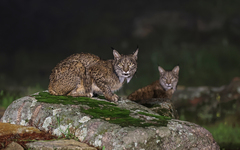
The Iberian lynx (Lynx pardinus) is one of four extant species of Lynx, a genus of medium-sized wild cats. It is endemic to the Iberian Peninsula. Fossils suggest that it has been present in Iberia since the end of the Early Pleistocene around 1 million years ago. It is a monotypic species and is thought to have evolved from Lynx issiodorensis.
The Iberian lynx population declined in the 20th century primarily due to overhunting, poaching, fragmentation of suitable habitats, and the population decline of its main prey species, such as the European rabbit (Oryctolagus cuniculus), caused by myxomatosis and rabbit haemorrhagic disease. By the turn of the 21st century, the Iberian lynx was on the verge of extinction, as only 94 individuals survived in two isolated subpopulations in Andalusia in 2002. Since then, conservation measures have been implemented, which included improving habitat, restocking of rabbits, translocating, reintroducing, and monitoring Iberian lynxes. Between 2012 and 2024, the population had increased from a low of 326 individuals to some 2,021, leading to its reclassification as vulnerable on the IUCN Red List.
Felis pardina was the scientific name... Wikipedia →
Sounds
Call0:39
Spain · 2026
© SonoNatura · XC1084869 · CC BY-NC-ND 4.0
Recent sightings of Iberian Lynx in Doñana National Park
LIVEiNaturalistGlobal Distribution
Parks Where Found
| # | Park | Country | Daily sighting probability |
|---|---|---|---|
| 1 | Doñana National Park | 🇪🇸 Spain |
More parks will be added in future updates.
Zoos & Centres Where Found
| # | Zoo / Centre | Country | |
|---|---|---|---|
| 1 | Everland | 🇰🇷 South Korea | |
| 2 | Cabarceno Natural Park | 🇪🇸 Spain | |
| 3 | Zoobotánico Jerez | 🇪🇸 Spain | |
| 4 | Selwo Aventura | 🇪🇸 Spain | |
| 5 | Terra Natura Murcia | 🇪🇸 Spain | |
| 6 | Zoo de Córdoba | 🇪🇸 Spain | |
| 7 | Great Cats World Park | 🇺🇸 United States | |
| 8 | Centro de Recuperación de Rapaces Brinzal | 🇪🇸 Spain |






Before you go
What are the chances of seeing an Iberian Lynx in Doñana National Park?
Possible
About 30% of wildlife watchers report an Iberian Lynx sighting in Doñana National Park on a given day, based on 52 verified sightings from GBIF citizen-science data from 2019 to 2026. It is the 4th most-seen of the 9 mammals we can rate there. Over three days the chance rises to about 60%, and over a week to about 90%, if each day is a fresh chance.
When is the best time to see an Iberian Lynx in Doñana National Park?
February and August
In those months about 40% of wildlife watchers report an Iberian Lynx in Doñana National Park on a given day, against under 5% in June, September and November, the lowest months. Those are among Doñana National Park's driest months, with about 20 mm of rain a month against 90 mm in October.
What time of day is best to see an Iberian Lynx?
Between 8 and 11 am
Across all the parks we cover, that three-hour window holds the most Iberian Lynx sightings with a recorded time, and about 8 in 10 of them come between 6 am and 6 pm: it is a daytime animal.
Where else can you see an Iberian Lynx?
Only Doñana National Park, in our data
Doñana National Park is the only park on Wallace's Line with enough records to rate Iberian Lynx sightings: about 30% of wildlife watchers there report one on a given day.
Which relatives of the Iberian Lynx live in Doñana National Park?
Same order: Carnivora
The closest relatives of the Iberian Lynx that you can see in Doñana National Park (order Carnivora, Carnivorans) are Red Fox (about 20%), European Badger (about 10%) and Egyptian Mongoose (about 10%), with each one's daily chance of a sighting.
Where does the Iberian Lynx sighting chance come from?
GBIF citizen-science records
It is estimated from how often the Iberian Lynx is recorded against all the mammals logged in Doñana National Park (52 verified sightings from 2019 to 2026), calibrated against known sighting rates. Figures are rounded to the nearest 10% because citizen-science data supports honest approximations, not decimals, and months with records from fewer than five people show "—". How it works.
