Lamenting Grasshopper

Lamenting Grasshopper

Eyprepocnemis plorans

Daily sighting probability ~10% · With luck
at Doñana National Park

In 3 days ~30% in a week ~50%

7 Verified sightings at Doñana National Park From 2019 to 2026
7 In 1 park
November Best month
☀️ Diurnal When it's spotted

About the Lamenting Grasshopper

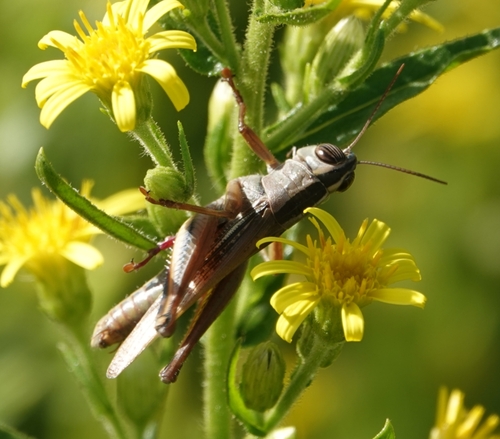
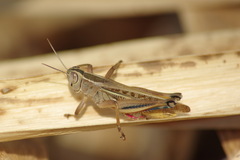
Eyprepocnemis plorans, the lamenting grasshopper, is a species of insect in the family Acrididae. It is the type species of the genus Eyprepocnemis, and is found in Africa, parts of the Middle East, and southern Europe. It typically inhabits wetlands and other moist habitats.

This is a medium-sized grasshopper, with females growing to a length of about 4.5 cm (1.8 in), while males are slightly smaller. The general colour is greyish-brown. The head and prothorax have a central dark band edged with paler stripes. The eye has a longitudinal dark streak, a characteristic shared by Anacridium aegyptium, Heteracris annulosa and Heteracris adspersa. The femurs of the hind legs have greenish, blue and yellow striations, and the hind tibia have reddish or bluish iridescence, and black and white spines.

Eyprepocnemis plorans is native to much of Africa, parts of the Middle East such as Iran, and southern Europe, where it is present in southern Greece, southern Italy, Sicily, Sardinia and southern Spain. It seems to be expanding its range northwards in Italy, possibly as a result of putative climate change. It usually occurs in wetlands, reed beds... Wikipedia →
Global Distribution

Parks Where Found

# Park Country Daily sighting probability
1 Doñana National Park 🇪🇸 Spain
~10%

More parks will be added in future updates.

Cities Where Found

# City Country Daily sighting probability
1 Valencia 🇪🇸 Spain
~20%
2 Algiers 🇩🇿 Algeria
~10%
3 Jerusalem 🇮🇱 Israel
~10%
4 Athens 🇬🇷 Greece
~10%
5 Tel Aviv 🇮🇱 Israel
~10%
6 Rome 🇮🇹 Italy
~10%
7 Barcelona 🇪🇸 Spain
~10%

Before you go

What are the chances of seeing a Lamenting Grasshopper in Doñana National Park?

With luck

About 10% of wildlife watchers report a Lamenting Grasshopper sighting in Doñana National Park on a given day, based on 7 verified sightings from GBIF citizen-science data from 2019 to 2026. It is the 44th most-seen of the 87 insects we can rate there. Over three days the chance rises to about 30%, and over a week to about 50%, if each day is a fresh chance.

When is the best time to see a Lamenting Grasshopper in Doñana National Park?

November

In that month about 30% of wildlife watchers report a Lamenting Grasshopper in Doñana National Park on a given day, against under 5% in April–July, October and December–January, the lowest months. That is one of Doñana National Park's wettest months, with about 65 mm of rain against almost none in July.

What time of day is best to see a Lamenting Grasshopper?

Between 11 am and 2 pm

Across all the parks we cover, that three-hour window holds the most Lamenting Grasshopper sightings with a recorded time, and about 8 in 10 of them come between 6 am and 6 pm: it is a daytime animal.

Where else can you see a Lamenting Grasshopper?

Only Doñana National Park, in our data

Doñana National Park is the only park on Wallace's Line with enough records to rate Lamenting Grasshopper sightings: about 10% of wildlife watchers there report one on a given day.

Which relatives of the Lamenting Grasshopper live in Doñana National Park?

Same family: Acrididae

The closest relatives of the Lamenting Grasshopper that you can see in Doñana National Park (family Acrididae, Short-horned Grasshoppers) are Egyptian Bird Grasshopper (about 20%) and Truxalis nasuta (about 10%), with each one's daily chance of a sighting.

Where does the Lamenting Grasshopper sighting chance come from?

GBIF citizen-science records

It is estimated from how often the Lamenting Grasshopper is recorded against all the insects logged in Doñana National Park (7 verified sightings from 2019 to 2026), calibrated against known sighting rates. Figures are rounded to the nearest 10% because citizen-science data supports honest approximations, not decimals, and months with records from fewer than five people show "—". How it works.

← Back to Doñana National Park