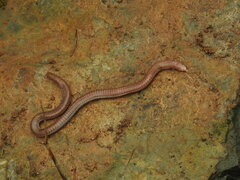
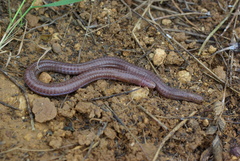
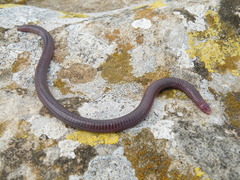
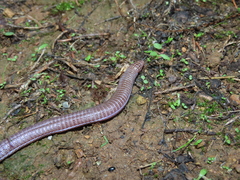
Southwest Iberian Worm Lizard

Southwest Iberian Worm Lizard

Blanus cinereus

Silhouette: Jose Carlos Arenas-Monroy · PhyloPic

LCLeast ConcernNTVUENCR
Daily sighting probability ~10% · With luck
at Doñana National Park

In 3 days ~30% in a week ~50%

5 Verified sightings at Doñana National Park From 2019 to 2026
5 In 1 park
March Best month
☀️ Diurnal When it's spotted

About the Southwest Iberian Worm Lizard

The Iberian worm lizard, Mediterranean worm lizard, or European worm lizard (Blanus cinereus) is a species of reptile in the family Blanidae (worm lizards) of the clade Amphisbaenia. The Iberian worm lizard is locally known as cobra-cega (Portuguese), culebrilla ciega (Spanish), and colobreta cega (Catalan), all meaning "blind snake". Recent studies into the mitochondrial and nuclear genomic data of 47 isolated B. cinereus populations show rather large sequence divergence between two apparent clades, leading some researchers to call for a division of the Iberian worm lizard into two species. While little is known of B. cinereus in comparison with some other reptile species, new insight is growing about this primitive, ancestral reptile.

The Iberian worm lizard is found within Portugal and through most of central and southern Spain. B. cinereus is a subterranean species found in a wide variety of Mediterranean habitats. Their abundance in population in different regions is difficult to determine due to their subterranean nature. However, studies on B. cinereus activity have shown the organism's ability to survive in habitats between 400 meters... Wikipedia →

Global Distribution

Parks Where Found

# Park Country Daily sighting probability
1 Doñana National Park 🇪🇸 Spain
~10%

More parks will be added in future updates.

Cities Where Found

# City Country Daily sighting probability
1 Lisbon 🇵🇹 Portugal
~10%

Closest Relatives at Doñana National Park

No species of the same family or order lives in Doñana National Park, so these are its closest relatives here: other reptiles.

Before you go

What are the chances of seeing a Southwest Iberian Worm Lizard in Doñana National Park?

With luck

About 10% of wildlife watchers report a Southwest Iberian Worm Lizard sighting in Doñana National Park on a given day, based on 5 verified sightings from GBIF citizen-science data from 2019 to 2026. It is the 11th most-seen of the 14 reptiles we can rate there. Over three days the chance rises to about 30%, and over a week to about 50%, if each day is a fresh chance.

When is the best time to see a Southwest Iberian Worm Lizard in Doñana National Park?

March

In that month about 30% of wildlife watchers report a Southwest Iberian Worm Lizard in Doñana National Park on a given day, against under 5% in May to February, the lowest months. That is one of Doñana National Park's wettest months, with about 80 mm of rain against almost none in July.

What time of day is best to see a Southwest Iberian Worm Lizard?

Between 1 and 4 pm

Across all the parks we cover, that three-hour window holds the most Southwest Iberian Worm Lizard sightings with a recorded time, and about 7 in 10 of them come between 6 am and 6 pm: it is a daytime animal.

Where else can you see a Southwest Iberian Worm Lizard?

Only Doñana National Park, in our data

Doñana National Park is the only park on Wallace's Line with enough records to rate Southwest Iberian Worm Lizard sightings: about 10% of wildlife watchers there report one on a given day.

Where does the Southwest Iberian Worm Lizard sighting chance come from?

GBIF citizen-science records

It is estimated from how often the Southwest Iberian Worm Lizard is recorded against all the reptiles logged in Doñana National Park (5 verified sightings from 2019 to 2026), calibrated against known sighting rates. Figures are rounded to the nearest 10% because citizen-science data supports honest approximations, not decimals, and months with records from fewer than five people show "—". How it works.

← Back to Doñana National Park