Common Pipistrelle

Common Pipistrelle

Pipistrellus pipistrellus

Silhouette: Margot Michaud · PhyloPic

LCLeast ConcernNTVUENCR
Daily sighting probability ~10% · With luck
at Ecrins National Park

In 3 days ~30% in a week ~60%

6 Verified sightings at Ecrins National Park From 2019 to 2026
38 In all 3 parks
July Best month
🌙 Nocturnal When it's spotted

About the Common Pipistrelle

The common pipistrelle (Pipistrellus pipistrellus) is a small pipistrelle microbat whose very large range extends across most of Europe, North Africa, and central South Asia, and may extend into Korea. It is one of the most common bat species in the British Isles. In Europe, the northernmost confirmed records are from southern Finland near 60°N.

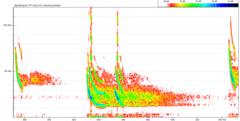
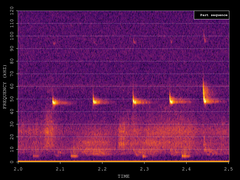
In 1999, the common pipistrelle was split into two species on the basis of different-frequency echolocation calls. The common pipistrelle uses a call of 45 kHz, while the soprano pipistrelle echolocates at 55 kHz. Since the two species were distinguished, a number of other differences in appearance, habitat, and food also have been discovered.

It was described as a new species in 1774 by German naturalist Johann Christian Daniel von Schreber, who initially placed it in the genus Vespertilio, calling it Vespertilio pipistrellus. In 1839, Keyserling and Blasius reclassified the species, naming it Vesperugo pipistrellus.

This classification stood until 1897, when Miller placed the species into the genus Pipistrellus, where it remains as Pipistrellus pipistrellus. Its species name "pipistrellus" is derived from the Italian... Wikipedia →
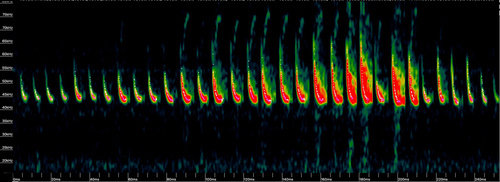
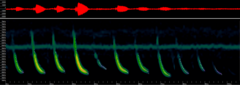
Sounds

Recording0:10

Italy · 2023

© Stefano Doglio · iNaturalist · CC BY-NC 4.0

Recording1:06

United Kingdom · 2021

© olliedav · iNaturalist · CC BY-NC 4.0

Recording0:03

United Kingdom · 2023

© chris_sherlock · iNaturalist · CC BY 4.0

Global Distribution

Parks Where Found

# Park Country Daily sighting probability
1 Ecrins National Park 🇫🇷 France
~10%
2 Cévennes National Park 🇫🇷 France
~10%
3 Wadden Sea National Park 🇩🇪 Germany
<5%

Cities Where Found

# City Country Daily sighting probability
1 Liverpool 🇬🇧 United Kingdom
~10%
2 Birmingham 🇬🇧 United Kingdom
~10%
3 Paris 🇫🇷 France
<5%
4 London 🇬🇧 United Kingdom
<5%

Before you go

What are the chances of seeing a Common Pipistrelle in Ecrins National Park?

With luck

About 10% of wildlife watchers report a Common Pipistrelle sighting in Ecrins National Park on a given day, based on 6 verified sightings from GBIF citizen-science data from 2019 to 2026. It is the 7th most-seen of the 9 mammals we can rate there. Over three days the chance rises to about 30%, and over a week to about 60%, if each day is a fresh chance.

When is the best time to see a Common Pipistrelle in Ecrins National Park?

July

In that month about 30% of wildlife watchers report a Common Pipistrelle in Ecrins National Park on a given day, against under 5% in August–October and December–June, the lowest months. That is one of Ecrins National Park's driest months, with about 50 mm of rain against 160 mm in December.

What time of day is best to see a Common Pipistrelle?

Between 8 and 11 pm

Across all the parks we cover, that three-hour window holds the most Common Pipistrelle sightings with a recorded time, and about 7 in 10 of them come between 6 pm and 6 am: it is mostly seen at night.

Is Ecrins National Park the best place to see a Common Pipistrelle?

Yes

Of the 3 parks where we can rate Common Pipistrelle sightings, Ecrins National Park has the highest daily chance: about 10%. Next come Cévennes National Park (France, about 10%) and Wadden Sea National Park (Germany, under 5%).

Where does the Common Pipistrelle sighting chance come from?

GBIF citizen-science records

It is estimated from how often the Common Pipistrelle is recorded against all the mammals logged in Ecrins National Park (6 verified sightings from 2019 to 2026), calibrated against known sighting rates. Figures are rounded to the nearest 10% because citizen-science data supports honest approximations, not decimals, and months with records from fewer than five people show "—". How it works.

← Back to Ecrins National Park