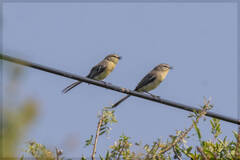
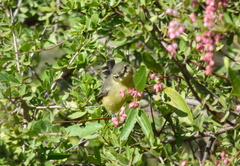

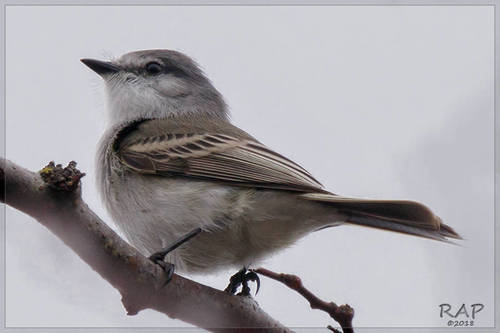
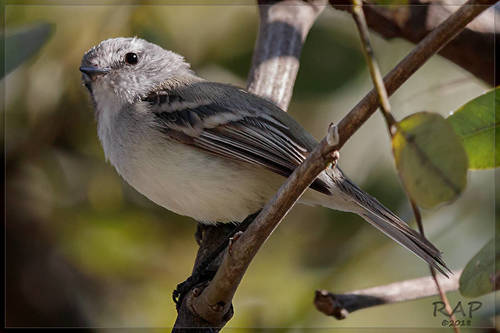
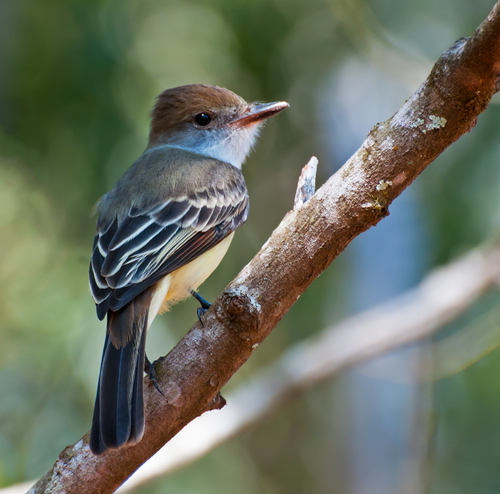
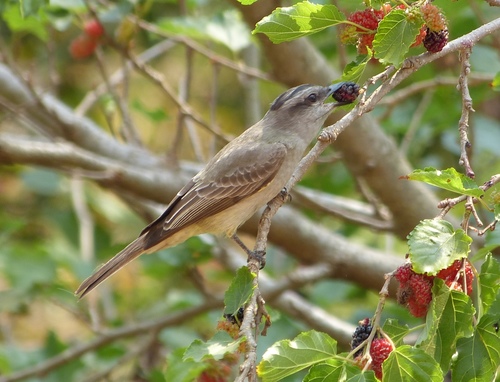
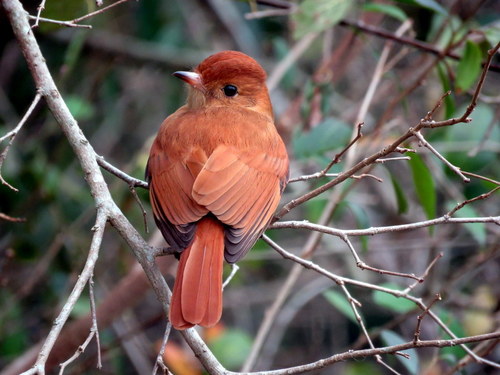
Greater Wagtail-Tyrant

Greater Wagtail-Tyrant

Stigmatura budytoides

Silhouette: Emily Willoughby · PhyloPic

LCLeast ConcernNTVUENCR
Daily sighting probability ~20% · Possible
at El Impenetrable National Park

In 3 days ~40% in a week ~70%

44 Verified sightings at El Impenetrable National Park From 2019 to 2026
44 In 1 park
November Best month
☀️ Diurnal When it's spotted

About the Greater Wagtail-Tyrant

The greater wagtail-tyrant (Stigmatura budytoides) is a species of bird in the family Tyrannidae, the tyrant flycatchers. It is found in Argentina, Bolivia, Brazil, and Paraguay. The greater wagtail-tyrant was originally described as Culicivora budytoides. Later in the nineteenth century it moved to genus Stigmatura and over time gained six subspecies. Two of them have been separated as what are now the lesser wagtail-tyrant (S. napensis) and Bahia wagtail-tyrant (S. bahiae).

The remaining four subspecies are: Subspecies S. b. gracilis differs from the other three in several characteristics and has a separate range, so some authors consider it a separate species. The greater wagtail-tyrant is 14 to 16 cm (5.5 to 6.3 in) long and weighs 8.5 to 13.2 g (0.30 to 0.47 oz). The sexes have the same plumage; males are slightly larger than females. Adults of the nominate subspecies have a bright... Wikipedia →

Sounds

Duet0:10

Bolivia · 2022

© Jacob Wijpkema · XC732465 · CC BY-NC-SA 4.0

Dawn song1:04

Argentina · 2021

© Niels Krabbe · XC687830 · CC BY-NC-SA 4.0

Song0:12

Brazil · 2019

© JAYRSON ARAUJO DE OLIVEIRA · XC451617 · CC BY-NC-SA 4.0

Global Distribution

Parks Where Found

# Park Country Daily sighting probability
1 El Impenetrable National Park 🇦🇷 Argentina
~20%

More parks will be added in future updates.

Cities Where Found

# City Country Daily sighting probability
1 Cochabamba 🇧🇴 Bolivia
~10%
2 Mendoza 🇦🇷 Argentina
~10%
3 Cordoba 🇦🇷 Argentina
<5%

Before you go

What are the chances of seeing a Greater Wagtail-Tyrant in El Impenetrable National Park?

Possible

About 20% of wildlife watchers report a Greater Wagtail-Tyrant sighting in El Impenetrable National Park on a given day, based on 44 verified sightings from GBIF citizen-science data from 2019 to 2026. It is the 94th most-seen of the 219 birds we can rate there. Over three days the chance rises to about 40%, and over a week to about 70%, if each day is a fresh chance.

When is the best time to see a Greater Wagtail-Tyrant in El Impenetrable National Park?

July, September and November

In those months about 30% of wildlife watchers report a Greater Wagtail-Tyrant in El Impenetrable National Park on a given day, against about 10% in February–June and October, the lowest months. December has too few records to rate.

What time of day is best to see a Greater Wagtail-Tyrant?

Between 3 and 6 pm

Across all the parks we cover, that three-hour window holds the most Greater Wagtail-Tyrant sightings with a recorded time, and about 9 in 10 of them come between 6 am and 6 pm: it is a daytime animal.

Where else can you see a Greater Wagtail-Tyrant?

Only El Impenetrable National Park, in our data

El Impenetrable National Park is the only park on Wallace's Line with enough records to rate Greater Wagtail-Tyrant sightings: about 20% of wildlife watchers there report one on a given day.

Which relatives of the Greater Wagtail-Tyrant live in El Impenetrable National Park?

Same family: Tyrannidae

The closest relatives of the Greater Wagtail-Tyrant that you can see in El Impenetrable National Park (family Tyrannidae, Tyrant Flycatchers) are Pearly-vented Tody-Tyrant (about 70%), Great Kiskadee (about 70%) and Cattle Tyrant (about 40%), with each one's daily chance of a sighting.

Where does the Greater Wagtail-Tyrant sighting chance come from?

GBIF citizen-science records

It is estimated from how often the Greater Wagtail-Tyrant is recorded against all the birds logged in El Impenetrable National Park (44 verified sightings from 2019 to 2026), calibrated against known sighting rates. Figures are rounded to the nearest 10% because citizen-science data supports honest approximations, not decimals, and months with records from fewer than five people show "—". How it works.

← Back to El Impenetrable National Park