
Little Thornbird

Little Thornbird

Phacellodomus sibilatrix

Silhouette: Sheatherius · PhyloPic

LCLeast ConcernNTVUENCR
Daily sighting probability ~10% · With luck
at El Impenetrable National Park

In 3 days ~20% in a week ~40%

22 Verified sightings at El Impenetrable National Park From 2019 to 2026
47 In all 2 parks
April Best month
☀️ Diurnal When it's spotted

About the Little Thornbird

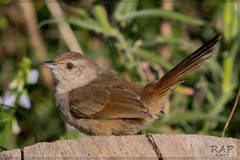
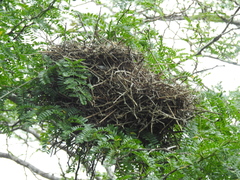
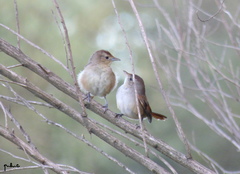
The little thornbird (Phacellodomus sibilatrix) is a species of bird in the Furnariinae subfamily of the ovenbird family Furnariidae. It is found in Argentina, Bolivia, Brazil, Paraguay, and Uruguay. The formal description of the little thornbird is credited to Philip Sclater's 1879 publication. However, a specimen collected by Azara and described in 1817 by Vieillot as Sylvia ruficollis was later determined to be a little thornbird. Sclater's binomial was retained in the interest of long usage and continuity.

The little thornbird is monotypic. The little thornbird is 13 to 14 cm (5.1 to 5.5 in) long and weighs about 14 to 16 g (0.49 to 0.56 oz). It is the smallest member of its genus. The sexes have the same plumage. Adults have a wide dull buff-whitish supercilium that extends beyond the eye and an indistinct dull brown stripe behind the eye on an otherwise light brownish face. Their forehead is light rufous with pale streaks, their crown and back dull brown, and their rump and uppertail coverts rufescent-tinged brown. Their wings are mostly shades of brown with darker brown primary coverts and some rufescence. Their tail's central... Wikipedia →

Sounds

Song0:14

Argentina · 2023

© Bernard BOUSQUET · XC823469 · CC BY-NC-SA 4.0

Call0:43

Argentina · 2022

© Guilherme Melo Becher · XC770830 · CC BY-NC-SA 4.0

Duet0:14

Argentina · 2022

© Franco Vushurovich · XC741111 · CC BY-NC-SA 4.0

Global Distribution

Parks Where Found

# Park Country Daily sighting probability
1 El Impenetrable National Park 🇦🇷 Argentina
~10%
2 Iberá National Park 🇦🇷 Argentina
<5%

Cities Where Found

# City Country Daily sighting probability
1 Buenos Aires 🇦🇷 Argentina
<5%

Before you go

What are the chances of seeing a Little Thornbird in El Impenetrable National Park?

With luck

About 10% of wildlife watchers report a Little Thornbird sighting in El Impenetrable National Park on a given day, based on 22 verified sightings from GBIF citizen-science data from 2019 to 2026. It is the 148th most-seen of the 219 birds we can rate there. Over three days the chance rises to about 20%, and over a week to about 40%, if each day is a fresh chance.

When is the best time to see a Little Thornbird in El Impenetrable National Park?

January, March–May, August and October–November

In those months about 10% of wildlife watchers report a Little Thornbird in El Impenetrable National Park on a given day, against under 5% in February, June–July and September, the lowest months. December has too few records to rate.

What time of day is best to see a Little Thornbird?

Between 9 am and noon

Across all the parks we cover, that three-hour window holds the most Little Thornbird sightings with a recorded time, and about 8 in 10 of them come between 6 am and 6 pm: it is a daytime animal.

Is El Impenetrable National Park the best place to see a Little Thornbird?

Yes

Of the 2 parks where we can rate Little Thornbird sightings, El Impenetrable National Park has the highest daily chance: about 10%. Next come Iberá National Park (Argentina, under 5%).

Which relatives of the Little Thornbird live in El Impenetrable National Park?

Same genus: Phacellodomus

The closest relatives of the Little Thornbird that you can see in El Impenetrable National Park (genus Phacellodomus, Thornbirds) are Rufous-fronted Thornbird (about 30%) and Greater Thornbird (about 10%), with each one's daily chance of a sighting.

Where does the Little Thornbird sighting chance come from?

GBIF citizen-science records

It is estimated from how often the Little Thornbird is recorded against all the birds logged in El Impenetrable National Park (22 verified sightings from 2019 to 2026), calibrated against known sighting rates. Figures are rounded to the nearest 10% because citizen-science data supports honest approximations, not decimals, and months with records from fewer than five people show "—". How it works.

← Back to El Impenetrable National Park