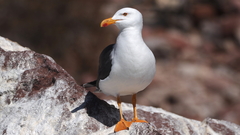
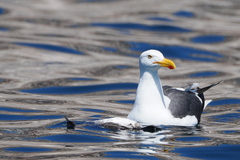

Yellow-footed Gull

Yellow-footed Gull

Larus livens

Silhouette: Sharon Wegner-Larsen · PhyloPic

LCLeast ConcernNTVUENCR
Daily sighting probability <5% · Rare
at El Vizcaíno Biosphere Reserve

In 3 days ~10% in a week ~20%

41 Verified sightings at El Vizcaíno Biosphere Reserve From 2019 to 2026
1,541 In all 3 parks
March Best month
☀️🌙 Day & Night When it's spotted

About the Yellow-footed Gull

The yellow-footed gull (Larus livens) is a large gull, closely related to the western gull and thought to be a subspecies until the 1960s. It is endemic to the Gulf of California. Adults are similar in appearance to the western gull with a white head, dark, slate-colored back and wings, and a thick yellow bill. Their legs are yellow, though first winter birds do display pink legs like those of the western gull. It attains full plumage at three years of age.

This species is tied with slaty-backed gull for the world's fourth-largest gull species and is one of the largest gulls in the world, being slightly larger than the western gull. It measures 53 to 72 cm (21 to 28 in) in length and spans 140 to 160 cm (55 to 63 in) across the wings. The body mass of this species can vary from 930 to 1,500 g (2.05 to 3.31 lb). Among standard measurements, the wing chord is 40 to 46 cm (16 to 18 in), the bill is 5.0 to 6.2 cm (2.0 to 2.4 in) and the tarsus is 5.9 to 7.5 cm (2.3 to 3.0 in).

Yellow-footed gulls are native to the Gulf of California in Mexico. Most are non-migratory, but an increasing number have been traveling to California's Salton Sea... Wikipedia →

Sounds

Song0:10

Mexico · 2016

© Manuel Grosselet · XC339880 · CC BY-NC-SA 4.0

Call0:29

United States · 2014

© Andrew Spencer · XC203777 · CC BY-NC-SA 4.0

Flight call0:08

United States · 2012

© Paul Marvin · XC153738 · CC BY-NC-SA 3.0

Global Distribution

Parks Where Found

# Park Country Daily sighting probability
1 Bahía de Loreto National Park 🇲🇽 Mexico
~80%
2 Cabo Pulmo National Park 🇲🇽 Mexico
~10%
3 El Vizcaíno Biosphere Reserve 🇲🇽 Mexico
<5%

Cities Where Found

# City Country Daily sighting probability
1 Los Angeles 🇺🇸 United States
<5%

Before you go

What are the chances of seeing a Yellow-footed Gull in El Vizcaíno Biosphere Reserve?

Rare

Under 5% of wildlife watchers report a Yellow-footed Gull sighting in El Vizcaíno Biosphere Reserve on a given day, based on 41 verified sightings from GBIF citizen-science data from 2019 to 2026. It is the 157th most-seen of the 237 birds we can rate there. Over three days the chance rises to about 10%, and over a week to about 20%, if each day is a fresh chance.

When is the best time to see a Yellow-footed Gull in El Vizcaíno Biosphere Reserve?

February and March

In those months about 10% of wildlife watchers report a Yellow-footed Gull in El Vizcaíno Biosphere Reserve on a given day, against under 5% in April to January, the lowest months.

What time of day is best to see a Yellow-footed Gull?

Between 7 and 10 pm

Across all the parks we cover, that three-hour window holds the most Yellow-footed Gull sightings with a recorded time, and about 6 in 10 of them come between 6 pm and 6 am: it is seen both by day and at night.

Is El Vizcaíno Biosphere Reserve the best place to see a Yellow-footed Gull?

3rd of 3

Of the 3 parks where we can rate Yellow-footed Gull sightings, El Vizcaíno Biosphere Reserve ranks 3rd at under 5%. The best odds are in Bahía de Loreto National Park (Mexico, about 80%) and Cabo Pulmo National Park (Mexico, about 10%).

Which relatives of the Yellow-footed Gull live in El Vizcaíno Biosphere Reserve?

Same genus: Larus

The closest relatives of the Yellow-footed Gull that you can see in El Vizcaíno Biosphere Reserve (genus Larus, Large White-headed Gulls) are Western Gull (about 70%), Ring-billed Gull (about 40%) and California Gull (about 20%), with each one's daily chance of a sighting.

Where does the Yellow-footed Gull sighting chance come from?

GBIF citizen-science records

It is estimated from how often the Yellow-footed Gull is recorded against all the birds logged in El Vizcaíno Biosphere Reserve (41 verified sightings from 2019 to 2026), calibrated against known sighting rates. Figures are rounded to the nearest 10% because citizen-science data supports honest approximations, not decimals, and months with records from fewer than five people show "—". How it works.

← Back to El Vizcaíno Biosphere Reserve