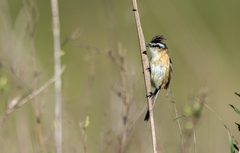


Sharp-tailed Tyrant

Sharp-tailed Tyrant

Culicivora caudacuta

Silhouette: Emily Willoughby · PhyloPic

LCLeast ConcernNTVUENCR
Daily sighting probability ~30% · Possible
at Emas National Park

In 3 days ~70% in a week ~90%

76 Verified sightings at Emas National Park From 2019 to 2026
295 In all 3 parks
October Best month
☀️ Diurnal When it's spotted

About the Sharp-tailed Tyrant

The sharp-tailed grass tyrant or sharp-tailed tyrant (Culicivora caudacuta) is a species of bird in the family Tyrannidae, the tyrant flycatchers. It is found in Argentina, Bolivia, Brazil, Paraguay, and Uruguay. The short-tailed grass tyrant is the only member of its genus and has no subspecies. Its closest relatives are the tachuris of genus Polystictus.

The sharp-tailed grass tyrant is 10 to 11 cm (3.9 to 4.3 in) long. The sexes have almost the same plumage; females are slightly smaller than males with a shorter tail. Adult males have a slightly bushy blackish crown and females a browner one. Both sexes have a wide white supercilium and a thin black line through the eye on an otherwise warm buffy brown face. Their back and rump are buffy brown with wide blackish streaks. Their wings are buffy brown with black and pale buff streaks and edges. Their tail is highly graduated. The central feathers are stiff and most feathers' webs are quickly worn away at the ends, giving the tail a resemblance to those of Synallaxis spinetails. Their chin is white and the rest of their underparts mostly pale yellowish white with a warm cinnamon-buff wash... Wikipedia →

Sounds

Song0:25

Brazil · 2023

© JAYRSON ARAUJO DE OLIVEIRA · XC832920 · CC BY-NC-SA 4.0

Call0:33

Brazil · 2022

© Robson Silva e Silva · XC772847 · CC BY-NC-SA 4.0

Duet0:35

Brazil · 2004

© Peter Boesman · XC221948 · CC BY-NC-ND 4.0

Global Distribution

Parks Where Found

# Park Country Daily sighting probability
1 Serra da Canastra National Park 🇧🇷 Brazil
~30%
2 Emas National Park 🇧🇷 Brazil
~30%
3 Chapada Diamantina National Park 🇧🇷 Brazil
<5%

Cities Where Found

# City Country Daily sighting probability
1 Campo Grande 🇧🇷 Brazil
<5%

Before you go

What are the chances of seeing a Sharp-tailed Tyrant in Emas National Park?

Possible

About 30% of wildlife watchers report a Sharp-tailed Tyrant sighting in Emas National Park on a given day, based on 76 verified sightings from GBIF citizen-science data from 2019 to 2026. It is the 62nd most-seen of the 187 birds we can rate there. Over three days the chance rises to about 70%, and over a week to about 90%, if each day is a fresh chance.

When is the best time to see a Sharp-tailed Tyrant in Emas National Park?

October

In that month about 50% of wildlife watchers report a Sharp-tailed Tyrant in Emas National Park on a given day, against about 10% in July, the lowest month. April and December–February have too few records to rate.

What time of day is best to see a Sharp-tailed Tyrant?

Between 7 and 10 am

Across all the parks we cover, that three-hour window holds the most Sharp-tailed Tyrant sightings with a recorded time, and about 9 in 10 of them come between 6 am and 6 pm: it is a daytime animal.

Is Emas National Park the best place to see a Sharp-tailed Tyrant?

Among the best

Of the 3 parks where we can rate Sharp-tailed Tyrant sightings, Emas National Park ranks 2nd at about 30%, level with the leaders once rounded. The best odds are in Serra da Canastra National Park (Brazil, about 30%).

Which relatives of the Sharp-tailed Tyrant live in Emas National Park?

Same family: Tyrannidae

The closest relatives of the Sharp-tailed Tyrant that you can see in Emas National Park (family Tyrannidae, Tyrant Flycatchers) are White-rumped Monjita (about 70%), Great Kiskadee (about 60%) and Grey Monjita (about 50%), with each one's daily chance of a sighting.

Where does the Sharp-tailed Tyrant sighting chance come from?

GBIF citizen-science records

It is estimated from how often the Sharp-tailed Tyrant is recorded against all the birds logged in Emas National Park (76 verified sightings from 2019 to 2026), calibrated against known sighting rates. Figures are rounded to the nearest 10% because citizen-science data supports honest approximations, not decimals, and months with records from fewer than five people show "—". How it works.

← Back to Emas National Park