Yellow Tegu

Yellow Tegu

Salvator duseni

Silhouette: SeismicShrimp · PhyloPic

LCLeast ConcernNTVUENCR
Daily sighting probability ~30% · Possible
at Emas National Park

In 3 days ~60% in a week ~90%

9 Verified sightings at Emas National Park From 2019 to 2026
9 In 1 park
October Best month
☀️ Diurnal When it's spotted

About the Yellow Tegu

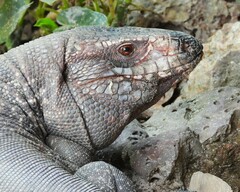
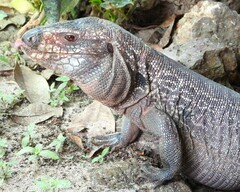
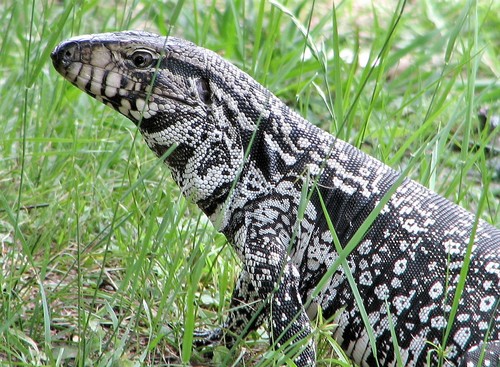
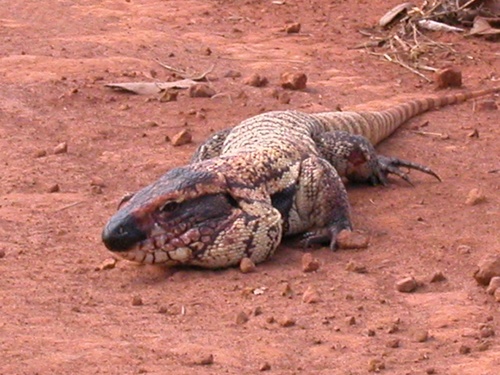
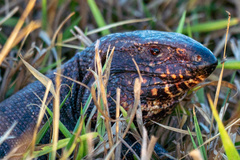
Salvator duseni is a species of lizard in the family Teiidae. The species is sometimes known commonly as the yellow tegu. It is native to South America. S. duseni is named after Swedish botanist Per Karl Hjalmar Dusén who collected the holotype.

S. duseni is found in Brazil, Bolivia and Paraguay. In Brazil it is found in Bahia, Distrito Federal, Goiás, Mato Grosso, Mato Grosso do Sul, Minas Gerais, Paraná, and Tocantins. The preferred natural habitat of S. duseni is savanna.

S. duseni can grow to 41 cm (16.1 in) in snout-to-vent length (SVL). S. duseni is diurnal and terrestrial. An omnivore, S. duseni eats plants, invertebrates, and small vertebrates. S. duseni is oviparous. Clutch size is approximately 36 eggs.

Harvey MB, Ugueto GN, Gutberlet RL (2012). "Review of Teiid Morphology with a Revised Taxonomy and Phylogeny of the Teiidae (Lepidosauria: Squamata)". Zootaxa 3459: 1–156. (Salvator duseni, new combination). Lönnberg E, Andersson LG (1910). "A new Lizard and a new Frog from Paranà". Arkiv för Zoologi 6 (9): 1–11. (Tupinambis... Wikipedia →
Global Distribution

Parks Where Found

# Park Country Daily sighting probability
1 Emas National Park 🇧🇷 Brazil
~30%

More parks will be added in future updates.

Before you go

What are the chances of seeing a Yellow Tegu in Emas National Park?

Possible

About 30% of wildlife watchers report a Yellow Tegu sighting in Emas National Park on a given day, based on 9 verified sightings from GBIF citizen-science data from 2019 to 2026. It is the 9th most-seen of the 11 reptiles we can rate there. Over three days the chance rises to about 60%, and over a week to about 90%, if each day is a fresh chance.

When is the best time to see a Yellow Tegu in Emas National Park?

October

In that month about 50% of wildlife watchers report a Yellow Tegu in Emas National Park on a given day, against under 5% in December to September, the lowest months.

What time of day is best to see a Yellow Tegu?

Between 10 am and 1 pm

Across all the parks we cover, that three-hour window holds the most Yellow Tegu sightings with a recorded time, and about 8 in 10 of them come between 6 am and 6 pm: it is a daytime animal.

Where else can you see a Yellow Tegu?

Only Emas National Park, in our data

Emas National Park is the only park on Wallace's Line with enough records to rate Yellow Tegu sightings: about 30% of wildlife watchers there report one on a given day.

Where does the Yellow Tegu sighting chance come from?

GBIF citizen-science records

It is estimated from how often the Yellow Tegu is recorded against all the reptiles logged in Emas National Park (9 verified sightings from 2019 to 2026), calibrated against known sighting rates. Figures are rounded to the nearest 10% because citizen-science data supports honest approximations, not decimals, and months with records from fewer than five people show "—". How it works.

← Back to Emas National Park