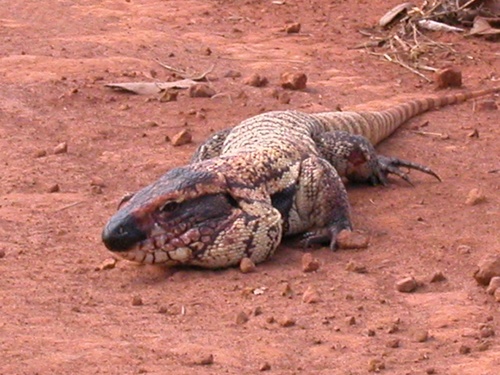
About the Urutu Lancehead
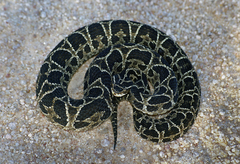
Bothrops alternatus, known by the common names crossed pit viper, yarará grande, and urutu, among others, is a highly venomous pit viper species found in South America (Brazil, Paraguay, Uruguay and Argentina). Within its range, it is an important cause of a snakebite. The specific name, alternatus, which is Latin for "alternating", is apparently a reference to the staggered markings along its body. No subspecies are currently recognized.
Large and stout, B. alternatus reportedly exceeds 2 m (6.6 ft) in total length, although the verified maximum is 1.69 m (5.5 ft). Most specimens are 0.8–1.2 m (2.6–3.9 ft) in total length, with females being significantly longer and heavier than males.
Scalation includes 25-35 (usually 27-31/29-33 in males/females) rows of dorsal scales at midbody, 155-183/164-190 ventral scales in males/females, and 38-53/30-44 subcaudal scales in males/females. On the head are 8-13 strongly keeled intersupraocular scales, 8-10 supralabial scales, none of which is fused with the prelacunal, and 12-14 sublabial scales.
The color pattern is exceedingly variable. The ground color may be brown, tan, or gray, sometimes... Wikipedia →