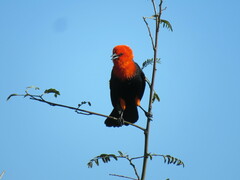
Scarlet-headed Blackbird

Scarlet-headed Blackbird

Amblyramphus holosericeus

Silhouette: Sheatherius · PhyloPic

LCLeast ConcernNTVUENCR
Daily sighting probability <5% · Rare
at Parque Estadual Encontro das Águas

In 3 days <5% in a week ~10%

25 Verified sightings at Parque Estadual Encontro das Águas From 2019 to 2026
783 In all 2 parks
October Best month
☀️ Diurnal When it's spotted

About the Scarlet-headed Blackbird

The scarlet-headed blackbird (Amblyramphus holosericeus) is a species of bird in the family Icteridae, the oropendolas, New World orioles, and New World blackbirds. It is found in Argentina, Bolivia, Brazil, Paraguay, and Uruguay.

The scarlet-headed blackbird was formally described in 1786 with the binomial Xanthornus holosericeus. It is now the only member of genus Amblyramphus and has no subspecies. Male scarlet-headed blackbirds average 25 cm (9.8 in) long and weigh an average of 86 g (3.0 oz). Females average 22.5 cm (8.9 in) long and weigh an average of 75 g (2.6 oz). The sexes have the same plumage. Adults have a thin black stripe behind the lores and black eyelids. The rest of their head and their neck, upper breast, and thighs are scarlet-red. The rest of their plumage is a slightly glossy black. They have a black iris, a sharp, chisel-shaped black bill, and black legs and feet. Juveniles are almost entirely brownish black with a yellowish wash on the throat and breast; they gradually acquire the adult's red.

The scarlet-headed blackbird has a disjunct distribution. Its largest range from northern... Wikipedia →

Sounds

Call0:35

Bolivia · 2022

© Jacob Wijpkema · XC722225 · CC BY-NC-SA 4.0

Song0:54

Brazil · 2019

© GABRIEL LEITE · XC510627 · CC BY-NC-SA 4.0

Call0:37

Argentina · 2019

© Pablo Adrián Otero · XC501180 · CC BY-NC-SA 4.0

Global Distribution

Parks Where Found

# Park Country Daily sighting probability
1 Iberá National Park 🇦🇷 Argentina
~40%
2 Parque Estadual Encontro das Águas 🇧🇷 Brazil
<5%

Cities Where Found

# City Country Daily sighting probability
1 Buenos Aires 🇦🇷 Argentina
<5%
2 Porto Alegre 🇧🇷 Brazil
<5%

Zoos & Centres Where Found

# Zoo / Centre Country
1 Prague Zoo 🇨🇿 Czechia In captivity
2 Zoo Miami 🇺🇸 United States In captivity
3 Toronto Zoo 🇨🇦 Canada In captivity
4 Parc zoologique de Montpellier 🇫🇷 France In captivity
5 Zoo Aquarium de Madrid 🇪🇸 Spain In captivity
6 Cleres Zoological Park 🇫🇷 France In captivity
7 Vogelpark Avifauna 🇳🇱 Netherlands In captivity
8 National Aviary 🇺🇸 United States In captivity
9 Rákosův pavilon 🇨🇿 Czechia In captivity
10 Velemlokárium 🇨🇿 Czechia In captivity

Before you go

What are the chances of seeing a Scarlet-headed Blackbird in Parque Estadual Encontro das Águas?

Rare

Under 5% of wildlife watchers report a Scarlet-headed Blackbird sighting in Parque Estadual Encontro das Águas on a given day, based on 25 verified sightings from GBIF citizen-science data from 2019 to 2026. It is the 235th most-seen of the 308 birds we can rate there. Over three days the chance rises to under 5%, and over a week to about 10%, if each day is a fresh chance.

When is the best time to see a Scarlet-headed Blackbird in Parque Estadual Encontro das Águas?

Any time of year

In every month with enough records, under 5% of wildlife watchers report a Scarlet-headed Blackbird in Parque Estadual Encontro das Águas on a given day, so our monthly data shows no clear season. January to April have too few records to rate.

What time of day is best to see a Scarlet-headed Blackbird?

Between 8 and 11 am

Across all the parks we cover, that three-hour window holds the most Scarlet-headed Blackbird sightings with a recorded time, and about 9 in 10 of them come between 6 am and 6 pm: it is a daytime animal.

Is Parque Estadual Encontro das Águas the best place to see a Scarlet-headed Blackbird?

2nd of 2

Of the 2 parks where we can rate Scarlet-headed Blackbird sightings, Parque Estadual Encontro das Águas ranks 2nd at under 5%. The best odds are in Iberá National Park (Argentina, about 40%).

Which relatives of the Scarlet-headed Blackbird live in Parque Estadual Encontro das Águas?

Same family: Icteridae

The closest relatives of the Scarlet-headed Blackbird that you can see in Parque Estadual Encontro das Águas (family Icteridae, New World Blackbirds and Orioles) are Yellow-rumped Cacique (about 50%), Unicoloured Blackbird (about 50%) and Orange-backed Oriole (about 40%), with each one's daily chance of a sighting.

Where does the Scarlet-headed Blackbird sighting chance come from?

GBIF citizen-science records

It is estimated from how often the Scarlet-headed Blackbird is recorded against all the birds logged in Parque Estadual Encontro das Águas (25 verified sightings from 2019 to 2026), calibrated against known sighting rates. Figures are rounded to the nearest 10% because citizen-science data supports honest approximations, not decimals, and months with records from fewer than five people show "—". How it works.

← Back to Parque Estadual Encontro das Águas