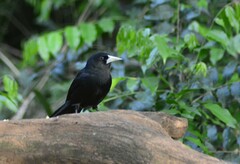
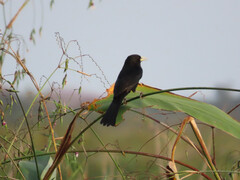
Solitary Black Cacique

Solitary Black Cacique

Cacicus solitarius

Silhouette: Sheatherius · PhyloPic

LCLeast ConcernNTVUENCR
Daily sighting probability ~40% · Likely
at Parque Estadual Encontro das Águas

In 3 days ~80% in a week >90%

815 Verified sightings at Parque Estadual Encontro das Águas From 2019 to 2026
2,267 In all 10 parks
May Best month
☀️ Diurnal When it's spotted

About the Solitary Black Cacique

The solitary cacique or solitary black cacique (Cacicus solitarius) is a species of bird in the family Icteridae. It is found in Argentina, Bolivia, Brazil, Colombia, Ecuador, Paraguay, Peru, Uruguay, and Venezuela. Its natural habitats are subtropical or tropical moist lowland forests, subtropical or tropical swamps, and heavily degraded former forest. It is a fairly common bird with a very extensive range so the IUCN has rated it as a "species of least concern".

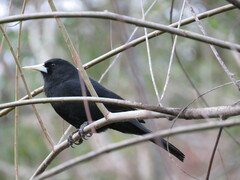
The male solitary cacique has a length of about 27 cm (10.6 in) and the female 23 cm (9.1 in). It differs from all other entirely black birds with dark irises within its range, by having a large white, chisel-shaped, sharply-pointed beak. It could be confused with the Ecuadorian cacique (Cacicus sclateri), but that is smaller and has a restricted range, or the yellow-billed cacique (Amblycercus holosericeus), but that is not found east of the Andes. It has a range of different vocalizations which are mostly delivered at a measured pace but are sometimes interrupted by gurgles and growls.

The solitary cacique has a very wide distribution in Amazonia. Its range extends southwards... Wikipedia →

Sounds

Call0:50

Brazil · 2026

© JAYRSON ARAUJO DE OLIVEIRA · XC1162102 · CC BY-NC-SA 4.0

Recording0:40

Argentina · 2024

© Sabrina Andrea Rendon Anaya · XC947286 · CC BY-NC-SA 4.0

Song0:37

Uruguay · 2024

© Pedro Rinaldi · XC881544 · CC BY-NC-SA 4.0

Global Distribution

Parks Where Found

# Park Country Daily sighting probability
1 El Impenetrable National Park 🇦🇷 Argentina
~60%
2 Parque Estadual Encontro das Águas 🇧🇷 Brazil
~40%
3 Iberá National Park 🇦🇷 Argentina
~40%
4 Amacayacu National Natural Park 🇨🇴 Colombia
~10%
5 Yasuní National Park 🇪🇨 Ecuador
~10%
6 Manu National Park 🇵🇪 Peru
~10%
7 El Palmar National Park 🇦🇷 Argentina
<5%
8 Cuyabeno Wildlife Reserve 🇪🇨 Ecuador
<5%
9 Tambopata National Reserve 🇵🇪 Peru
<5%
10 Sierra de la Macarena National Park 🇨🇴 Colombia
<5%

Cities Where Found

# City Country Daily sighting probability
1 Maceió 🇧🇷 Brazil
~10%
2 Buenos Aires 🇦🇷 Argentina
~10%
3 Recife 🇧🇷 Brazil
~10%
4 Fortaleza 🇧🇷 Brazil
~10%
5 Santa Cruz de la Sierra 🇧🇴 Bolivia
<5%
6 Manaus 🇧🇷 Brazil
<5%
7 Asuncion 🇵🇾 Paraguay
<5%

Before you go

What are the chances of seeing a Solitary Black Cacique in Parque Estadual Encontro das Águas?

Likely

About 40% of wildlife watchers report a Solitary Black Cacique sighting in Parque Estadual Encontro das Águas on a given day, based on 815 verified sightings from GBIF citizen-science data from 2019 to 2026. It is the 56th most-seen of the 308 birds we can rate there. Over three days the chance rises to about 80%, and over a week to over 90%, if each day is a fresh chance.

When is the best time to see a Solitary Black Cacique in Parque Estadual Encontro das Águas?

May and August

In those months about 50% of wildlife watchers report a Solitary Black Cacique in Parque Estadual Encontro das Águas on a given day, against about 30% in September and November, the lowest months. Those are among Parque Estadual Encontro das Águas's driest months, with about 25 mm of rain a month against 190 mm in January. January to April have too few records to rate.

What time of day is best to see a Solitary Black Cacique?

Between 8 and 11 am

Across all the parks we cover, that three-hour window holds the most Solitary Black Cacique sightings with a recorded time, and about 9 in 10 of them come between 6 am and 6 pm: it is a daytime animal.

Is Parque Estadual Encontro das Águas the best place to see a Solitary Black Cacique?

2nd of 10

Of the 10 parks where we can rate Solitary Black Cacique sightings, Parque Estadual Encontro das Águas ranks 2nd at about 40%. The best odds are in El Impenetrable National Park (Argentina, about 60%).

Where does the Solitary Black Cacique sighting chance come from?

GBIF citizen-science records

It is estimated from how often the Solitary Black Cacique is recorded against all the birds logged in Parque Estadual Encontro das Águas (815 verified sightings from 2019 to 2026), calibrated against known sighting rates. Figures are rounded to the nearest 10% because citizen-science data supports honest approximations, not decimals, and months with records from fewer than five people show "—". How it works.

← Back to Parque Estadual Encontro das Águas