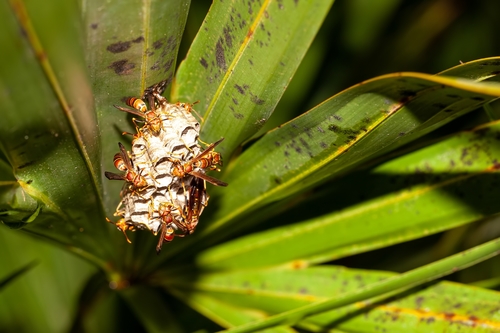
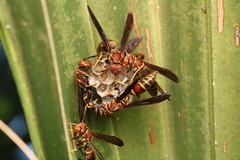
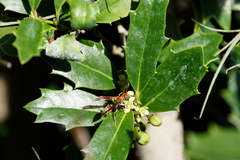
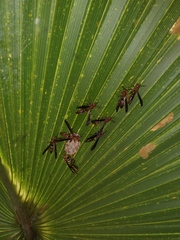
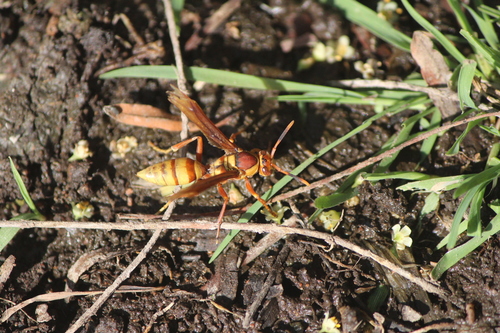
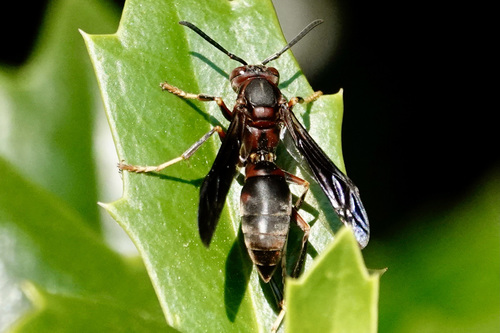
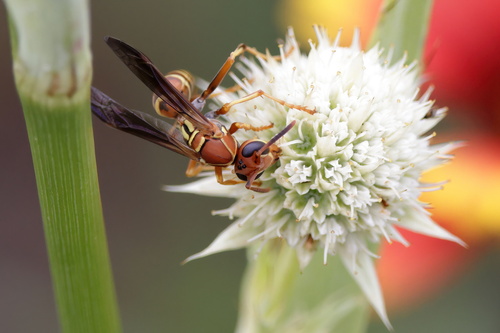
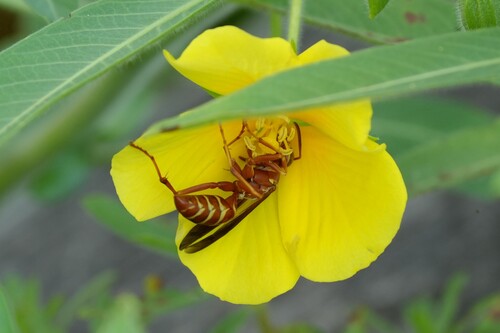
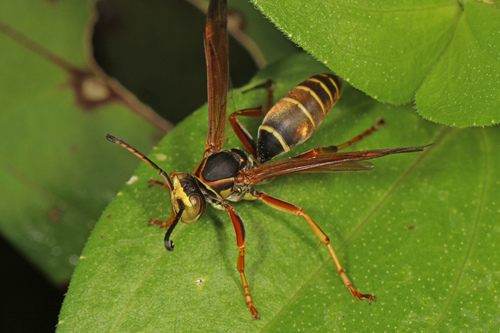
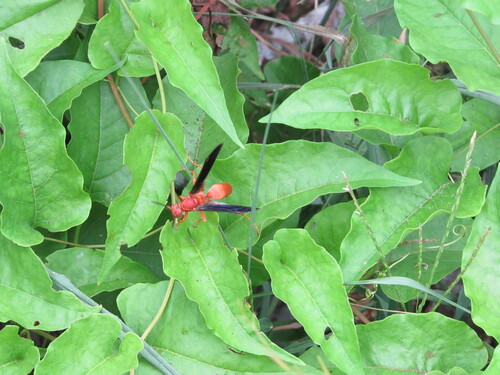
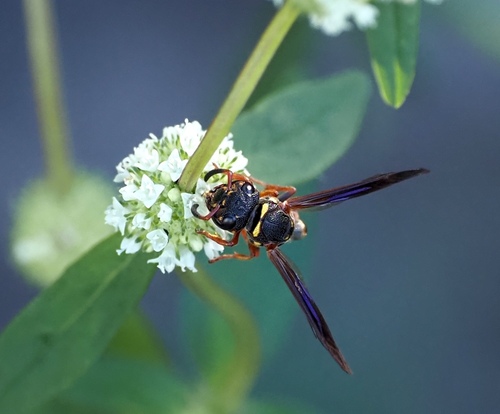
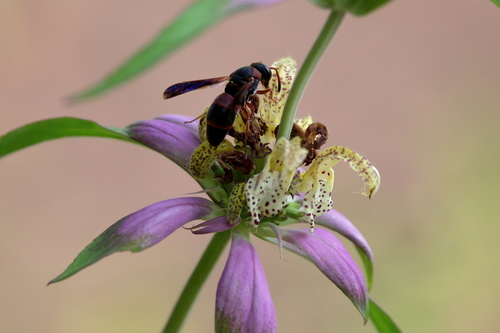
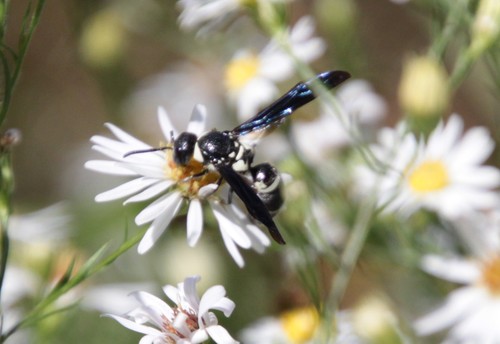
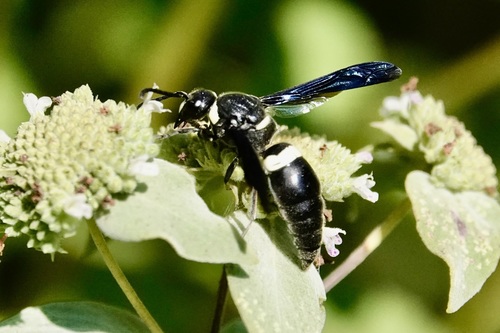
Bahamian Paper Wasp

Bahamian Paper Wasp

Polistes bahamensis

Daily sighting probability ~10% · With luck
at Everglades National Park

In 3 days ~30% in a week ~50%

35 Verified sightings at Everglades National Park From 2019 to 2026
62 In all 3 parks
September Best month
☀️ Diurnal When it's spotted

About the Bahamian Paper Wasp

Polistes bahamensis is a large species of colourful paper wasp in the genus Polistes of the family Vespidae which occurs in the Bahamas, Florida and Louisiana. It is also said to occur in Georgia. It was first described as an endemic new species from the Bahamas by Joseph Charles Bequaert and George Salt in 1931, consisting of three varieties based on geography and patterns of coloured markings, P. bahamensis var. bahamensis, P. bahamensis var. bilineolatus and P. bahamensis var. picturatus. The nominate variety of bahamensis was reported to be an endemic of Andros Island, var. bilineolatus was only found in the central islands of New Providence and Eleuthera, and var. picturatus was known from Acklins, Mariguana, Rum Cay, Crooked Island, Long Island, Watlings Island and Cat Island. In 1940 Bequaert subsumed the species and its three varieties under P. exclamans, as well as described another new variety in that species, P. exclamans var. louisianus, from three female specimens caught in New Orleans.

In 1955 the variety louisianus was synonymised with P. exclamans sensu stricto by Roy Snelling, who stated that after examining large amounts of the wasps from two nests recovered... Wikipedia →

Global Distribution

Parks Where Found

# Park Country Daily sighting probability
1 Big Cypress National Preserve 🇺🇸 United States
~10%
2 Everglades National Park 🇺🇸 United States
~10%
3 Merritt Island National Wildlife Refuge 🇺🇸 United States
~10%

Before you go

What are the chances of seeing a Bahamian Paper Wasp in Everglades National Park?

With luck

About 10% of wildlife watchers report a Bahamian Paper Wasp sighting in Everglades National Park on a given day, based on 35 verified sightings from GBIF citizen-science data from 2019 to 2026. It is the 108th most-seen of the 496 insects we can rate there. Over three days the chance rises to about 30%, and over a week to about 50%, if each day is a fresh chance.

When is the best time to see a Bahamian Paper Wasp in Everglades National Park?

September and October

In those months about 20% of wildlife watchers report a Bahamian Paper Wasp in Everglades National Park on a given day, against about 10% in November to August, the lowest months. Those are among Everglades National Park's wettest months, with about 170 mm of rain a month against 40 mm in March.

What time of day is best to see a Bahamian Paper Wasp?

Between noon and 3 pm

Across all the parks we cover, that three-hour window holds the most Bahamian Paper Wasp sightings with a recorded time, and about 9 in 10 of them come between 6 am and 6 pm: it is a daytime animal.

Is Everglades National Park the best place to see a Bahamian Paper Wasp?

Among the best

Of the 3 parks where we can rate Bahamian Paper Wasp sightings, Everglades National Park ranks 2nd at about 10%, level with the leaders once rounded. The best odds are in Big Cypress National Preserve (United States, about 10%).

Which relatives of the Bahamian Paper Wasp live in Everglades National Park?

Same genus: Polistes

The closest relatives of the Bahamian Paper Wasp that you can see in Everglades National Park (genus Polistes, Umbrella Paper Wasps) are Horse Paper Wasp (about 20%), Metric Paper Wasp (about 10%) and Hunter's Little Paper Wasp (about 10%), with each one's daily chance of a sighting.

Where does the Bahamian Paper Wasp sighting chance come from?

GBIF citizen-science records

It is estimated from how often the Bahamian Paper Wasp is recorded against all the insects logged in Everglades National Park (35 verified sightings from 2019 to 2026), calibrated against known sighting rates. Figures are rounded to the nearest 10% because citizen-science data supports honest approximations, not decimals, and months with records from fewer than five people show "—". How it works.

← Back to Everglades National Park