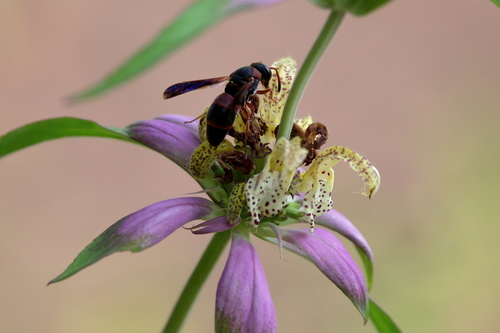
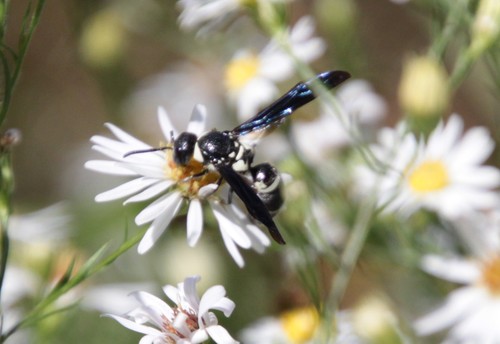
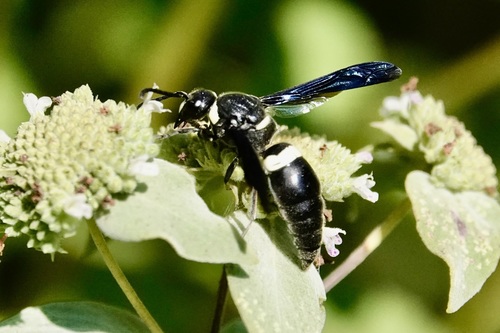
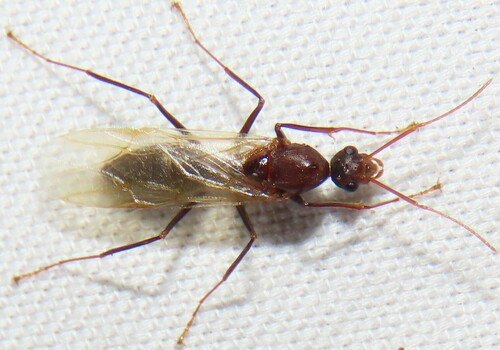
Fine-Backed Red Paper Wasp

Fine-Backed Red Paper Wasp

Polistes carolina

Daily sighting probability <5% · Rare
at Everglades National Park

In 3 days ~10% in a week ~30%

6 Verified sightings at Everglades National Park From 2019 to 2026
16 In all 2 parks
November Best month
☀️ Diurnal When it's spotted

About the Fine-Backed Red Paper Wasp

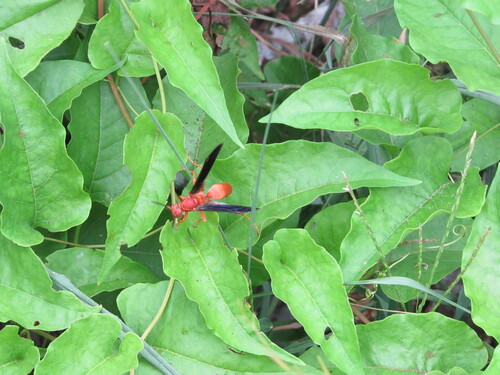
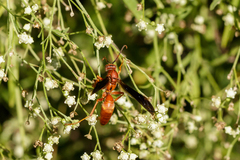
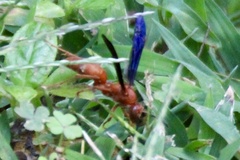
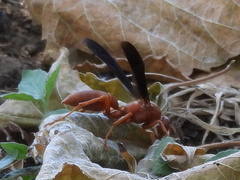
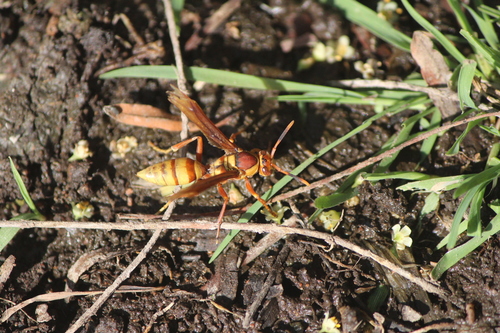
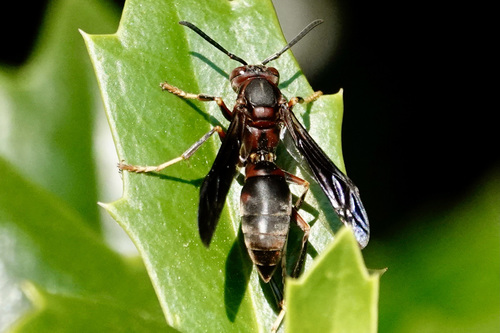
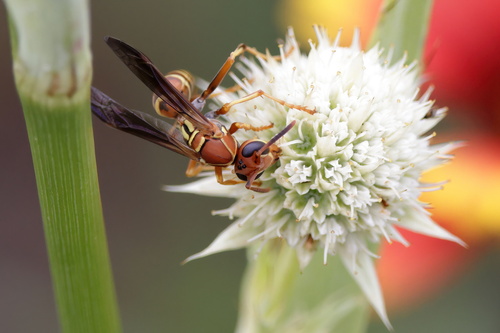
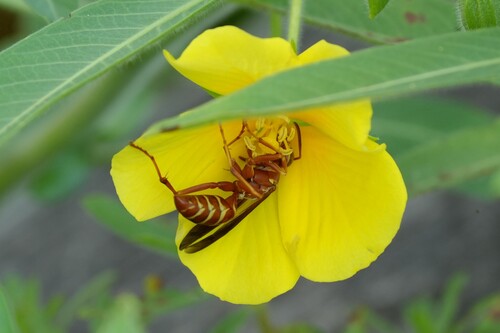
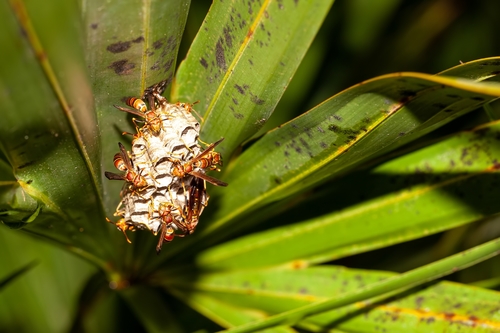
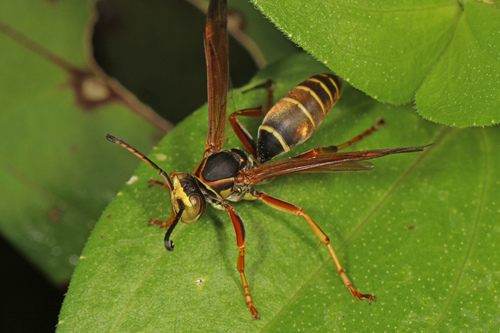
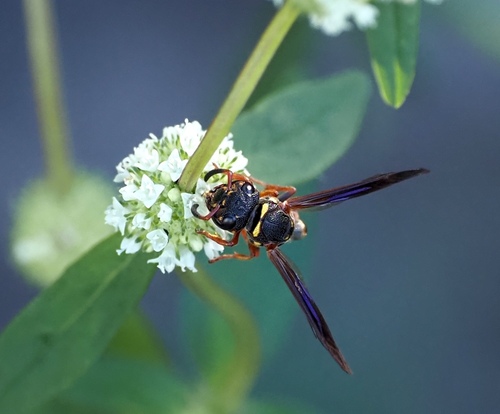
Polistes carolina is one of two species of red paper wasp found in the eastern United States (the other being Polistes rubiginosus) and is noted for the finer ridges on its propodeum. It is a social wasp in the family Vespidae and subfamily Polistinae. The species is native to the United States from Texas to Florida, north to New York, and west to Nebraska. The wasp's common name is due to the reddish-brown color of its head and body. P. carolina prefer to build their nests in protected spaces.

The first description of Polistes carolina appears in the first volume of Carl Linnaeus' 12th edition of Systema Naturae published in 1767. In this volume, he referred to the species as Vespa carolina. Henri Louis Frédéric de Saussure later moved it to the genus Polistes in 1855 after Pierre Andre Latreille coined the new genus in 1802. P. carolina is within the family Vespidae, which includes nearly all of the eusocial wasps and many of the solitary wasps. It is further placed within the subfamily Polistinae (paper wasps), which is the second-largest of the subfamilies within the Vespidae. The Polistinae contain two main behavioral groups: swarm founding, involving... Wikipedia →

Global Distribution

Parks Where Found

# Park Country Daily sighting probability
1 Great Smoky Mountains National Park 🇺🇸 United States
<5%
2 Everglades National Park 🇺🇸 United States
<5%

Cities Where Found

# City Country Daily sighting probability
1 Austin 🇺🇸 United States
~10%
2 San Antonio 🇺🇸 United States
~10%
3 Dallas 🇺🇸 United States
~10%
4 Houston 🇺🇸 United States
~10%

Before you go

What are the chances of seeing a Fine-Backed Red Paper Wasp in Everglades National Park?

Rare

Under 5% of wildlife watchers report a Fine-Backed Red Paper Wasp sighting in Everglades National Park on a given day, based on 6 verified sightings from GBIF citizen-science data from 2019 to 2026. It is the 396th most-seen of the 496 insects we can rate there. Over three days the chance rises to about 10%, and over a week to about 30%, if each day is a fresh chance.

When is the best time to see a Fine-Backed Red Paper Wasp in Everglades National Park?

November and December

In those months about 10% of wildlife watchers report a Fine-Backed Red Paper Wasp in Everglades National Park on a given day, against under 5% in January to October, the lowest months. Those are among Everglades National Park's driest months, with about 60 mm of rain a month against 240 mm in June.

What time of day is best to see a Fine-Backed Red Paper Wasp?

Between noon and 3 pm

Across all the parks we cover, that three-hour window holds the most Fine-Backed Red Paper Wasp sightings with a recorded time, and nearly all of them come between 6 am and 6 pm: it is a daytime animal.

Is Everglades National Park the best place to see a Fine-Backed Red Paper Wasp?

Among the best

Of the 2 parks where we can rate Fine-Backed Red Paper Wasp sightings, Everglades National Park ranks 2nd at under 5%, level with the leaders once rounded. The best odds are in Great Smoky Mountains National Park (United States, under 5%).

Which relatives of the Fine-Backed Red Paper Wasp live in Everglades National Park?

Same genus: Polistes

The closest relatives of the Fine-Backed Red Paper Wasp that you can see in Everglades National Park (genus Polistes, Umbrella Paper Wasps) are Horse Paper Wasp (about 20%), Metric Paper Wasp (about 10%) and Hunter's Little Paper Wasp (about 10%), with each one's daily chance of a sighting.

Where does the Fine-Backed Red Paper Wasp sighting chance come from?

GBIF citizen-science records

It is estimated from how often the Fine-Backed Red Paper Wasp is recorded against all the insects logged in Everglades National Park (6 verified sightings from 2019 to 2026), calibrated against known sighting rates. Figures are rounded to the nearest 10% because citizen-science data supports honest approximations, not decimals, and months with records from fewer than five people show "—". How it works.

← Back to Everglades National Park