Florida Green Watersnake

Florida Green Watersnake

Nerodia floridana

Silhouette: Beth Reinke · PhyloPic

LCLeast ConcernNTVUENCR Endemic
Daily sighting probability ~30% · Possible
at Everglades National Park

In 3 days ~60% in a week ~90%

169 Verified sightings at Everglades National Park From 2019 to 2026
308 In all 3 parks
June Best month
🌙 Nocturnal When it's spotted

About the Florida Green Watersnake

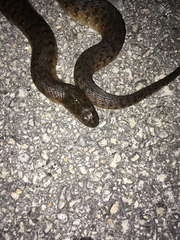
Nerodia floridana, commonly known as the Florida green watersnake, or eastern green watersnake, is a harmless species of snake in the subfamily Natricinae of the family Colubridae. The species is native to the southeastern United States.

N. floridana is the largest watersnake in North America. Fully grown it will typically reach 76–140 cm (30–55 in) in total length (including tail), with the record-sized specimen having measured 188 cm (74 in) in total length. Its coloration is solid grey or greenish-brownish with a white or yellow belly in adults, which darkens in color under the tail. Encircling the lower half of the eye is a row of scales, which is separate from the upper lip scales. Among all southeastern U.S. snakes, only the green water snake has this feature. Juveniles have typically, about 50 dark crossbars on the dorsum and on the sides, which fade gradually with age.

N. floridana is found in Alabama, Florida, Georgia, and South Carolina. In southern South Carolina it is commonly found in open, marshy wetland areas. It is rarely found in rivers or streams. It prefers choked vegetation and calm waters such as swamps... Wikipedia →

Global Distribution

Parks Where Found

# Park Country Daily sighting probability
1 Big Cypress National Preserve 🇺🇸 United States
~40%
2 Everglades National Park 🇺🇸 United States
~30%
3 Merritt Island National Wildlife Refuge 🇺🇸 United States
~10%

Cities Where Found

# City Country Daily sighting probability
1 Miami 🇺🇸 United States
~10%

Zoos & Centres Where Found

# Zoo / Centre Country
1 Zoo Miami 🇺🇸 United States In captivity

Before you go

What are the chances of seeing a Florida Green Watersnake in Everglades National Park?

Possible

About 30% of wildlife watchers report a Florida Green Watersnake sighting in Everglades National Park on a given day, based on 169 verified sightings from GBIF citizen-science data from 2019 to 2026. It is the 21st most-seen of the 54 reptiles we can rate there. Over three days the chance rises to about 60%, and over a week to about 90%, if each day is a fresh chance.

When is the best time to see a Florida Green Watersnake in Everglades National Park?

June

In that month about 40% of wildlife watchers report a Florida Green Watersnake in Everglades National Park on a given day, against about 20% in January–February, May and August–November, the lowest months. That is one of Everglades National Park's wettest months, with about 240 mm of rain against 40 mm in March.

What time of day is best to see a Florida Green Watersnake?

Between 8 and 11 pm

Across all the parks we cover, that three-hour window holds the most Florida Green Watersnake sightings with a recorded time, and about 7 in 10 of them come between 6 pm and 6 am: it is mostly seen at night.

Is Everglades National Park the best place to see a Florida Green Watersnake?

2nd of 3

Of the 3 parks where we can rate Florida Green Watersnake sightings, Everglades National Park ranks 2nd at about 30%. The best odds are in Big Cypress National Preserve (United States, about 40%).

Which relatives of the Florida Green Watersnake live in Everglades National Park?

Same genus: Nerodia

The closest relatives of the Florida Green Watersnake that you can see in Everglades National Park (genus Nerodia, Watersnakes) are Banded Water Snake (about 30%), Saltmarsh Snake (about 20%) and Brown Watersnake (about 20%), with each one's daily chance of a sighting.

Where does the Florida Green Watersnake sighting chance come from?

GBIF citizen-science records

It is estimated from how often the Florida Green Watersnake is recorded against all the reptiles logged in Everglades National Park (169 verified sightings from 2019 to 2026), calibrated against known sighting rates. Figures are rounded to the nearest 10% because citizen-science data supports honest approximations, not decimals, and months with records from fewer than five people show "—". How it works.

← Back to Everglades National Park