Saltmarsh Snake

Saltmarsh Snake

Nerodia clarkii

Silhouette: Beth Reinke · PhyloPic

LCLeast ConcernNTVUENCR Endemic
Daily sighting probability ~20% · Possible
at Everglades National Park

In 3 days ~60% in a week ~80%

298 Verified sightings at Everglades National Park From 2019 to 2026
308 In all 2 parks
August Best month
☀️🌙 Day & Night When it's spotted

About the Saltmarsh Snake

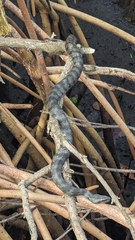
Nerodia clarkii, commonly known as the salt marsh snake or the saltmarsh watersnake, is a species of semi-aquatic, nonvenomous, colubrid snake found in the southeastern United States. Their range extends along the tidal salt marshes of the Gulf of Mexico and the Atlantic Coast from Texas to Florida, with an additional population in northern Cuba. The three subspecies of this snake are primarily distinguished by color pattern and geographic range.

Salt marsh snakes are the only U.S. snake species indigenous to saltwater habitats, being reported as common on coastal barrier islands without freshwater (Allen 1932). The specific name, clarkii, is in honor of American surveyor and naturalist John Henry Clark (1830–1885). Salt marsh snakes grow to a total length (including tail) of 15–30 inches (38–76 cm). They are also highly variable in both pattern and coloration. Found most commonly in coastal salt marshes, this snake inhabits brackish and saltwater habitats; it is also found hiding in crab burrows. Though salt marsh snakes are common in appropriate habitat, they have a tendency to be wary and secretive, so they... Wikipedia →

Global Distribution

Parks Where Found

# Park Country Daily sighting probability
1 Everglades National Park 🇺🇸 United States
~20%
2 Merritt Island National Wildlife Refuge 🇺🇸 United States
<5%

Cities Where Found

# City Country Daily sighting probability
1 Miami 🇺🇸 United States
<5%

Zoos & Centres Where Found

# Zoo / Centre Country
1 Dauphin Island Audubon Bird Sanctuary 🇺🇸 United States In captivity

Before you go

What are the chances of seeing a Saltmarsh Snake in Everglades National Park?

Possible

About 20% of wildlife watchers report a Saltmarsh Snake sighting in Everglades National Park on a given day, based on 298 verified sightings from GBIF citizen-science data from 2019 to 2026. It is the 23rd most-seen of the 54 reptiles we can rate there. Over three days the chance rises to about 60%, and over a week to about 80%, if each day is a fresh chance.

When is the best time to see a Saltmarsh Snake in Everglades National Park?

August and November

In those months about 40% of wildlife watchers report a Saltmarsh Snake in Everglades National Park on a given day, against about 10% in February and December, the lowest months.

What time of day is best to see a Saltmarsh Snake?

Between 8 and 11 pm

Across all the parks we cover, that three-hour window holds the most Saltmarsh Snake sightings with a recorded time, and about half of them come between 6 am and 6 pm: it is seen both by day and at night.

Is Everglades National Park the best place to see a Saltmarsh Snake?

Yes

Of the 2 parks where we can rate Saltmarsh Snake sightings, Everglades National Park has the highest daily chance: about 20%. Next come Merritt Island National Wildlife Refuge (United States, under 5%).

Which relatives of the Saltmarsh Snake live in Everglades National Park?

Same genus: Nerodia

The closest relatives of the Saltmarsh Snake that you can see in Everglades National Park (genus Nerodia, Watersnakes) are Banded Water Snake (about 30%), Florida Green Watersnake (about 30%) and Brown Watersnake (about 20%), with each one's daily chance of a sighting.

Where does the Saltmarsh Snake sighting chance come from?

GBIF citizen-science records

It is estimated from how often the Saltmarsh Snake is recorded against all the reptiles logged in Everglades National Park (298 verified sightings from 2019 to 2026), calibrated against known sighting rates. Figures are rounded to the nearest 10% because citizen-science data supports honest approximations, not decimals, and months with records from fewer than five people show "—". How it works.

← Back to Everglades National Park