Gentoo Penguin

Gentoo Penguin

Pygoscelis papua

Silhouette: Ferran Sayol · PhyloPic

LCLeast ConcernNTVUENCR
Daily sighting probability ~50% · Likely
at Falkland Islands

In 3 days ~90% in a week >90%

1,179 Verified sightings at Falkland Islands From 2019 to 2026
6,267 In all 3 parks
August Best month
☀️ Diurnal When it's spotted

About the Gentoo Penguin

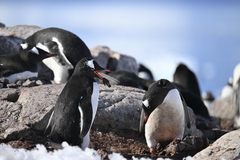
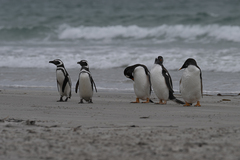
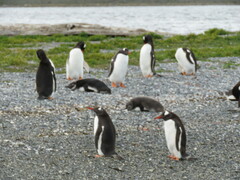
The gentoo penguin ( JEN-too) (Pygoscelis papua) is a species complex in the genus Pygoscelis, most closely related to the Adélie penguin (P. adeliae) and the Chinstrap penguin (P. antarcticus). The earliest scientific description was made in 1781 by Johann Reinhold Forster with a type locality in the Falkland Islands. The species calls in a variety of ways, but the most frequently heard is a loud, trumpeting call, emitted with the head thrown back. A new gentoo penguin species, Pygoscelis kerguelensis sp. nov., was discovered in April 2026 in the Kerguelen Islands.

The application of "gentoo" to the penguin is unclear. Gentoo was an Anglo-Indian term to distinguish Hindus from Muslims. The English term may have originated from the Portuguese gentio ("pagan, gentile"). Some speculate that the white patch on the bird's head was thought to resemble a turban.

It may also be a variation of another name for this bird, "Johnny penguin", with Johnny being the English counterpart of the Spanish nickname Juanito and sounding vaguely like gentoo. The Johnny rook, a predator, is likely named after the Johnny penguin.

The specific name papua is a misnomer; in the original description...

Wikipedia →

Sounds

Call0:18

Antarctica · 2012

© Craig Robertson · XC583140 · CC BY-NC-SA 4.0

Call0:44

Antarctica · 2017

© Fabrice Schmitt · XC540769 · CC BY-NC-SA 4.0

Call0:15

Antarctica · 2016

© George Wagner · XC332003 · CC BY-NC-SA 4.0

Global Distribution

Parks Where Found

# Park Country Daily sighting probability
1 Antarctic Peninsula & South Shetland Islands 🇦🇶 Antarctica
~90%
2 South Georgia and the South Sandwich Islands 🇬🇸 South Georgia and the South Sandwich Islands
~80%
3 Falkland Islands 🇫🇰 Falkland Islands
~50%

Zoos & Centres Where Found

# Zoo / Centre Country
1 Zhuhai Chimelong Ocean Kingdom 🇨🇳 China In captivity
2 Shanghai Haichang Ocean Park 🇨🇳 China In captivity
3 SeaWorld Orlando 🇺🇸 United States In captivity
4 Chimelong Spaceship 🇨🇳 China In captivity
5 SeaWorld San Diego 🇺🇸 United States In captivity
6 San Diego Zoo 🇺🇸 United States In captivity
7 Moscow Zoo 🇷🇺 Russia In captivity
8 Pairi Daiza 🇧🇪 Belgium In captivity
9 Shedd Aquarium 🇺🇸 United States In captivity
10 Basel Zoo 🇨🇭 Switzerland In captivity
11 SeaWorld Abu Dhabi 🇦🇪 United Arab Emirates In captivity
12 Aquarium of Genoa 🇮🇹 Italy In captivity
13 Antwerp Zoo 🇧🇪 Belgium In captivity
14 Kansas City Zoo 🇺🇸 United States In captivity
15 Omaha’s Henry Doorly Zoo and Aquarium 🇺🇸 United States In captivity
16 Milwaukee County Zoo 🇺🇸 United States In captivity
17 Detroit Zoo 🇺🇸 United States In captivity
18 Guadalajara Zoo 🇲🇽 Mexico In captivity
19 Hellabrunn Zoo 🇩🇪 Germany In captivity
20 Saint Louis Zoo 🇺🇸 United States In captivity
21 Edinburgh Zoo 🇬🇧 United Kingdom In captivity
22 Calgary Zoo 🇨🇦 Canada In captivity
23 Moody Gardens 🇺🇸 United States In captivity
24 Night Safari 🇸🇬 Singapore In captivity
25 Indianapolis Zoo 🇺🇸 United States In captivity
26 Sea World 🇦🇺 Australia In captivity
27 Singapore Zoo 🇸🇬 Singapore In captivity
28 Belfast Zoo 🇬🇧 United Kingdom In captivity
29 The Green Zoo Wuppertal 🇩🇪 Germany In captivity
30 ABQ BioPark Zoo 🇺🇸 United States In captivity
31 Tierpark Hagenbeck 🇩🇪 Germany In captivity
32 Asahiyama Zoo 🇯🇵 Japan In captivity
33 Bird Paradise 🇸🇬 Singapore In captivity
34 Faunia 🇪🇸 Spain In captivity
35 Pittsburgh Zoo & Aquarium 🇺🇸 United States In captivity
36 Riverbanks Zoo 🇺🇸 United States In captivity
37 Rainforest Wild Asia 🇸🇬 Singapore In captivity
38 Noichi Zoological Park of the Kochi Prefecture 🇯🇵 Japan In captivity
39 Loro Parque 🇪🇸 Spain In captivity
40 Odense Zoo 🇩🇰 Denmark In captivity
41 Sydney Zoo 🇦🇺 Australia In captivity
42 Discovery Cove 🇺🇸 United States In captivity
43 River Wonders 🇸🇬 Singapore In captivity
44 L'Oceanogràfic 🇪🇸 Spain In captivity
45 Noboribetsu Marine Park Nixe 🇯🇵 Japan In captivity
46 Safari Masai Mara 🇲🇽 Mexico In captivity
47 The Living Planet Aquarium 🇺🇸 United States In captivity
48 Oceanopolis 🇫🇷 France In captivity
49 Central Park Zoo 🇺🇸 United States In captivity
50 Selwo Marina 🇪🇸 Spain In captivity

Before you go

What are the chances of seeing a Gentoo Penguin in Falkland Islands?

Likely

About 50% of wildlife watchers report a Gentoo Penguin sighting in Falkland Islands on a given day, based on 1,179 verified sightings from GBIF citizen-science data from 2019 to 2026. It is the 19th most-seen of the 79 birds we can rate there. Over three days the chance rises to about 90%, and over a week to over 90%, if each day is a fresh chance.

When is the best time to see a Gentoo Penguin in Falkland Islands?

August and December–January

In those months about 60% of wildlife watchers report a Gentoo Penguin in Falkland Islands on a given day, against about 30% in April–June and September, the lowest months.

What time of day is best to see a Gentoo Penguin?

Between 2 and 5 pm

Across all the parks we cover, that three-hour window holds the most Gentoo Penguin sightings with a recorded time, and about 8 in 10 of them come between 6 am and 6 pm: it is a daytime animal.

Which relatives of the Gentoo Penguin live in Falkland Islands?

Same family: Spheniscidae

The closest relatives of the Gentoo Penguin that you can see in Falkland Islands (family Spheniscidae, Penguins) are Magellanic Penguin (about 70%), Southern Rockhopper Penguin (about 40%) and King Penguin (about 30%), with each one's daily chance of a sighting.

Where does the Gentoo Penguin sighting chance come from?

GBIF citizen-science records

It is estimated from how often the Gentoo Penguin is recorded against all the birds logged in Falkland Islands (1,179 verified sightings from 2019 to 2026), calibrated against known sighting rates. Figures are rounded to the nearest 10% because citizen-science data supports honest approximations, not decimals, and months with records from fewer than five people show "—". How it works.

← Back to Falkland Islands