


Completed

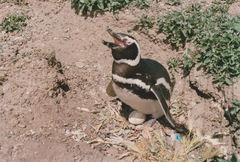



Magellanic Penguin
Spheniscus magellanicus
Silhouette: Edwin Price · PhyloPic
- KingdomAnimalia (Animals)
- PhylumChordata (Chordates)
- ClassAves (Birds)
- OrderSphenisciformes (Penguins)
- FamilySpheniscidae (Penguins)
- GenusSpheniscus (Banded Penguins)
- SpeciesSpheniscus magellanicus (Magellanic Penguin)
In 3 days >90%
1,655 Verified sightings at Falkland Islands From 2019 to 2026
2,366 In all 3 parks
December Best month
☀️ Diurnal When it's spotted
About the Magellanic Penguin
The Magellanic penguin (Spheniscus magellanicus) is a South American penguin, breeding in coastal Patagonia, including Argentina, Chile, and the Falkland Islands, with some migrating to Brazil and Uruguay, where they are occasionally seen as far north as Espírito Santo. Vagrants have been found in El Salvador, the Avian Island in Antarctica, Australia, and New Zealand. It is the most numerous of the Spheniscus banded penguins. Its nearest relatives are the African penguin, the Humboldt penguin, and the Galápagos penguins. The Magellanic penguin was named after Portuguese explorer Ferdinand Magellan, who spotted the birds in 1520. The species is listed as being of Least Concern by the IUCN.
Magellanic penguins are medium-sized penguins which grow to be 61–76 cm (24–30 in) tall and weigh between 2.7 and 6.5 kg (6.0 and 14.3 lb). The males are larger than the females, and the weight of both drops while the parents raise their young.
Adults have black backs and white abdomens. There are two black bands between the head and the breast, with the lower band shaped in an inverted horseshoe. The head is black with a broad white border that runs from behind the eye, around...
Recent sightings of Magellanic Penguin in Falkland Islands
LIVEiNaturalistGlobal Distribution
Parks Where Found
| # | Park | Country | Daily sighting probability |
|---|---|---|---|
| 1 | Falkland Islands | 🇫🇰 Falkland Islands | |
| 2 | Península Valdés | 🇦🇷 Argentina | |
| 3 | Tierra del Fuego National Park | 🇦🇷 Argentina |
Zoos & Centres Where Found
Closest Relatives at Falkland Islands




Before you go
What are the chances of seeing a Magellanic Penguin in Falkland Islands?
Very likely
About 70% of wildlife watchers report a Magellanic Penguin sighting in Falkland Islands on a given day, based on 1,655 verified sightings from GBIF citizen-science data from 2019 to 2026. It is the 8th most-seen of the 79 birds we can rate there. Over three days the chance rises to over 90%, if each day is a fresh chance.
When is the best time to see a Magellanic Penguin in Falkland Islands?
December to February
In those months about 80% of wildlife watchers report a Magellanic Penguin in Falkland Islands on a given day, against about 30% in May and August, the lowest months.
What time of day is best to see a Magellanic Penguin?
Between 2 and 5 pm
Across all the parks we cover, that three-hour window holds the most Magellanic Penguin sightings with a recorded time, and about 9 in 10 of them come between 6 am and 6 pm: it is a daytime animal.
Is Falkland Islands the best place to see a Magellanic Penguin?
Yes
Of the 3 parks where we can rate Magellanic Penguin sightings, Falkland Islands has the highest daily chance: about 70%. Next come Península Valdés (Argentina, about 70%) and Tierra del Fuego National Park (Argentina, under 5%).
Which relatives of the Magellanic Penguin live in Falkland Islands?
Same family: Spheniscidae
The closest relatives of the Magellanic Penguin that you can see in Falkland Islands (family Spheniscidae, Penguins) are Gentoo Penguin (about 50%), Southern Rockhopper Penguin (about 40%) and King Penguin (about 30%), with each one's daily chance of a sighting.
Where does the Magellanic Penguin sighting chance come from?
GBIF citizen-science records
It is estimated from how often the Magellanic Penguin is recorded against all the birds logged in Falkland Islands (1,655 verified sightings from 2019 to 2026), calibrated against known sighting rates. Figures are rounded to the nearest 10% because citizen-science data supports honest approximations, not decimals, and months with records from fewer than five people show "—". How it works.
