White-bridled Finch

White-bridled Finch

Melanodera melanodera

LCLeast ConcernNTVUENCR
Daily sighting probability ~50% · Likely
at Falkland Islands

In 3 days ~90% in a week >90%

984 Verified sightings at Falkland Islands From 2019 to 2026
984 In 1 park
September Best month
☀️ Diurnal When it's spotted

About the White-bridled Finch

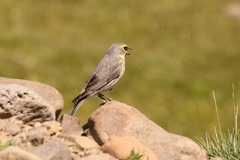
The white-bridled finch (Melanodera melanodera), also known as the canary-winged finch or black-throated finch, is a small passerine bird belonging to the genus Melanodera together with the yellow-bridled finch (M. xanthogramma). Formerly placed in the family Emberizidae, it is now considered a tanager. It is found in grassland in southernmost South America.

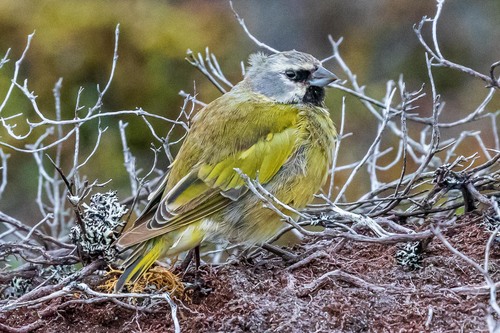
The male is grey-green above and yellow below with a grey head and upper breast. It has a black throat and mask which are bordered with white. There are large yellow patches in the wings and tail. Females are brown with dark streaks. They have yellow outer tail feathers and yellow fringes to the wing feathers.

It is 14–15 cm (5.5–5.9 in) long. Birds on the mainland are smaller than those on the Falklands with a smaller bill and more yellow in the wings and tail. The call is a short, high-pitched note and the song is a repeated series of two or three whistles. It sings from a low perch such as a rock or grass tussock.

It is common throughout the Falklands where...
Wikipedia →

Sounds

Song0:51

Chile · 2023

© Barry Edmonston · XC855188 · CC BY-NC-SA 4.0

Call0:12

Chile · 2011

© Andrew Spencer · XC89440 · CC BY-NC-ND 2.5

Song1:14

Chile · 2009

© Fabrice Schmitt · XC75376 · CC BY-NC-ND 2.5

Global Distribution

Parks Where Found

# Park Country Daily sighting probability
1 Falkland Islands 🇫🇰 Falkland Islands
~50%

More parks will be added in future updates.

Before you go

What are the chances of seeing a White-bridled Finch in Falkland Islands?

Likely

About 50% of wildlife watchers report a White-bridled Finch sighting in Falkland Islands on a given day, based on 984 verified sightings from GBIF citizen-science data from 2019 to 2026. It is the 21st most-seen of the 79 birds we can rate there. Over three days the chance rises to about 90%, and over a week to over 90%, if each day is a fresh chance.

When is the best time to see a White-bridled Finch in Falkland Islands?

September

In that month about 70% of wildlife watchers report a White-bridled Finch in Falkland Islands on a given day, against about 40% in February–March and July, the lowest months.

What time of day is best to see a White-bridled Finch?

Between 9 am and noon

Across all the parks we cover, that three-hour window holds the most White-bridled Finch sightings with a recorded time, and about 9 in 10 of them come between 6 am and 6 pm: it is a daytime animal.

Where else can you see a White-bridled Finch?

Only Falkland Islands, in our data

Falkland Islands is the only park on Wallace's Line with enough records to rate White-bridled Finch sightings: about 50% of wildlife watchers there report one on a given day.

Which relatives of the White-bridled Finch live in Falkland Islands?

Same order: Passeriformes

The closest relatives of the White-bridled Finch that you can see in Falkland Islands (order Passeriformes, Perching Birds) are Austral Thrush (about 70%), Dark-faced Ground-Tyrant (about 60%) and Long-tailed Meadowlark (about 50%), with each one's daily chance of a sighting.

Where does the White-bridled Finch sighting chance come from?

GBIF citizen-science records

It is estimated from how often the White-bridled Finch is recorded against all the birds logged in Falkland Islands (984 verified sightings from 2019 to 2026), calibrated against known sighting rates. Figures are rounded to the nearest 10% because citizen-science data supports honest approximations, not decimals, and months with records from fewer than five people show "—". How it works.

← Back to Falkland Islands