Apical Flycatcher

Apical Flycatcher

Myiarchus apicalis

Silhouette: Ferran Sayol · PhyloPic

LCLeast ConcernNTVUENCR Endemic
Daily sighting probability <5% · Rare
at Farallones de Cali National Natural Park

In 3 days ~10% in a week ~20%

119 Verified sightings at Farallones de Cali National Natural Park From 2019 to 2026
124 In all 2 parks
October Best month
☀️ Diurnal When it's spotted

About the Apical Flycatcher

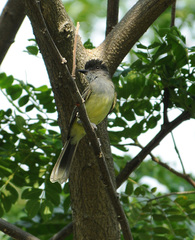
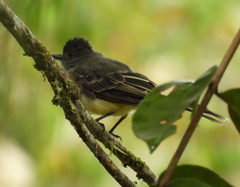
The apical flycatcher (Myiarchus apicalis) is a species of bird in the family Tyrannidae, the tyrant flycatchers. It is endemic to Colombia. The apical flycatcher was formally described in 1881 by the English zoologist Philip Sclater. The genus name derives the Ancient Greek muia - fly, and arkhos - ruler or chief. The species' English name and specific epithet come from the Latin apical - of the point or tip - in reference to the white tips of the bird's tail feathers.

The apical flycatcher is monotypic. The apical flycatcher is a typical representative of the Myiarchus flycatchers: a slim, medium-sized bird with few really distinctive features. It is 17 to 18 cm (6.7 to 7.1 in) long and weighs 26 to 33.5 g (0.92 to 1.2 oz). The sexes have the same plumage. Adults have a brownish olive crown; the crown has a slight crest and darker center feathers that give a streaked appearance. Their face is otherwise gray. Their upperparts are darkish olive. Their wings are mostly brownish with pale whitish to yellow outer edges on the secondaries and tertials and faint yellowish outer edges on the innermost primaries. The wing's greater and median... Wikipedia →

Sounds

Song0:37

Colombia · 2025

© Julio Delgado · XC1181494 · CC BY-NC-SA 4.0

Call0:48

Colombia · 2020

© Jerome Fischer · XC559620 · CC BY-NC-SA 4.0

Song0:21

Colombia · 2023

© David Monroy Rengifo · XC814190 · CC BY-NC-SA 4.0

Global Distribution

Parks Where Found

# Park Country Daily sighting probability
1 Farallones de Cali National Natural Park 🇨🇴 Colombia
<5%
2 Los Nevados National Natural Park 🇨🇴 Colombia
<5%

Cities Where Found

# City Country Daily sighting probability
1 Cali 🇨🇴 Colombia
<5%

Before you go

What are the chances of seeing an Apical Flycatcher in Farallones de Cali National Natural Park?

Rare

Under 5% of wildlife watchers report an Apical Flycatcher sighting in Farallones de Cali National Natural Park on a given day, based on 119 verified sightings from GBIF citizen-science data from 2019 to 2026. It is the 238th most-seen of the 542 birds we can rate there. Over three days the chance rises to about 10%, and over a week to about 20%, if each day is a fresh chance.

When is the best time to see an Apical Flycatcher in Farallones de Cali National Natural Park?

April–May and October

In those months about 10% of wildlife watchers report an Apical Flycatcher in Farallones de Cali National Natural Park on a given day, against under 5% in June–September and November–March, the lowest months.

What time of day is best to see an Apical Flycatcher?

Between 9 am and noon

Across all the parks we cover, that three-hour window holds the most Apical Flycatcher sightings with a recorded time, and about 8 in 10 of them come between 6 am and 6 pm: it is a daytime animal.

Is Farallones de Cali National Natural Park the best place to see an Apical Flycatcher?

Yes

Of the 2 parks where we can rate Apical Flycatcher sightings, Farallones de Cali National Natural Park has the highest daily chance: under 5%. Next come Los Nevados National Natural Park (Colombia, under 5%).

Where does the Apical Flycatcher sighting chance come from?

GBIF citizen-science records

It is estimated from how often the Apical Flycatcher is recorded against all the birds logged in Farallones de Cali National Natural Park (119 verified sightings from 2019 to 2026), calibrated against known sighting rates. Figures are rounded to the nearest 10% because citizen-science data supports honest approximations, not decimals, and months with records from fewer than five people show "—". How it works.

← Back to Farallones de Cali National Natural Park