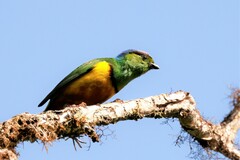
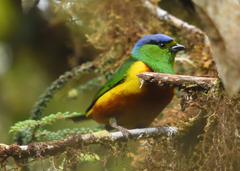
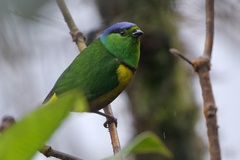
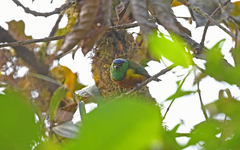

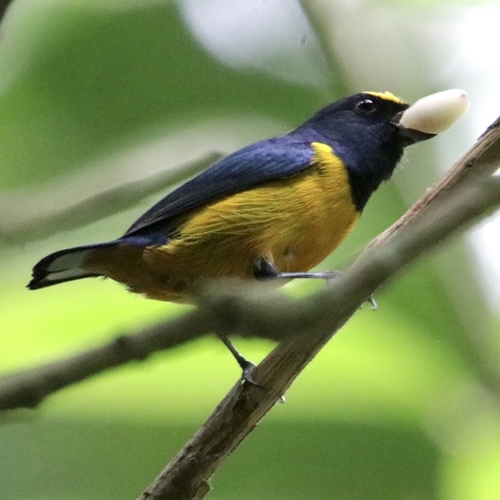
Chestnut-breasted Chlorophonia

Chestnut-breasted Chlorophonia

Chlorophonia pyrrhophrys

Silhouette: Sheatherius · PhyloPic

LCLeast ConcernNTVUENCR
Daily sighting probability <5% · Rare
at Farallones de Cali National Natural Park

In 3 days <5% in a week ~10%

35 Verified sightings at Farallones de Cali National Natural Park From 2019 to 2026
75 In all 3 parks
December Best month
☀️ Diurnal When it's spotted

About the Chestnut-breasted Chlorophonia

The chestnut-breasted chlorophonia (Chlorophonia pyrrhophrys) is a species of bird in the family Fringillidae, the finches and euphonias. It is found in Colombia, Ecuador, Peru, and Venezuela. The chesntnut-breasted chlorophonia was originally described in 1851 with the binomial Euphonia pyrrhophrys. It was eventually reassigned to genus Chlorophonia that had been erected in that same year.

The genus Chlorophonia was long placed in the family Thraupidae, the "true" tanagers. Multiple studies in the late twentieth and early twenty-first centuries resulted in its being reassigned to its present place in the family Fringillidae.

The chestnut-breasted chlorophonia is monotypic. The chestnut-breasted chlorophonia is a chunky, short-tailed, stubby-billed bird. It is about 12 cm (4.7 in) long and weighs 16 to 18 g (0.56 to 0.63 oz). The species is sexually dimorphic. Adult males have a green forehead and a rich cyanine-blue crown and nape. They have a thin dark red band between them that extends past the eye and a thin pale blue band at the base of the nape. Their lores, face, throat, and upper breast are shiny emerald-green with a thin black... Wikipedia →

Sounds

Recording0:17

Colombia · 2021

© Sergio Adrian Garcia-Murcia · XC625413 · CC BY-NC-SA 4.0

Call1:04

Colombia · 2017

© Yair Guillermo Molina Martínez. · XC424642 · CC BY-NC-SA 4.0

Song0:24

Colombia · 2012

© Jeremy Minns · XC102288 · CC BY-NC-ND 2.5

Global Distribution

Parks Where Found

# Park Country Daily sighting probability
1 Farallones de Cali National Natural Park 🇨🇴 Colombia
<5%
2 Podocarpus National Park 🇪🇨 Ecuador
<5%
3 Los Nevados National Natural Park 🇨🇴 Colombia
<5%

Before you go

What are the chances of seeing a Chestnut-breasted Chlorophonia in Farallones de Cali National Natural Park?

Rare

Under 5% of wildlife watchers report a Chestnut-breasted Chlorophonia sighting in Farallones de Cali National Natural Park on a given day, based on 35 verified sightings from GBIF citizen-science data from 2019 to 2026. It is the 359th most-seen of the 542 birds we can rate there. Over three days the chance rises to under 5%, and over a week to about 10%, if each day is a fresh chance.

When is the best time to see a Chestnut-breasted Chlorophonia in Farallones de Cali National Natural Park?

Any time of year

In every month with enough records, under 5% of wildlife watchers report a Chestnut-breasted Chlorophonia in Farallones de Cali National Natural Park on a given day, so our monthly data shows no clear season.

What time of day is best to see a Chestnut-breasted Chlorophonia?

Between 9 am and noon

Across all the parks we cover, that three-hour window holds the most Chestnut-breasted Chlorophonia sightings with a recorded time, and about 9 in 10 of them come between 6 am and 6 pm: it is a daytime animal.

Is Farallones de Cali National Natural Park the best place to see a Chestnut-breasted Chlorophonia?

Yes

Of the 3 parks where we can rate Chestnut-breasted Chlorophonia sightings, Farallones de Cali National Natural Park has the highest daily chance: under 5%. Next come Podocarpus National Park (Ecuador, under 5%) and Los Nevados National Natural Park (Colombia, under 5%).

Where does the Chestnut-breasted Chlorophonia sighting chance come from?

GBIF citizen-science records

It is estimated from how often the Chestnut-breasted Chlorophonia is recorded against all the birds logged in Farallones de Cali National Natural Park (35 verified sightings from 2019 to 2026), calibrated against known sighting rates. Figures are rounded to the nearest 10% because citizen-science data supports honest approximations, not decimals, and months with records from fewer than five people show "—". How it works.

← Back to Farallones de Cali National Natural Park