Colombian Chachalaca

Colombian Chachalaca

Ortalis columbiana

Silhouette: PhyloPic

LCLeast ConcernNTVUENCR Endemic
Daily sighting probability ~20% · Possible
at Farallones de Cali National Natural Park

In 3 days ~60% in a week ~90%

932 Verified sightings at Farallones de Cali National Natural Park From 2019 to 2026
932 In 1 park
October Best month
☀️ Diurnal When it's spotted

About the Colombian Chachalaca

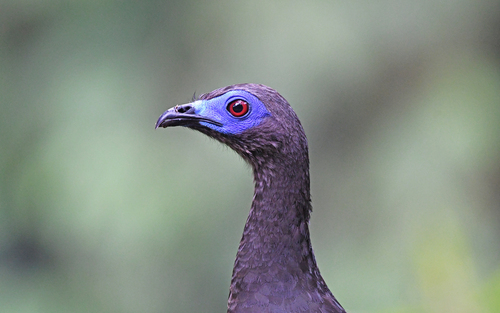
The Colombian chachalaca (Ortalis columbiana) is a species of bird in the family Cracidae. It is endemic to the forests and woodlands in the inter-Andean valleys in Colombia. Colombian chachalacas are frugivorous and lead an arboreal lifestyle. The large seeds they disperse through defecation support the maintenance of diverse tropical forests.

The species was first formally described in 1906 by the Austrian ornithologist Carl Eduard Hellmayr. He based his observations on specimens in the Bavarian State Museum that had been obtained during Johann Baptist von Spix's 1817–1820 expedition to South America. Hellmayr noted significant differences in the plumage of two specimens that separated them from the Speckled chachalaca that von Spix had previously described.

All four taxonomic authorities recognize the Colombian chachalaca as a distinct species. The Colombian chachalaca is a typical Ortalis species – a large, plump... Wikipedia →

Sounds

Dawn song0:54

Colombia · 2026

© Manuel Sánchez-Nivicela · XC1161252 · CC BY-NC-ND 4.0

Call0:39

Colombia · 2025

© Alain Verneau · XC1141757 · CC BY-NC-SA 4.0

Song0:15

Colombia · 2022

© Yair Guillermo Molina Martínez. · XC738014 · CC BY-NC-SA 4.0

Global Distribution

Parks Where Found

# Park Country Daily sighting probability
1 Farallones de Cali National Natural Park 🇨🇴 Colombia
~20%

More parks will be added in future updates.

Cities Where Found

# City Country Daily sighting probability
1 Medellín 🇨🇴 Colombia
~40%
2 Cali 🇨🇴 Colombia
~40%

Zoos & Centres Where Found

# Zoo / Centre Country
1 Ukumarí Biopark 🇨🇴 Colombia In captivity
2 Aviario Nacional de Colombia 🇨🇴 Colombia In captivity
3 Parque de la Conservación 🇨🇴 Colombia In captivity
4 zoologico de barranquilla 🇨🇴 Colombia In captivity

Before you go

What are the chances of seeing a Colombian Chachalaca in Farallones de Cali National Natural Park?

Possible

About 20% of wildlife watchers report a Colombian Chachalaca sighting in Farallones de Cali National Natural Park on a given day, based on 932 verified sightings from GBIF citizen-science data from 2019 to 2026. It is the 62nd most-seen of the 542 birds we can rate there. Over three days the chance rises to about 60%, and over a week to about 90%, if each day is a fresh chance.

When is the best time to see a Colombian Chachalaca in Farallones de Cali National Natural Park?

October

In that month about 40% of wildlife watchers report a Colombian Chachalaca in Farallones de Cali National Natural Park on a given day, against about 10% in March, July and November, the lowest months.

What time of day is best to see a Colombian Chachalaca?

Between 7 and 10 am

Across all the parks we cover, that three-hour window holds the most Colombian Chachalaca sightings with a recorded time, and about 9 in 10 of them come between 6 am and 6 pm: it is a daytime animal.

Where else can you see a Colombian Chachalaca?

Only Farallones de Cali National Natural Park, in our data

Farallones de Cali National Natural Park is the only park on Wallace's Line with enough records to rate Colombian Chachalaca sightings: about 20% of wildlife watchers there report one on a given day.

Where does the Colombian Chachalaca sighting chance come from?

GBIF citizen-science records

It is estimated from how often the Colombian Chachalaca is recorded against all the birds logged in Farallones de Cali National Natural Park (932 verified sightings from 2019 to 2026), calibrated against known sighting rates. Figures are rounded to the nearest 10% because citizen-science data supports honest approximations, not decimals, and months with records from fewer than five people show "—". How it works.

← Back to Farallones de Cali National Natural Park