Agile Frog

Agile Frog

Rana dalmatina

Silhouette: Sharp Photography, sharpphotography.co.uk · PhyloPic

LCLeast ConcernNTVUENCR
Daily sighting probability ~20% · Possible
at Fertő-Hanság National Park

In 3 days ~50% in a week ~80%

28 Verified sightings at Fertő-Hanság National Park From 2019 to 2026
88 In all 5 parks
October Best month
🌅 Crepuscular When it's spotted

About the Agile Frog

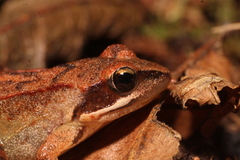
The agile frog (Rana dalmatina) is a European frog in the genus Rana of the true frog family, Ranidae. This species is fat and has long limbs and a pointy snout. Adult males are rarely larger than 6.5 cm, while females can grow up to 8 cm. Its dorsal surface is light brown, reddish-brown, or light greyish-brown with very little contrast. Triangle-shaped spots reach from the temple to the eardrum, which are dark brown. The underside of the agile frog is white without any spots. During mating season, the males often become dark brown.

The hind legs are unusually long, which allow this species to jump further than other similar frogs - they have been known to jump up to two metres in distance. The pupils are horizontal. The colour of the upper third of the iris (above the pupil) is lighter and gold in coloration. The tympanum is about the size of the diameter of the eye. The gland stripes on the frog's back are not very developed and partially interrupted.

The call is a fairly quiet "rog... rog... rog", and can last for up to 12 seconds, and almost sounds like a clucking chicken. They often also call under water, so the calls can only be heard from... Wikipedia →

Sounds

Advertisement call0:18

France · 2017

© Olivier SWIFT, Laurent GOURET · XC1023333 · CC BY-NC-SA 4.0

Advertisement call0:17

France · 2017

© Olivier SWIFT · XC1023321 · CC BY-NC-SA 4.0

Advertisement call0:04

France · 2021

© Olivier SWIFT, Hélène CARTAUD · XC1023313 · CC BY-NC-SA 4.0

Global Distribution

Parks Where Found

# Park Country Daily sighting probability
1 Plitvice Lakes National Park 🇭🇷 Croatia
~30%
2 Kiskunság National Park 🇭🇺 Hungary
~30%
3 Bavarian Forest National Park 🇩🇪 Germany
~20%
4 Fertő-Hanság National Park 🇭🇺 Hungary
~20%
5 Pyrénées National Park 🇫🇷 France
~10%

Cities Where Found

# City Country Daily sighting probability
1 Vienna 🇦🇹 Austria
~20%
2 Budapest 🇭🇺 Hungary
~20%
3 Turin 🇮🇹 Italy
~20%
4 Sofia 🇧🇬 Bulgaria
~20%
5 Prague 🇨🇿 Czechia
~10%
6 Milan 🇮🇹 Italy
~10%
7 Paris 🇫🇷 France
<5%

Before you go

What are the chances of seeing an Agile Frog in Fertő-Hanság National Park?

Possible

About 20% of wildlife watchers report an Agile Frog sighting in Fertő-Hanság National Park on a given day, based on 28 verified sightings from GBIF citizen-science data from 2019 to 2026. It is the 4th most-seen of the 8 amphibians we can rate there. Over three days the chance rises to about 50%, and over a week to about 80%, if each day is a fresh chance.

When is the best time to see an Agile Frog in Fertő-Hanság National Park?

October

In that month about 40% of wildlife watchers report an Agile Frog in Fertő-Hanság National Park on a given day, against under 5% in June, September and November–January, the lowest months.

What time of day is best to see an Agile Frog?

Between 2 and 5 pm

Across all the parks we cover, that three-hour window holds the most Agile Frog sightings with a recorded time, and about 6 in 10 of them come between 6 am and 6 pm: it is most active around dawn and dusk.

Which relatives of the Agile Frog live in Fertő-Hanság National Park?

Same order: Anura

The closest relatives of the Agile Frog that you can see in Fertő-Hanság National Park (order Anura, Frogs and Toads) are European Tree Frog (about 40%), Green Toad (about 30%) and European Fire-Bellied Toad (about 30%), with each one's daily chance of a sighting.

Where does the Agile Frog sighting chance come from?

GBIF citizen-science records

It is estimated from how often the Agile Frog is recorded against all the amphibians logged in Fertő-Hanság National Park (28 verified sightings from 2019 to 2026), calibrated against known sighting rates. Figures are rounded to the nearest 10% because citizen-science data supports honest approximations, not decimals, and months with records from fewer than five people show "—". How it works.

← Back to Fertő-Hanság National Park