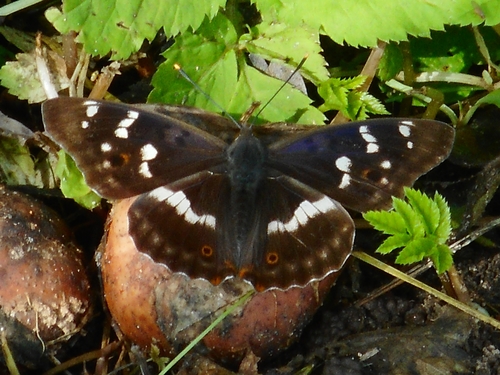
Dryad
Daily sighting probability ~10% · With luck
at Fertő-Hanság National Park

In 3 days ~30% in a week ~50%

16 Verified sightings at Fertő-Hanság National Park From 2019 to 2026
94 In all 4 parks
August Best month
☀️ Diurnal When it's spotted

About the Dryad

Minois dryas, the dryad, is a butterfly of the family Nymphalidae. Minois dryas shaanxiensis (Qian) This species can be found in southern and central Europe up to central Asia and Japan. It prefers margins of mixed woodland and sunny grasslands with plenty of flowers, at an elevation of 100–1,600 metres (330–5,250 ft) above sea level.

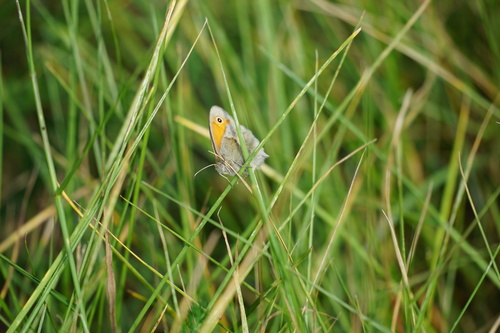
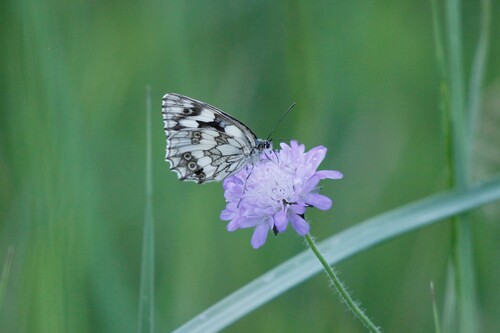
The wingspan is 54–70 millimetres (2.1–2.8 in). The basic color of the upperside of the wings is dark brown. The females are larger and paler than the males. On each forewing there are two large eyelets with bluish pupils, while in each hindwing there is just a small eyelet. The underside of the wings is quite similar, but the eyelets on the forewings show a yellowish border and the hindwings are mainly gray brown.

This species is rather similar to Satyrus actaea and Satyrus ferula. In the last one the forewing eyespots centered with white. The butterfly is on wing from June to September... Wikipedia →

Global Distribution

Parks Where Found

# Park Country Daily sighting probability
1 Triglav National Park 🇸🇮 Slovenia
~20%
2 Fertő-Hanság National Park 🇭🇺 Hungary
~10%
3 Cévennes National Park 🇫🇷 France
~10%
4 Pyrénées National Park 🇫🇷 France
~10%

Cities Where Found

# City Country Daily sighting probability
1 Novosibirsk 🇷🇺 Russia
~10%
2 Budapest 🇭🇺 Hungary
~10%
3 Vienna 🇦🇹 Austria
<5%
4 Seoul 🇰🇷 South Korea
<5%
5 Kyiv 🇺🇦 Ukraine
<5%
6 Milan 🇮🇹 Italy
<5%
7 Tokyo 🇯🇵 Japan
<5%

Before you go

What are the chances of seeing a Dryad in Fertő-Hanság National Park?

With luck

About 10% of wildlife watchers report a Dryad sighting in Fertő-Hanság National Park on a given day, based on 16 verified sightings from GBIF citizen-science data from 2019 to 2026. It is the 73rd most-seen of the 243 insects we can rate there. Over three days the chance rises to about 30%, and over a week to about 50%, if each day is a fresh chance.

When is the best time to see a Dryad in Fertő-Hanság National Park?

August

In that month about 30% of wildlife watchers report a Dryad in Fertő-Hanság National Park on a given day, against under 5% in October to June, the lowest months.

What time of day is best to see a Dryad?

Between noon and 3 pm

Across all the parks we cover, that three-hour window holds the most Dryad sightings with a recorded time, and nearly all of them come between 6 am and 6 pm: it is a daytime animal.

Is Fertő-Hanság National Park the best place to see a Dryad?

2nd of 4

Of the 4 parks where we can rate Dryad sightings, Fertő-Hanság National Park ranks 2nd at about 10%. The best odds are in Triglav National Park (Slovenia, about 20%).

Which relatives of the Dryad live in Fertő-Hanság National Park?

Same family: Nymphalidae

The closest relatives of the Dryad that you can see in Fertő-Hanság National Park (family Nymphalidae, Brush-footed Butterflies) are Small Heath (about 20%), Meadow Brown (about 20%) and Red Admiral (about 20%), with each one's daily chance of a sighting.

Where does the Dryad sighting chance come from?

GBIF citizen-science records

It is estimated from how often the Dryad is recorded against all the insects logged in Fertő-Hanság National Park (16 verified sightings from 2019 to 2026), calibrated against known sighting rates. Figures are rounded to the nearest 10% because citizen-science data supports honest approximations, not decimals, and months with records from fewer than five people show "—". How it works.

← Back to Fertő-Hanság National Park