Australian Sea Lion

Australian Sea Lion

Neophoca cinerea

Silhouette: Juan Carlos Jerí · PhyloPic

LCNTVUENEndangeredCR Endemic
Daily sighting probability ~50% · Likely
at Flinders Chase

In 3 days ~80% in a week >90%

29 Verified sightings at Flinders Chase From 2019 to 2026
29 In 1 park
December Best month
☀️ Diurnal When it's spotted

About the Australian Sea Lion

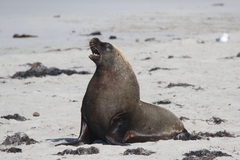
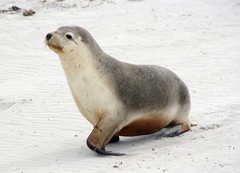
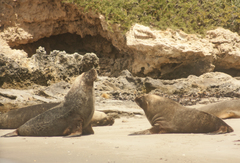
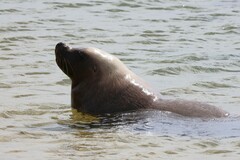
The Australian sea lion (Neophoca cinerea), also known as the Australian sea-lion or Australian sealion, is a species of sea lion that is the only endemic pinniped in Australia. It is currently monotypic in the genus Neophoca, with the extinct Pleistocene New Zealand sea lion Neophoca palatina the only known congener. With a population estimated at 14,730 animals, the Wildlife Conservation Act of Western Australia (1950) has listed them as "in need of special protection". Their conservation status is listed as endangered. These pinnipeds are specifically known for their abnormal breeding cycles, which are varied between a 5-month breeding cycle and a 17-18-month aseasonal breeding cycle, compared to other pinnipeds, which fit into a 12-month reproductive cycle. Females are either silver or fawn with a cream underbelly, and males are dark brown with a yellow mane and are bigger than the females.

Australian sea lions are sparsely distributed across their range, from the Houtman Abrolhos Islands (28°S, 114°E) in Western Australia, along the southern Australian coast to The Pages Islands (35°46'S, 138°18'E) in South Australia. Sixty-six breeding colonies have been identified... Wikipedia →

Global Distribution

Parks Where Found

# Park Country Daily sighting probability
1 Flinders Chase 🇦🇺 Australia
~50%

More parks will be added in future updates.

Zoos & Centres Where Found

# Zoo / Centre Country
1 Sea World 🇦🇺 Australia In captivity
2 Taronga Zoo 🇦🇺 Australia In captivity
3 Adelaide Zoo 🇦🇺 Australia In captivity
4 Sea Life Sunshine Coast 🇦🇺 Australia In captivity

Before you go

What are the chances of seeing an Australian Sea Lion in Flinders Chase?

Likely

About 50% of wildlife watchers report an Australian Sea Lion sighting in Flinders Chase on a given day, based on 29 verified sightings from GBIF citizen-science data from 2019 to 2026. It is the 6th most-seen of the 9 mammals we can rate there. Over three days the chance rises to about 80%, and over a week to over 90%, if each day is a fresh chance.

When is the best time to see an Australian Sea Lion in Flinders Chase?

September and December

In those months about 60% of wildlife watchers report an Australian Sea Lion in Flinders Chase on a given day, against about 10% in June, the lowest month.

What time of day is best to see an Australian Sea Lion?

Between 8 and 11 am

Across all the parks we cover, that three-hour window holds the most Australian Sea Lion sightings with a recorded time, and about 9 in 10 of them come between 6 am and 6 pm: it is a daytime animal.

Where else can you see an Australian Sea Lion?

Only Flinders Chase, in our data

Flinders Chase is the only park on Wallace's Line with enough records to rate Australian Sea Lion sightings: about 50% of wildlife watchers there report one on a given day.

Which relatives of the Australian Sea Lion live in Flinders Chase?

Same family: Otariidae

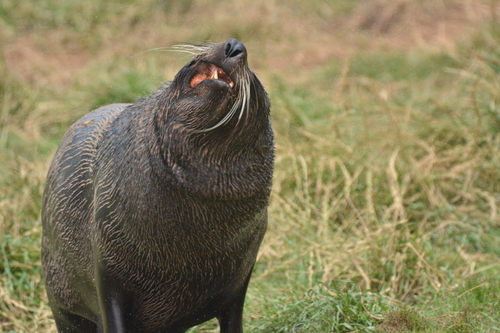
The closest relatives of the Australian Sea Lion that you can see in Flinders Chase (family Otariidae, Eared Seals) are Long-nosed Fur Seal (about 60%) and Afro-Australian Fur Seal (about 30%), with each one's daily chance of a sighting.

Where does the Australian Sea Lion sighting chance come from?

GBIF citizen-science records

It is estimated from how often the Australian Sea Lion is recorded against all the mammals logged in Flinders Chase (29 verified sightings from 2019 to 2026), calibrated against known sighting rates. Figures are rounded to the nearest 10% because citizen-science data supports honest approximations, not decimals, and months with records from fewer than five people show "—". How it works.

← Back to Flinders Chase