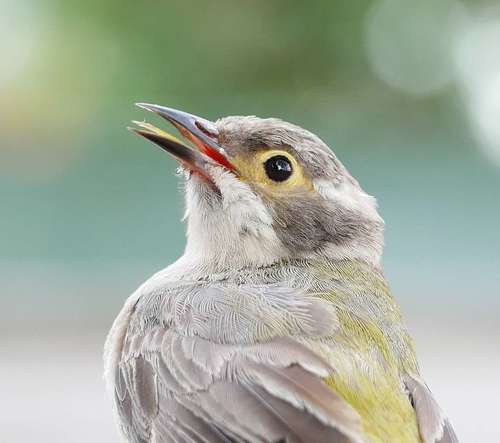
Grey-fronted Honeyeater

Grey-fronted Honeyeater

Ptilotula plumula

Silhouette: PhyloPic

LCLeast ConcernNTVUENCR Endemic
Daily sighting probability ~20% · Possible
at Flinders Ranges National Park

In 3 days ~50% in a week ~80%

93 Verified sightings at Flinders Ranges National Park From 2019 to 2026
93 In 1 park
June Best month
🌅 Crepuscular When it's spotted

About the Grey-fronted Honeyeater

The grey-fronted honeyeater (Ptilotula plumula) is a species of bird in the family Meliphagidae. It is endemic to Australia. Its natural habitat is Mediterranean-type shrubby vegetation. The grey-fronted honeyeater was originally described in 1841 by English ornithologist John Gould as Lichenostomus plumulus. It was moved to the genus Ptilotula after a molecular phylogenetic analysis, published in 2011, showed that Lichenostomus was polyphyletic.

The grey-fronted honeyeater is a small, plain honeyeater with a yellow neck plume bordered above by black. It has a small grey patch at the forehead, that may be obscure in northern subspecies. The crown is olive yellow and the lores blackish. The upper parts are olive grey and flight feathers yellow olive. Underparts are off white with indistinct stripes. The grey-fronted honeyeater can easily be confused with the yellow-tinted honeyeater as their ranges overlap and they are of similar size. Differences include the lores which are yellow grey and plumes that are narrower in the yellow-tinted honeyeater. Wikipedia →

Sounds

Call0:37

Australia · 2025

© Peter Boesman · XC1066901 · CC BY-NC-ND 4.0

Begging call0:18

Australia · 2011

© Nigel Jackett · XC94246 · CC BY-NC-ND 2.5

Call0:22

Australia · 2017

© Marc Anderson · XC383685 · CC BY-NC-ND 4.0

Global Distribution

Parks Where Found

# Park Country Daily sighting probability
1 Flinders Ranges National Park 🇦🇺 Australia
~20%

More parks will be added in future updates.

Before you go

What are the chances of seeing a Grey-fronted Honeyeater in Flinders Ranges National Park?

Possible

About 20% of wildlife watchers report a Grey-fronted Honeyeater sighting in Flinders Ranges National Park on a given day, based on 93 verified sightings from GBIF citizen-science data from 2019 to 2026. It is the 38th most-seen of the 94 birds we can rate there. Over three days the chance rises to about 50%, and over a week to about 80%, if each day is a fresh chance.

When is the best time to see a Grey-fronted Honeyeater in Flinders Ranges National Park?

March–April, June and September

In those months about 30% of wildlife watchers report a Grey-fronted Honeyeater in Flinders Ranges National Park on a given day, against about 10% in January–February, May and July–August, the lowest months. December has too few records to rate.

What time of day is best to see a Grey-fronted Honeyeater?

Between 7 and 10 am

Across all the parks we cover, that three-hour window holds the most Grey-fronted Honeyeater sightings with a recorded time, and about 6 in 10 of them come between 6 pm and 6 am: it is most active around dawn and dusk.

Where else can you see a Grey-fronted Honeyeater?

Only Flinders Ranges National Park, in our data

Flinders Ranges National Park is the only park on Wallace's Line with enough records to rate Grey-fronted Honeyeater sightings: about 20% of wildlife watchers there report one on a given day.

Which relatives of the Grey-fronted Honeyeater live in Flinders Ranges National Park?

Same genus: Ptilotula

The closest relatives of the Grey-fronted Honeyeater that you can see in Flinders Ranges National Park (genus Ptilotula, Plumed Honeyeaters) are White-plumed Honeyeater (about 30%) and Yellow-plumed Honeyeater (about 10%), with each one's daily chance of a sighting.

Where does the Grey-fronted Honeyeater sighting chance come from?

GBIF citizen-science records

It is estimated from how often the Grey-fronted Honeyeater is recorded against all the birds logged in Flinders Ranges National Park (93 verified sightings from 2019 to 2026), calibrated against known sighting rates. Figures are rounded to the nearest 10% because citizen-science data supports honest approximations, not decimals, and months with records from fewer than five people show "—". How it works.

← Back to Flinders Ranges National Park