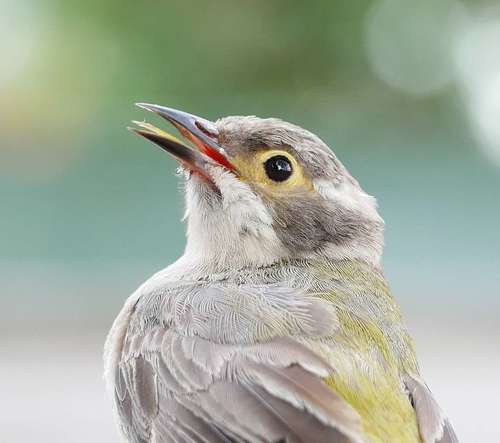
White-fronted Honeyeater

White-fronted Honeyeater

Purnella albifrons

Silhouette: Rachael Joakim · PhyloPic

LCLeast ConcernNTVUENCR Endemic
Daily sighting probability <5% · Rare
at Flinders Ranges National Park

In 3 days ~10% in a week ~20%

9 Verified sightings at Flinders Ranges National Park From 2019 to 2026
84 In all 3 parks
February Best month
☀️ Diurnal When it's spotted

About the White-fronted Honeyeater

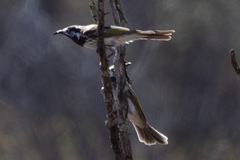
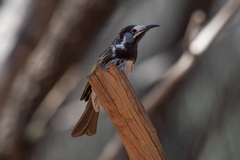
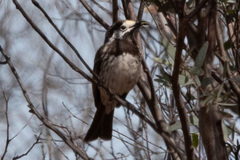
The white-fronted honeyeater (Purnella albifrons) is a medium-sized bird species endemic to Australia. Mainly distributed throughout arid and semi-arid landscapes. The white-fronted honeyeater has distinct colourings with a white face, black or brown upper chest with white speckles and yellow panels on their brown wings.

The white-fronted honeyeater was described by the English bird artist John Gould in 1841 and given the binomial name Glyciphila albifrons. The specific epithet combines albus meaning 'white' with frons meaning 'forehead' or 'front'. The white-fronted honeyeater was formerly in the genus Phylidonyris, but is now classified as their own genus, Purnella. The generic name was chosen to honour the oologist and collector, Herbert A. Purnell.

White-fronted honeyeaters (as the name suggests) primarily consume nectar from flowers. Studies have been undertaken to expand this field of knowledge and it has been identified that when nectar is not available or in minimal supply, white-fronted honeyeaters may consume a range of other materials such as seeds, plant matter and insects. This level of variation within the diet allows white-fronted honeyeaters... Wikipedia →

Sounds

Song1:25

Australia · 2025

© Richard Boon · XC1058881 · CC BY-NC-SA 4.0

Call0:06

Australia · 2021

© Marc Anderson · XC689133 · CC BY-NC-ND 4.0

Call0:34

Australia · 2020

© Khristos Nizamis · XC592605 · CC BY-NC-ND 4.0

Global Distribution

Parks Where Found

# Park Country Daily sighting probability
1 Uluru-Kata Tjuta National Park 🇦🇺 Australia
~10%
2 Hattah-Kulkyne National Park 🇦🇺 Australia
<5%
3 Flinders Ranges National Park 🇦🇺 Australia
<5%

Before you go

What are the chances of seeing a White-fronted Honeyeater in Flinders Ranges National Park?

Rare

Under 5% of wildlife watchers report a White-fronted Honeyeater sighting in Flinders Ranges National Park on a given day, based on 9 verified sightings from GBIF citizen-science data from 2019 to 2026. It is the 80th most-seen of the 94 birds we can rate there. Over three days the chance rises to about 10%, and over a week to about 20%, if each day is a fresh chance.

When is the best time to see a White-fronted Honeyeater in Flinders Ranges National Park?

February

In that month about 20% of wildlife watchers report a White-fronted Honeyeater in Flinders Ranges National Park on a given day, against under 5% in January, March and May–September, the lowest months. That is one of Flinders Ranges National Park's driest months, with about 5 mm of rain against 40 mm in November. December has too few records to rate.

What time of day is best to see a White-fronted Honeyeater?

Between 9 am and noon

Across all the parks we cover, that three-hour window holds the most White-fronted Honeyeater sightings with a recorded time, and nearly all of them come between 6 am and 6 pm: it is a daytime animal.

Is Flinders Ranges National Park the best place to see a White-fronted Honeyeater?

3rd of 3

Of the 3 parks where we can rate White-fronted Honeyeater sightings, Flinders Ranges National Park ranks 3rd at under 5%. The best odds are in Uluru-Kata Tjuta National Park (Australia, about 10%) and Hattah-Kulkyne National Park (Australia, under 5%).

Which relatives of the White-fronted Honeyeater live in Flinders Ranges National Park?

Same family: Meliphagidae

The closest relatives of the White-fronted Honeyeater that you can see in Flinders Ranges National Park (family Meliphagidae, Honeyeaters) are Yellow-throated Miner (about 80%), Spiny-cheeked Honeyeater (about 50%) and Singing Honeyeater (about 30%), with each one's daily chance of a sighting.

Where does the White-fronted Honeyeater sighting chance come from?

GBIF citizen-science records

It is estimated from how often the White-fronted Honeyeater is recorded against all the birds logged in Flinders Ranges National Park (9 verified sightings from 2019 to 2026), calibrated against known sighting rates. Figures are rounded to the nearest 10% because citizen-science data supports honest approximations, not decimals, and months with records from fewer than five people show "—". How it works.

← Back to Flinders Ranges National Park