Green Rosella

Green Rosella

Platycercus caledonicus

Silhouette: Farelli (photo), John E. McCormack, Michael G. Harvey, Brant C. Faircloth, Nicholas G. Crawford, Travis C. Glenn, Robb T. Brumfield & T. Michael Keesey · PhyloPic

LCLeast ConcernNTVUENCR Endemic
Daily sighting probability ~50% · Likely
at Freycinet National Park

In 3 days ~80% in a week >90%

198 Verified sightings at Freycinet National Park From 2019 to 2026
976 In all 3 parks
May Best month
🌅 Crepuscular When it's spotted

About the Green Rosella

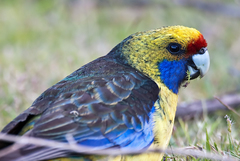
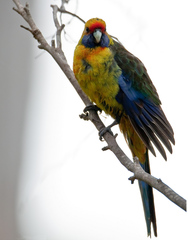
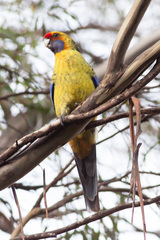
The green rosella or Tasmanian rosella (Platycercus caledonicus) is a species of parrot native to Tasmania and Bass Strait islands. It was described by the German naturalist Johann Friedrich Gmelin in 1788, and named on the mistaken assumption it came from New Caledonia. At 14.5 in (37 cm) long it is the largest species of the rosella genus, Platycercus. Two subspecies are recognised. The green rosella's underparts, neck and head are yellow, with a red band above the beak and violet-blue cheeks. The back is mostly black and green, and its long tail blue and green. The sexes have similar plumage, except the female has duller yellow plumage and more prominent red markings, as well as a smaller beak. Juvenile and immature birds have predominantly green plumage.

Found in a wide range of habitats with some form of tree cover, the green rosella is predominantly herbivorous, consuming seeds, berries, nuts and fruit, as well as flowers, but may also eat insect larvae and insects such as psyllids. Nesting takes place in tree hollows. Common and widespread across Tasmania, the green rosella is rated as least concern on the International Union for Conservation of Nature (IUCN)'s Red List of Endangered species. The King Island subspecies has been classed as vulnerable as its population has declined after much of its habitat on King Island was cleared. Wikipedia →

Sounds

Uncertain0:17

Australia · 2024

© nick talbot · XC893950 · CC BY-NC-SA 4.0

Call0:27

Australia · 2023

© Peter Boesman · XC860078 · CC BY-NC-ND 4.0

Song0:55

Australia · 2020

© Marc Anderson · XC674048 · CC BY-NC-ND 4.0

Global Distribution

Parks Where Found

# Park Country Daily sighting probability
1 Maria Island National Park 🇦🇺 Australia
~80%
2 Cradle Mountain-Lake St Clair National Park 🇦🇺 Australia
~70%
3 Freycinet National Park 🇦🇺 Australia
~50%

Cities Where Found

# City Country Daily sighting probability
1 Hobart 🇦🇺 Australia
~20%

Zoos & Centres Where Found

# Zoo / Centre Country
1 Hobart Zoo and Aquarium 🇦🇺 Australia In captivity
2 Loro Parque 🇪🇸 Spain In captivity
3 Bonorong Wildlife Sanctuary 🇦🇺 Australia In captivity
4 Zoodoo Wildlife Park 🇦🇺 Australia In captivity

Before you go

What are the chances of seeing a Green Rosella in Freycinet National Park?

Likely

About 50% of wildlife watchers report a Green Rosella sighting in Freycinet National Park on a given day, based on 198 verified sightings from GBIF citizen-science data from 2019 to 2026. It is the 9th most-seen of the 72 birds we can rate there. Over three days the chance rises to about 80%, and over a week to over 90%, if each day is a fresh chance.

When is the best time to see a Green Rosella in Freycinet National Park?

May

In that month about 70% of wildlife watchers report a Green Rosella in Freycinet National Park on a given day, against about 30% in January, the lowest month.

What time of day is best to see a Green Rosella?

Between 5 and 8 am

Across all the parks we cover, that three-hour window holds the most Green Rosella sightings with a recorded time, and about 6 in 10 of them come between 6 pm and 6 am: it is most active around dawn and dusk.

Where does the Green Rosella sighting chance come from?

GBIF citizen-science records

It is estimated from how often the Green Rosella is recorded against all the birds logged in Freycinet National Park (198 verified sightings from 2019 to 2026), calibrated against known sighting rates. Figures are rounded to the nearest 10% because citizen-science data supports honest approximations, not decimals, and months with records from fewer than five people show "—". How it works.

← Back to Freycinet National Park