Parkinson's Petrel

Parkinson's Petrel

Procellaria parkinsoni

Silhouette: Alexandre Vong · PhyloPic

LCNTVUVulnerableENCR
Daily sighting probability <5% · Rare
at Galápagos Islands

In 3 days <5%

5 Verified sightings at Galápagos Islands From 2019 to 2026
5 In 1 park
June Best month
☀️ Diurnal When it's spotted

About the Parkinson's Petrel

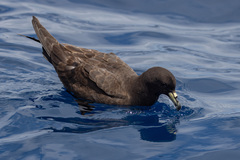
The black petrel (Procellaria parkinsoni), (Māori: tāiko, or tākoketai) also called Parkinson's petrel, is a medium-sized, black-plumaged petrel, the smallest of the Procellaria. The species is an endemic breeder of New Zealand, breeding only on Great Barrier Island and Little Barrier Island, off the North Island. At sea it disperses as far as Australia and Ecuador.

The black petrel was formally described in 1862 by the English zoologist George Robert Gray in a list of birds from New Zealand. He coined the binomial name Procellaria parkinsoni. The genus name is from the Latin procella meaning "storm" or "gale". The specific epithet parkinsoni was chosen to honour the artist and collector Sydney Parkinson. The species is considered to be monotypic: no subspecies are recognised.

The plumage of the black petrel is all black, as are its legs and bill except for pale sections on the bill. It is a medium-sized petrel: males average about 720 g (25 oz), females around 680 g (24 oz). It has an overall length of 46 cm (18 in) and a wingspan averaging 115 cm (45 in).

It is endemic to New Zealand. It was previously found throughout the North... Wikipedia →

Sounds

Call0:04

New Zealand · 2015

© Dan Lane · XC293325 · CC BY-NC-SA 4.0

Recording0:31

New Zealand · 2020

© apburns · iNaturalist · CC BY-NC 4.0

Recording0:17

New Zealand · 2026

© brock · iNaturalist · CC BY-NC 4.0

Global Distribution

Parks Where Found

# Park Country Daily sighting probability
1 Galápagos Islands 🇪🇨 Ecuador
<5%

More parks will be added in future updates.

Before you go

What are the chances of seeing a Parkinson's Petrel in Galápagos Islands?

Rare

Under 5% of wildlife watchers report a Parkinson's Petrel sighting in Galápagos Islands on a given day, based on 5 verified sightings from GBIF citizen-science data from 2019 to 2026. It is the 113th most-seen of the 114 birds we can rate there. Over three days the chance rises to under 5%, if each day is a fresh chance.

When is the best time to see a Parkinson's Petrel in Galápagos Islands?

Any time of year

In every month with enough records, under 5% of wildlife watchers report a Parkinson's Petrel in Galápagos Islands on a given day, so our monthly data shows no clear season.

What time of day is best to see a Parkinson's Petrel?

Between 9 am and noon

Across all the parks we cover, that three-hour window holds the most Parkinson's Petrel sightings with a recorded time, and about 9 in 10 of them come between 6 am and 6 pm: it is a daytime animal.

Where else can you see a Parkinson's Petrel?

Only Galápagos Islands, in our data

Galápagos Islands is the only park on Wallace's Line with enough records to rate Parkinson's Petrel sightings: under 5% of wildlife watchers there report one on a given day.

Which relatives of the Parkinson's Petrel live in Galápagos Islands?

Same family: Procellariidae

The closest relatives of the Parkinson's Petrel that you can see in Galápagos Islands (family Procellariidae, Shearwaters and Petrels) are Galápagos Shearwater (about 50%) and Galápagos Petrel (about 20%), with each one's daily chance of a sighting.

Where does the Parkinson's Petrel sighting chance come from?

GBIF citizen-science records

It is estimated from how often the Parkinson's Petrel is recorded against all the birds logged in Galápagos Islands (5 verified sightings from 2019 to 2026), calibrated against known sighting rates. Figures are rounded to the nearest 10% because citizen-science data supports honest approximations, not decimals, and months with records from fewer than five people show "—". How it works.

← Back to Galápagos Islands