


Completed


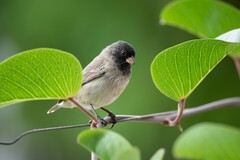

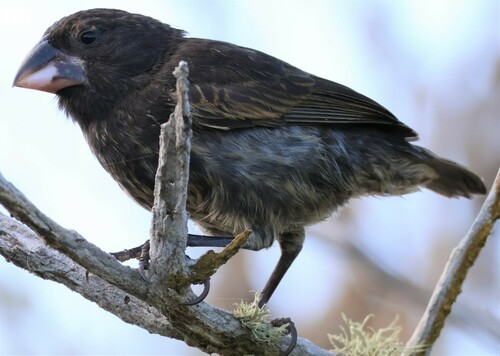
Small Tree-Finch
Camarhynchus parvulus
Silhouette: Sheatherius · PhyloPic
- KingdomAnimalia (Animals)
- PhylumChordata (Chordates)
- ClassAves (Birds)
- OrderPasseriformes (Perching Birds)
- FamilyThraupidae (Tanagers and Allies)
- GenusCamarhynchus (Tree-Finches)
- SpeciesCamarhynchus parvulus (Small Tree-Finch)
In 3 days ~60% in a week ~90%
2,818 Verified sightings at Galápagos Islands From 2019 to 2026
2,818 In 1 park
July Best month
☀️ Diurnal When it's spotted
About the Small Tree-Finch
The small tree finch (Camarhynchus parvulus) is a bird species belonging to the Darwin's finch group within the tanager family Thraupidae. It has a grasping beak with curved culmens. Its natural habitats are subtropical or tropical dry forests and subtropical or tropical dry shrubland. During the non-breeding season it is known to form large groups with small ground-finches.
It is an endemic species to the Galapagos islands and its conservation status has been listed as "Least Concern". However, bird counts which have been conducted since 1997 have shown a continuous decline in small tree-finch populations in the Scalesia and agricultural zones of Santa Cruz, where the small tree-finch is most abundant. Small tree-finch counts have remained stable in the transition zone (also quite abundant here) and in the less popular dry and fern zones on Santa Cruz island. This species is in particularly impacted by the larvae of the parasitic avian vampire fly (Philornis downsi).
The small tree finch is found on all the main islands except Española, Genovesa, Marchena, Darwin, and Wolf. It was also absent in the most recent census (2017–2018) on Rábida, Pinta, and Santa Fé islands... Wikipedia →
Recent sightings of Small Tree-Finch in Galápagos Islands
LIVEiNaturalistGlobal Distribution
Parks Where Found
| # | Park | Country | Daily sighting probability |
|---|---|---|---|
| 1 | Galápagos Islands | 🇪🇨 Ecuador |
More parks will be added in future updates.
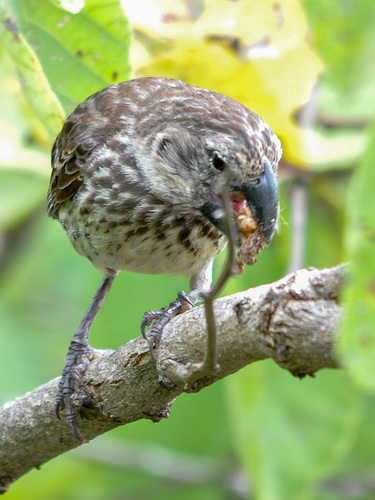
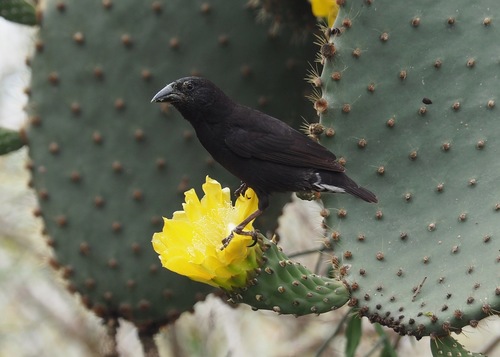
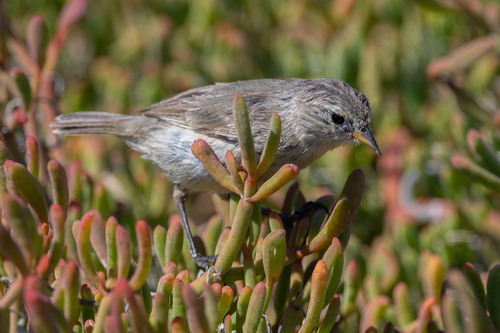
Closest Relatives at Galápagos Islands







Before you go
What are the chances of seeing a Small Tree-Finch in Galápagos Islands?
Possible
About 30% of wildlife watchers report a Small Tree-Finch sighting in Galápagos Islands on a given day, based on 2,818 verified sightings from GBIF citizen-science data from 2019 to 2026. It is the 28th most-seen of the 114 birds we can rate there. Over three days the chance rises to about 60%, and over a week to about 90%, if each day is a fresh chance.
When is the best time to see a Small Tree-Finch in Galápagos Islands?
April, June–July, October and December–January
In those months about 30% of wildlife watchers report a Small Tree-Finch in Galápagos Islands on a given day, against about 20% in February–March, May, August–September and November, the lowest months.
What time of day is best to see a Small Tree-Finch?
Between 8 and 11 am
Across all the parks we cover, that three-hour window holds the most Small Tree-Finch sightings with a recorded time, and about 9 in 10 of them come between 6 am and 6 pm: it is a daytime animal.
Where else can you see a Small Tree-Finch?
Only Galápagos Islands, in our data
Galápagos Islands is the only park on Wallace's Line with enough records to rate Small Tree-Finch sightings: about 30% of wildlife watchers there report one on a given day.
Which relatives of the Small Tree-Finch live in Galápagos Islands?
Same genus: Camarhynchus
The closest relatives of the Small Tree-Finch that you can see in Galápagos Islands (genus Camarhynchus, Tree-Finches) are Woodpecker Finch (about 10%) and Large Tree-Finch (about 10%), with each one's daily chance of a sighting.
Where does the Small Tree-Finch sighting chance come from?
GBIF citizen-science records
It is estimated from how often the Small Tree-Finch is recorded against all the birds logged in Galápagos Islands (2,818 verified sightings from 2019 to 2026), calibrated against known sighting rates. Figures are rounded to the nearest 10% because citizen-science data supports honest approximations, not decimals, and months with records from fewer than five people show "—". How it works.
