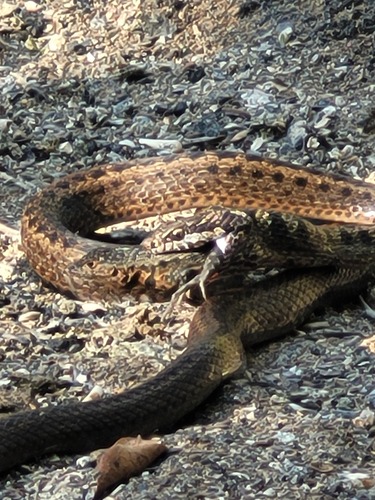
Thomas's Racer

Thomas's Racer

Pseudalsophis thomasi

Silhouette: Alex Slavenko · PhyloPic

Endemic
Daily sighting probability ~10% · With luck
at Galápagos Islands

In 3 days ~20% in a week ~40%

22 Verified sightings at Galápagos Islands From 2019 to 2026
22 In 1 park
January Best month
☀️ Diurnal When it's spotted

About the Thomas's Racer

Pseudalsophis thomasi, or Thomas' racer, a species of snake in the family Colubridae. It is endemic to several islands in the Galápagos group. The genus name Pseudalsophis comes from the name of a genus of Caribbean snakes Alsophis due to their superficial similarities, combined with the Greek word pseudo meaning false. The specific name is in honor of the herpetologist Robert A. Thomas.

Diurnal snakes, active throughout the day with the exception of hot midday hours. They can be found in rocky areas, deciduous forest, and dry grassland habitats. Foraging predators they feed on small animals such as lizards (Microlophus jacobii), geckos (Phyllodactylus maresi), snakes, birds, and insects. Snakes are mildly venomous enough to endanger small prey items but not enough to harm a human. Thomas's Racers have no natural predators however they are preyed upon by introduced black rats.

Thomas's racer is endemic to the islands of Santiago, Bartolomé, and Rábida. Its total estimated range is approximately 459 km2 It is the more common of the two snake species found on Santiago and Rábida, the other being the much rarer Pseudalsophis hephaestus... Wikipedia →
Global Distribution

Parks Where Found

# Park Country Daily sighting probability
1 Galápagos Islands 🇪🇨 Ecuador
~10%

More parks will be added in future updates.

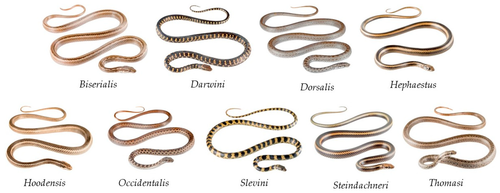
Closest Relatives at Galápagos Islands

Before you go

What are the chances of seeing a Thomas's Racer in Galápagos Islands?

With luck

About 10% of wildlife watchers report a Thomas's Racer sighting in Galápagos Islands on a given day, based on 22 verified sightings from GBIF citizen-science data from 2019 to 2026. It is the 26th most-seen of the 31 reptiles we can rate there. Over three days the chance rises to about 20%, and over a week to about 40%, if each day is a fresh chance.

When is the best time to see a Thomas's Racer in Galápagos Islands?

July and September–April

In those months about 10% of wildlife watchers report a Thomas's Racer in Galápagos Islands on a given day, against under 5% in May–June and August, the lowest months.

What time of day is best to see a Thomas's Racer?

Between 6 and 9 am

Across all the parks we cover, that three-hour window holds the most Thomas's Racer sightings with a recorded time, and about 7 in 10 of them come between 6 am and 6 pm: it is a daytime animal.

Where else can you see a Thomas's Racer?

Only Galápagos Islands, in our data

Galápagos Islands is the only park on Wallace's Line with enough records to rate Thomas's Racer sightings: about 10% of wildlife watchers there report one on a given day.

Which relatives of the Thomas's Racer live in Galápagos Islands?

Same genus: Pseudalsophis

The closest relatives of the Thomas's Racer that you can see in Galápagos Islands (genus Pseudalsophis, Galápagos and Elegant Racers) are Fernandina Racer (about 10%), Striped Galapagos Snake (about 10%) and Santa Cruz Racer (about 10%), with each one's daily chance of a sighting.

Where does the Thomas's Racer sighting chance come from?

GBIF citizen-science records

It is estimated from how often the Thomas's Racer is recorded against all the reptiles logged in Galápagos Islands (22 verified sightings from 2019 to 2026), calibrated against known sighting rates. Figures are rounded to the nearest 10% because citizen-science data supports honest approximations, not decimals, and months with records from fewer than five people show "—". How it works.

← Back to Galápagos Islands