Cape Genet

Cape Genet

Genetta tigrina

Silhouette: Margot Michaud · PhyloPic

LCLeast ConcernNTVUENCR
Daily sighting probability ~10% · With luck
at Garden Route National Park

In 3 days ~30% in a week ~60%

51 Verified sightings at Garden Route National Park From 2019 to 2026
103 In all 2 parks
May Best month
☀️🌙 Day & Night When it's spotted

About the Cape Genet

The Cape genet (Genetta tigrina), also known as the South African large-spotted genet, is a genet species endemic to South Africa. As it is common and not threatened, it is listed as Least Concern on the IUCN Red List. Like other genets, it is nocturnal and arboreal, preferring to live in the riparian zones of forests, as long as these are not marshy areas.

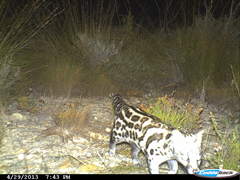
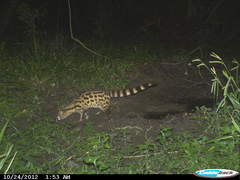
The Cape genet is ash grey with brown irregular spots and a black stripe along the spine. Its muzzle is white, and it has white spots below the eye. Its ears are grey. Its tail is black and white banded with a black tip.

Some individuals living in areas with more than 375 mm (14.8 in) annual precipitation are darker than individuals from drier areas. Measurements of adult males range from 460 to 580 mm (18 to 23 in) in head and body with a 390 to 459 mm (15.4 to 18.1 in) long tail and a weight of 1.6 to 2.1 kg (3.5 to 4.6 lb). Adult females range from 427 to 560 mm (16.8 to 22.0 in) in head and body with a 385 to 432 mm (15.2 to 17.0 in) long tail and a weight of 1.36 to 1.870 kg (3.00 to 4.12 lb).

Like in all Viverrinae, its dental formula is: 3.1.4.23.1.4.2. Like all genets, it has musk glands and anal sacs... Wikipedia →


Global Distribution

Parks Where Found

# Park Country Daily sighting probability
1 Garden Route National Park 🇿🇦 South Africa
~10%
2 Table Mountain National Park 🇿🇦 South Africa
~10%

Cities Where Found

# City Country Daily sighting probability
1 Cape Town 🇿🇦 South Africa
<5%

Zoos & Centres Where Found

# Zoo / Centre Country
1 Cincinnati Zoo and Botanical Garden 🇺🇸 United States In captivity
2 Poznań Nowe Zoo 🇵🇱 Poland In captivity
3 Memphis Zoo 🇺🇸 United States In captivity
4 World of Birds Wildlife Sanctuary and Monkey Park 🇿🇦 South Africa In captivity

Before you go

What are the chances of seeing a Cape Genet in Garden Route National Park?

With luck

About 10% of wildlife watchers report a Cape Genet sighting in Garden Route National Park on a given day, based on 51 verified sightings from GBIF citizen-science data from 2019 to 2026. It is the 7th most-seen of the 35 mammals we can rate there. Over three days the chance rises to about 30%, and over a week to about 60%, if each day is a fresh chance.

When is the best time to see a Cape Genet in Garden Route National Park?

March, May–June, September and November

In those months about 20% of wildlife watchers report a Cape Genet in Garden Route National Park on a given day, against under 5% in August, the lowest month.

What time of day is best to see a Cape Genet?

Between 7 and 10 pm

Across all the parks we cover, that three-hour window holds the most Cape Genet sightings with a recorded time, and about 6 in 10 of them come between 6 pm and 6 am: it is seen both by day and at night.

Is Garden Route National Park the best place to see a Cape Genet?

Yes

Of the 2 parks where we can rate Cape Genet sightings, Garden Route National Park has the highest daily chance: about 10%. Next come Table Mountain National Park (South Africa, about 10%).

Where does the Cape Genet sighting chance come from?

GBIF citizen-science records

It is estimated from how often the Cape Genet is recorded against all the mammals logged in Garden Route National Park (51 verified sightings from 2019 to 2026), calibrated against known sighting rates. Figures are rounded to the nearest 10% because citizen-science data supports honest approximations, not decimals, and months with records from fewer than five people show "—". How it works.

← Back to Garden Route National Park