Egyptian Mongoose

Egyptian Mongoose

Herpestes ichneumon

Silhouette: Margot Michaud · PhyloPic

LCLeast ConcernNTVUENCR
Daily sighting probability ~10% · With luck
at Garden Route National Park

In 3 days ~20% in a week ~30%

8 Verified sightings at Garden Route National Park From 2019 to 2026
27 In all 4 parks
September Best month
☀️ Diurnal When it's spotted

About the Egyptian Mongoose

The Egyptian mongoose (Herpestes ichneumon), also known as ichneumon, is a mongoose species native to the tropical and subtropical grasslands, savannas, and shrublands of Africa and around the Mediterranean Basin in North Africa, the Middle East and the Iberian Peninsula. Whether it is introduced or native to the Iberian Peninsula is in some doubt. Because of its widespread occurrence, it is listed as Least Concern on the IUCN Red List.

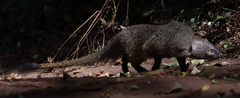
The Egyptian mongoose's long, coarse fur is grey to reddish brown and ticked with brown and yellow flecks. Its snout is pointed, its ears are small. Its slender body is 48–60 cm (1 ft 7 in – 2 ft 0 in) long with a 33–54 cm (1 ft 1 in – 1 ft 9 in) long black tipped tail. Its hind feet and a small area around the eyes are furless. It has 35–40 teeth, with highly developed carnassials, used for shearing meat. It weighs 1.7–4 kg (3.7–8.8 lb).

Sexually dimorphic Egyptian mongooses were observed in Portugal, where some females are smaller than males. Female Egyptian mongooses have 44 chromosomes, and males 43, as one Y chromosome is translocated to an autosome.

The Egyptian mongoose lives in swampy and... Wikipedia →

Global Distribution

Parks Where Found

# Park Country Daily sighting probability
1 Monfragüe National Park 🇪🇸 Spain
~10%
2 Amboseli National Park 🇰🇪 Kenya
~10%
3 Doñana National Park 🇪🇸 Spain
~10%
4 Garden Route National Park 🇿🇦 South Africa
~10%

Zoos & Centres Where Found

# Zoo / Centre Country
1 Friguia Park 🇹🇳 Tunisia In captivity
2 Terra Natura Murcia 🇪🇸 Spain In captivity
3 Valencia Bioparc 🇪🇸 Spain In captivity

Before you go

What are the chances of seeing an Egyptian Mongoose in Garden Route National Park?

With luck

About 10% of wildlife watchers report an Egyptian Mongoose sighting in Garden Route National Park on a given day, based on 8 verified sightings from GBIF citizen-science data from 2019 to 2026. It is the 20th most-seen of the 35 mammals we can rate there. Over three days the chance rises to about 20%, and over a week to about 30%, if each day is a fresh chance.

When is the best time to see an Egyptian Mongoose in Garden Route National Park?

April and July–September

In those months about 10% of wildlife watchers report an Egyptian Mongoose in Garden Route National Park on a given day, against under 5% in May–June and October–March, the lowest months.

What time of day is best to see an Egyptian Mongoose?

Between 1 and 4 pm

Across all the parks we cover, that three-hour window holds the most Egyptian Mongoose sightings with a recorded time, and about 8 in 10 of them come between 6 am and 6 pm: it is a daytime animal.

Is Garden Route National Park the best place to see an Egyptian Mongoose?

Among the best

Of the 4 parks where we can rate Egyptian Mongoose sightings, Garden Route National Park ranks 4th at about 10%, level with the leaders once rounded. The best odds are in Monfragüe National Park (Spain, about 10%), Amboseli National Park (Kenya, about 10%) and Doñana National Park (Spain, about 10%).

Where does the Egyptian Mongoose sighting chance come from?

GBIF citizen-science records

It is estimated from how often the Egyptian Mongoose is recorded against all the mammals logged in Garden Route National Park (8 verified sightings from 2019 to 2026), calibrated against known sighting rates. Figures are rounded to the nearest 10% because citizen-science data supports honest approximations, not decimals, and months with records from fewer than five people show "—". How it works.

← Back to Garden Route National Park