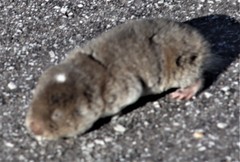
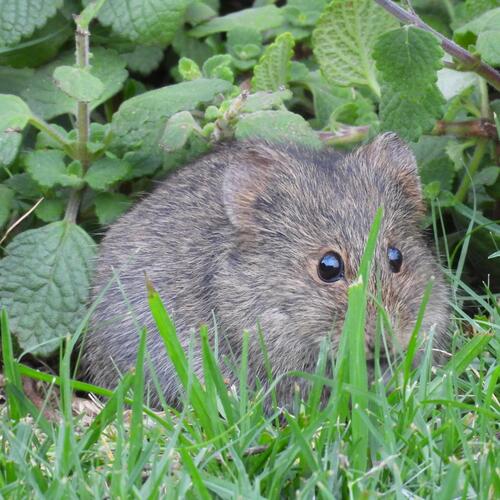
Common Mole Rat

Common Mole Rat

Cryptomys hottentotus

Silhouette: Kai R. Caspar · PhyloPic

LCLeast ConcernNTVUENCR
Daily sighting probability <5% · Rare
at Garden Route National Park

In 3 days ~10% in a week ~30%

6 Verified sightings at Garden Route National Park From 2019 to 2026
6 In 1 park
June Best month
☀️ Diurnal When it's spotted

About the Common Mole Rat

The common mole-rat, African mole-rat, or Hottentot mole-rat, (Cryptomys hottentotus) is a burrowing rodent found in Southern Africa, in particular in the Western Cape province of South Africa. It also occurs in Eswatini, Lesotho, Malawi, Mozambique, Tanzania, Zambia, and Zimbabwe. It is a species in the subfamily Bathyerginae.

René Primevère Lesson was the first to describe the common mole-rat in 1826, based on an animal captured near Paarl, and called it Bathyergus hottentotus. The following year, the Dutch zoologist Anton Brants described a specimen from the eastern part of the Cape Colony which he named Bathyergus caecutiens. In 1828, Andrew Smith described Bathyergus ludwigii. Around 1900 these little mole rats were no longer considered to fit into the genus Bathyergus, and various forms were described in the genus Georychus, namely G. exenticus in 1899 by Édouard Louis Trouessart, G. jorisseni in 1909 by Henry Lyster Jameson, G. albus in 1913 and G. vandamii in 1917, both by Austin Roberts. The same Roberts described two more forms in 1924, but now under the current genus name Cryptomys, namely C. cradockensis and C. transvaalensis. However, the current combination... Wikipedia →

Global Distribution

Parks Where Found

# Park Country Daily sighting probability
1 Garden Route National Park 🇿🇦 South Africa
<5%

More parks will be added in future updates.

Cities Where Found

# City Country Daily sighting probability
1 Pretoria 🇿🇦 South Africa
~10%
2 Johannesburg 🇿🇦 South Africa
~10%
3 Cape Town 🇿🇦 South Africa
<5%

Before you go

What are the chances of seeing a Common Mole Rat in Garden Route National Park?

Rare

Under 5% of wildlife watchers report a Common Mole Rat sighting in Garden Route National Park on a given day, based on 6 verified sightings from GBIF citizen-science data from 2019 to 2026. It is the 28th most-seen of the 35 mammals we can rate there. Over three days the chance rises to about 10%, and over a week to about 30%, if each day is a fresh chance.

When is the best time to see a Common Mole Rat in Garden Route National Park?

February, June, September and December

In those months about 10% of wildlife watchers report a Common Mole Rat in Garden Route National Park on a given day, against under 5% in January, March–May, July–August and October–November, the lowest months.

What time of day is best to see a Common Mole Rat?

Between 9 am and noon

Across all the parks we cover, that three-hour window holds the most Common Mole Rat sightings with a recorded time, and about 9 in 10 of them come between 6 am and 6 pm: it is a daytime animal.

Where else can you see a Common Mole Rat?

Only Garden Route National Park, in our data

Garden Route National Park is the only park on Wallace's Line with enough records to rate Common Mole Rat sightings: under 5% of wildlife watchers there report one on a given day.

Where does the Common Mole Rat sighting chance come from?

GBIF citizen-science records

It is estimated from how often the Common Mole Rat is recorded against all the mammals logged in Garden Route National Park (6 verified sightings from 2019 to 2026), calibrated against known sighting rates. Figures are rounded to the nearest 10% because citizen-science data supports honest approximations, not decimals, and months with records from fewer than five people show "—". How it works.

← Back to Garden Route National Park