Wahlberg's Epauletted Fruit Bat

Wahlberg's Epauletted Fruit Bat

Epomophorus wahlbergi

Silhouette: Steven Traver · PhyloPic

LCLeast ConcernNTVUENCR
Daily sighting probability <5% · Rare
at Garden Route National Park

In 3 days ~10% in a week ~30%

5 Verified sightings at Garden Route National Park From 2019 to 2026
34 In all 3 parks
May Best month
☀️ Diurnal When it's spotted

About the Wahlberg's Epauletted Fruit Bat

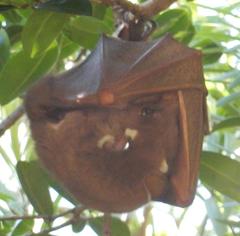
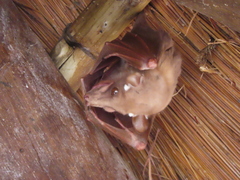
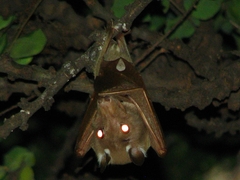
Wahlberg's epauletted fruit bat (Epomophorus wahlbergi) is a species of megabat in the family Pteropodidae. It is commonly found across southern Africa. Wahlberg's epauletted fruit bat is brown to tawny colored with white hair patches at the base of the ears. Males are typically darker in coloration than females. This species is named for erectable epaulettes of hair that form around large scent glands in males only. Males are also distinguished from females by air sacs on the neck that may increase the volume of courtship calls. Scent glands are located near the white ear patches in both sexes. Wings are broad as compared to other bat species. Adult wingspan is 510–600 mm (20–24 in) and 456–540 mm (18.0–21.3 in) for males and females, respectively. Adults weight 54–125 g (1.9–4.4 oz).

The eyes of E. wahlbergi are large. Ears are simple, oval-shaped, and lack a tragus. The nose is also simple, but the lips are highly folded and expansible. Skulls are 44–57 mm (1.7–2.2 in) and 41–49 mm (1.6–1.9 in) long for males and females, respectively.

Species of the genus Epomophorus can be distinguished from other megabats (Family Pteropodidae) by their eponymous white... Wikipedia →

Sounds

Recording0:19

South Africa · 2024

© Errol Douwes · iNaturalist · CC BY-NC 4.0

Recording0:26

South Africa · 2019

© Alex Rebelo · iNaturalist · CC BY-NC 4.0

Recording0:26

South Africa · 2026

© Craig Peter · iNaturalist · CC BY-NC 4.0

Global Distribution

Parks Where Found

# Park Country Daily sighting probability
1 Hluhluwe-Imfolozi Park 🇿🇦 South Africa
~20%
2 iSimangaliso Wetland Park 🇿🇦 South Africa
~10%
3 Garden Route National Park 🇿🇦 South Africa
<5%

Cities Where Found

# City Country Daily sighting probability
1 Durban 🇿🇦 South Africa
~20%
2 Pretoria 🇿🇦 South Africa
~10%
3 Johannesburg 🇿🇦 South Africa
~10%

Closest Relatives at Garden Route National Park

No species of the same family or order lives in Garden Route National Park, so these are its closest relatives here: other mammals.

Before you go

What are the chances of seeing a Wahlberg's Epauletted Fruit Bat in Garden Route National Park?

Rare

Under 5% of wildlife watchers report a Wahlberg's Epauletted Fruit Bat sighting in Garden Route National Park on a given day, based on 5 verified sightings from GBIF citizen-science data from 2019 to 2026. It is the 31st most-seen of the 35 mammals we can rate there. Over three days the chance rises to about 10%, and over a week to about 30%, if each day is a fresh chance.

When is the best time to see a Wahlberg's Epauletted Fruit Bat in Garden Route National Park?

March, May and July

In those months about 10% of wildlife watchers report a Wahlberg's Epauletted Fruit Bat in Garden Route National Park on a given day, against under 5% in April, June and August–February, the lowest months.

What time of day is best to see a Wahlberg's Epauletted Fruit Bat?

Between 9 am and noon

Across all the parks we cover, that three-hour window holds the most Wahlberg's Epauletted Fruit Bat sightings with a recorded time, and about 7 in 10 of them come between 6 am and 6 pm: it is a daytime animal.

Is Garden Route National Park the best place to see a Wahlberg's Epauletted Fruit Bat?

3rd of 3

Of the 3 parks where we can rate Wahlberg's Epauletted Fruit Bat sightings, Garden Route National Park ranks 3rd at under 5%. The best odds are in Hluhluwe-Imfolozi Park (South Africa, about 20%) and iSimangaliso Wetland Park (South Africa, about 10%).

Where does the Wahlberg's Epauletted Fruit Bat sighting chance come from?

GBIF citizen-science records

It is estimated from how often the Wahlberg's Epauletted Fruit Bat is recorded against all the mammals logged in Garden Route National Park (5 verified sightings from 2019 to 2026), calibrated against known sighting rates. Figures are rounded to the nearest 10% because citizen-science data supports honest approximations, not decimals, and months with records from fewer than five people show "—". How it works.

← Back to Garden Route National Park