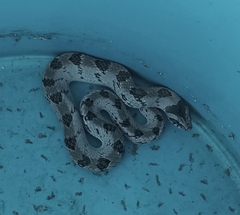
Snouted Night Adder

Snouted Night Adder

Causus defilippii

Silhouette: Steven Traver · PhyloPic

LCLeast ConcernNTVUENCR
Daily sighting probability ~20% · Possible
at Gorongosa National Park

In 3 days ~50% in a week ~80%

5 Verified sightings at Gorongosa National Park From 2019 to 2026
25 In all 2 parks
March Best month
☀️ Diurnal When it's spotted

About the Snouted Night Adder

Causus defilippii, also known commonly as the snouted night adder, is a species of venomous snake in the subfamily Viperinae of the family Viperidae. The species is native to East Africa and Southern Africa. Although its venom is nonlethal to humans, it is still considered medically significant. There are no subspecies that are recognized as being valid.

The specific name, defilippii, is in honor of Italian zoologist Filippo De Filippi. The average total length (including tail) of C. defilippii is 20–35 cm (8–14 in), rarely exceeding 50 cm (20 in). The head is short and wide, and the snout is prominent, pointed and upturned. The rostral is large. The eyes are medium-sized. The circumorbital ring consists of 1–2 preocular scales, 1–2 postoculars and 1–2 suboculars that separate the eye from the supralabials. There are a total of 6–7 supralabials and 7–10 sublabials. The first 3–4 sublabials are in contact with the anterior chin shields. The posterior chin shields are very small and indistinguishable from other posterior scales. The temporal scales number 2+3, sometimes 2+4, and rarely 1+2.

Midbody there are 16–18 rows of weakly keeled dorsal scales that... Wikipedia →

Global Distribution

Parks Where Found

# Park Country Daily sighting probability
1 Gorongosa National Park 🇲🇿 Mozambique
~20%
2 Kruger National Park 🇿🇦 South Africa
~10%

Before you go

What are the chances of seeing a Snouted Night Adder in Gorongosa National Park?

Possible

About 20% of wildlife watchers report a Snouted Night Adder sighting in Gorongosa National Park on a given day, based on 5 verified sightings from GBIF citizen-science data from 2019 to 2026. It is the 10th most-seen of the 11 reptiles we can rate there. Over three days the chance rises to about 50%, and over a week to about 80%, if each day is a fresh chance.

When is the best time to see a Snouted Night Adder in Gorongosa National Park?

March

In that month about 40% of wildlife watchers report a Snouted Night Adder in Gorongosa National Park on a given day, against under 5% in May and July–October, the lowest months. That is one of Gorongosa National Park's wettest months, with about 180 mm of rain against 15 mm in May. January has too few records to rate.

What time of day is best to see a Snouted Night Adder?

Between 6 and 9 am

Across all the parks we cover, that three-hour window holds the most Snouted Night Adder sightings with a recorded time, and about 9 in 10 of them come between 6 am and 6 pm: it is a daytime animal.

Is Gorongosa National Park the best place to see a Snouted Night Adder?

Yes

Of the 2 parks where we can rate Snouted Night Adder sightings, Gorongosa National Park has the highest daily chance: about 20%. Next come Kruger National Park (South Africa, about 10%).

Where does the Snouted Night Adder sighting chance come from?

GBIF citizen-science records

It is estimated from how often the Snouted Night Adder is recorded against all the reptiles logged in Gorongosa National Park (5 verified sightings from 2019 to 2026), calibrated against known sighting rates. Figures are rounded to the nearest 10% because citizen-science data supports honest approximations, not decimals, and months with records from fewer than five people show "—". How it works.

← Back to Gorongosa National Park