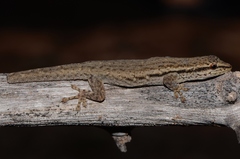
Cape Dwarf Gecko

Cape Dwarf Gecko

Lygodactylus capensis

Silhouette: SeismicShrimp · PhyloPic

LCLeast ConcernNTVUENCR
Daily sighting probability ~30% · Possible
at Gorongosa National Park

In 3 days ~70% in a week ~90%

11 Verified sightings at Gorongosa National Park From 2019 to 2026
1,249 In all 12 parks
June Best month
☀️ Diurnal When it's spotted

About the Cape Dwarf Gecko

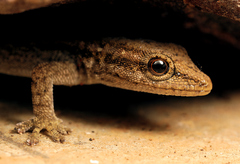
The Cape dwarf gecko (Lygodactylus capensis; 'lygodactylus' = 'flexible fingers') is a species of dwarf gecko found in the woodlands and forests of central and southern Africa. It also occurs commonly in towns and cities and is sometimes kept as a pet.

It occurs in South Africa, Botswana, Eswatini, the Democratic Republic of the Congo, Zambia, Angola, Namibia, Mozambique and Tanzania, including Pemba Island. Its distribution within South Africa has expanded south- and westwards towards the coastal areas since 1981.

They are often seen on garden walls in towns and cities. When moulting it actively assists the process by detaching skin flakes and consuming them. They have the ability to detach their tails from the rest of their bodies as a mechanism for survival. The high observed frequency of tail loss, coupled with rapid and complete regeneration, suggests that caudal autotomy is an important survival tactic in this species. Although caudal autotomy may allow the Cape dwarf gecko to escape its predator, there have been documented downsides to this survival mechanism. For example, the gecko loses its ability to successfully climb vertical surfaces quickly due... Wikipedia →

Global Distribution

Parks Where Found

# Park Country Daily sighting probability
1 Gonarezhou National Park 🇿🇼 Zimbabwe
~40%
2 Garden Route National Park 🇿🇦 South Africa
~30%
3 Liwonde National Park 🇲🇼 Malawi
~30%
4 iSimangaliso Wetland Park 🇿🇦 South Africa
~30%
5 uMkhuze Game Reserve 🇿🇦 South Africa
~30%
6 South Luangwa National Park 🇿🇲 Zambia
~30%
7 Gorongosa National Park 🇲🇿 Mozambique
~30%
8 Kruger National Park 🇿🇦 South Africa
~30%
9 Addo Elephant National Park 🇿🇦 South Africa
~30%
10 Pilanesberg National Park 🇿🇦 South Africa
~20%
11 Table Mountain National Park 🇿🇦 South Africa
~20%
12 Hluhluwe-Imfolozi Park 🇿🇦 South Africa
~20%

Cities Where Found

# City Country Daily sighting probability
1 Pretoria 🇿🇦 South Africa
~50%
2 Maputo 🇲🇿 Mozambique
~50%
3 Johannesburg 🇿🇦 South Africa
~40%
4 Lusaka 🇿🇲 Zambia
~40%
5 Cape Town 🇿🇦 South Africa
~30%
6 Harare 🇿🇼 Zimbabwe
~30%
7 Durban 🇿🇦 South Africa
~20%

Before you go

What are the chances of seeing a Cape Dwarf Gecko in Gorongosa National Park?

Possible

About 30% of wildlife watchers report a Cape Dwarf Gecko sighting in Gorongosa National Park on a given day, based on 11 verified sightings from GBIF citizen-science data from 2019 to 2026. It is the 3rd most-seen of the 11 reptiles we can rate there. Over three days the chance rises to about 70%, and over a week to about 90%, if each day is a fresh chance.

When is the best time to see a Cape Dwarf Gecko in Gorongosa National Park?

June, August and November

In those months about 40% of wildlife watchers report a Cape Dwarf Gecko in Gorongosa National Park on a given day, against under 5% in May and September, the lowest months. Those are among Gorongosa National Park's driest months, with about 45 mm of rain a month against 210 mm in January. January has too few records to rate.

What time of day is best to see a Cape Dwarf Gecko?

Between 8 and 11 am

Across all the parks we cover, that three-hour window holds the most Cape Dwarf Gecko sightings with a recorded time, and nearly all of them come between 6 am and 6 pm: it is a daytime animal.

Where does the Cape Dwarf Gecko sighting chance come from?

GBIF citizen-science records

It is estimated from how often the Cape Dwarf Gecko is recorded against all the reptiles logged in Gorongosa National Park (11 verified sightings from 2019 to 2026), calibrated against known sighting rates. Figures are rounded to the nearest 10% because citizen-science data supports honest approximations, not decimals, and months with records from fewer than five people show "—". How it works.

← Back to Gorongosa National Park