Painted Burrowing Frog

Painted Burrowing Frog

Neobatrachus pictus

Silhouette: Dmitry Bogdanov (vectorized by T. Michael Keesey) · PhyloPic

LCLeast ConcernNTVUENCR Endemic
Daily sighting probability ~10% · With luck
at Grampians National Park

In 3 days ~30% in a week ~50%

6 Verified sightings at Grampians National Park From 2019 to 2026
13 In all 2 parks
April Best month
🌙 Nocturnal When it's spotted

About the Painted Burrowing Frog

The painted burrowing frog (Neobatrachus pictus) is a species of burrowing frog native to western Victoria, eastern South Australia and southern New South Wales. They are also one of six species of frog which inhabit Kangaroo Island.

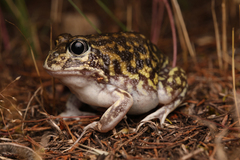
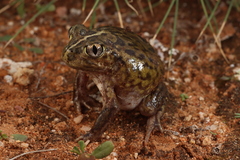
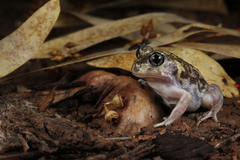
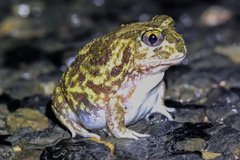
The painted burrowing frog is a moderate sized plump frog, reaching 55 mm in length. It is grey to yellow above with brown, olive or green patches. There is sometimes a thin, paler stripe running down the back. The belly is white. The rear toes are partially webbed and the metatarsal tubercles (shovel like structures on the heel of the foot to assist with burrowing) are completely black. The pupil is a vertical slit when contracted, and the iris is silver to gold.

Painted burrowing frogs inhabit waterholes, dams or pools of watercourses in woodland, grassland, and cleared areas. Males make an elongated trilling sound while floating in water after heavy rains, mainly in winter and autumn. Like other Neobatrachus the species is an adapted burrower and will often spend periods of time underground to avoid drought conditions.

Eggs are laid as loosely adherent clumps which may break apart. Tadpoles are large and... Wikipedia →

Sounds

Recording0:16

Australia · 2025

© patrickwhite57 · iNaturalist · CC BY-NC 4.0

Recording0:31

Australia · 2023

© Kelly O'Day · iNaturalist · CC BY-NC 4.0

Recording0:58

Australia · 2023

© Jessica · iNaturalist · CC BY-NC 4.0

Global Distribution

Parks Where Found

# Park Country Daily sighting probability
1 Flinders Chase 🇦🇺 Australia
~20%
2 Grampians National Park 🇦🇺 Australia
~10%

Before you go

What are the chances of seeing a Painted Burrowing Frog in Grampians National Park?

With luck

About 10% of wildlife watchers report a Painted Burrowing Frog sighting in Grampians National Park on a given day, based on 6 verified sightings from GBIF citizen-science data from 2019 to 2026. It is the 4th most-seen of the 5 amphibians we can rate there. Over three days the chance rises to about 30%, and over a week to about 50%, if each day is a fresh chance.

When is the best time to see a Painted Burrowing Frog in Grampians National Park?

February, April and July–August

In those months about 20% of wildlife watchers report a Painted Burrowing Frog in Grampians National Park on a given day, against under 5% in March, May–June, September and November–January, the lowest months.

What time of day is best to see a Painted Burrowing Frog?

Between 7 and 10 pm

Across all the parks we cover, that three-hour window holds the most Painted Burrowing Frog sightings with a recorded time, and about 9 in 10 of them come between 6 pm and 6 am: it is mostly seen at night.

Is Grampians National Park the best place to see a Painted Burrowing Frog?

2nd of 2

Of the 2 parks where we can rate Painted Burrowing Frog sightings, Grampians National Park ranks 2nd at about 10%. The best odds are in Flinders Chase (Australia, about 20%).

Which relatives of the Painted Burrowing Frog live in Grampians National Park?

Same family: Limnodynastidae

The closest relatives of the Painted Burrowing Frog that you can see in Grampians National Park (family Limnodynastidae, Foam-nesting Ground Frogs) are Pobblebonk (about 30%) and Spotted Grass Frog (about 10%), with each one's daily chance of a sighting.

Where does the Painted Burrowing Frog sighting chance come from?

GBIF citizen-science records

It is estimated from how often the Painted Burrowing Frog is recorded against all the amphibians logged in Grampians National Park (6 verified sightings from 2019 to 2026), calibrated against known sighting rates. Figures are rounded to the nearest 10% because citizen-science data supports honest approximations, not decimals, and months with records from fewer than five people show "—". How it works.

← Back to Grampians National Park