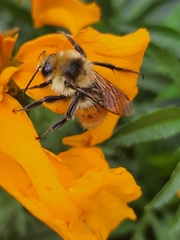
Hunt's Bumble Bee
Daily sighting probability ~20% · Possible
at Grand Canyon National Park

In 3 days ~40% in a week ~70%

46 Verified sightings at Grand Canyon National Park From 2019 to 2026
189 In all 6 parks
July Best month
☀️ Diurnal When it's spotted

About the Hunt's Bumble Bee

Bombus huntii is a species of bumblebee. It is native to western North America, where it occurs in western Canada and the United States as far east as Ontario and Minnesota, and in Mexico as far south as the Trans-Mexican Volcanic Belt. It is known commonly as the Hunt bumblebee or Hunt's bumblebee. This bee's whole genome has been recently sequenced as part of the Beenome100 project.

This bee lives in desert scrub, prairies, and meadows. In the southern part of its range in Mexico it lives in pine ecosystems and it can be found at high elevations, such as the tops of tall volcanoes. The bee is active in summer and fall, and in Mexico it flies throughout much of the year. It nests underground in colonies consisting of a queen, workers, males, and new queens. Colonies only last one-year, with only mated queens overwintering.

Food plants visited by this species include rabbitbrush, thistles, sunflowers, penstemons, phacelias, currants, rudbeckias, and clovers. This species has experienced declines, but it is still one of the more common bees of western North America.

This bumblebee is susceptible to certain viruses that infect honey bees, such as Black Queen Cell Virus (BQCV) and Deformed Wing Virus (DWV). Experiments suggest that this and other native species make efficient pollinators of crop plants such as tomatoes, and that commercial rearing would be a viable alternative to introducing non-native bees for the purpose. Wikipedia →

Global Distribution

Parks Where Found

# Park Country Daily sighting probability
1 Reserva de la Biosfera Mariposa Monarca 🇲🇽 Mexico
~30%
2 Grand Canyon National Park 🇺🇸 United States
~20%
3 Rocky Mountain National Park 🇺🇸 United States
~10%
4 Zion National Park 🇺🇸 United States
~10%
5 Grand Teton National Park 🇺🇸 United States
~10%
6 Yellowstone National Park 🇺🇸 United States
~10%

Cities Where Found

# City Country Daily sighting probability
1 Calgary 🇨🇦 Canada
~30%
2 Salt Lake City 🇺🇸 United States
~30%
3 Denver 🇺🇸 United States
~20%
4 Edmonton 🇨🇦 Canada
~10%

Before you go

What are the chances of seeing a Hunt's Bumble Bee in Grand Canyon National Park?

Possible

About 20% of wildlife watchers report a Hunt's Bumble Bee sighting in Grand Canyon National Park on a given day, based on 46 verified sightings from GBIF citizen-science data from 2019 to 2026. It is the 12th most-seen of the 143 insects we can rate there. Over three days the chance rises to about 40%, and over a week to about 70%, if each day is a fresh chance.

When is the best time to see a Hunt's Bumble Bee in Grand Canyon National Park?

July

In that month about 30% of wildlife watchers report a Hunt's Bumble Bee in Grand Canyon National Park on a given day, against under 5% in November to March, the lowest months.

What time of day is best to see a Hunt's Bumble Bee?

Between noon and 3 pm

Across all the parks we cover, that three-hour window holds the most Hunt's Bumble Bee sightings with a recorded time, and about 9 in 10 of them come between 6 am and 6 pm: it is a daytime animal.

Is Grand Canyon National Park the best place to see a Hunt's Bumble Bee?

2nd of 6

Of the 6 parks where we can rate Hunt's Bumble Bee sightings, Grand Canyon National Park ranks 2nd at about 20%. The best odds are in Reserva de la Biosfera Mariposa Monarca (Mexico, about 30%).

Which relatives of the Hunt's Bumble Bee live in Grand Canyon National Park?

Same genus: Bombus

The closest relatives of the Hunt's Bumble Bee that you can see in Grand Canyon National Park (genus Bombus, Bumble Bees) are Morrison's Bumble Bee (about 20%) and Nevada Bumble Bee (about 10%), with each one's daily chance of a sighting.

Where does the Hunt's Bumble Bee sighting chance come from?

GBIF citizen-science records

It is estimated from how often the Hunt's Bumble Bee is recorded against all the insects logged in Grand Canyon National Park (46 verified sightings from 2019 to 2026), calibrated against known sighting rates. Figures are rounded to the nearest 10% because citizen-science data supports honest approximations, not decimals, and months with records from fewer than five people show "—". How it works.

← Back to Grand Canyon National Park