
Sunburst Diving Beetle

Sunburst Diving Beetle

Thermonectus marmoratus

Daily sighting probability ~10% · With luck
at Grand Canyon National Park

In 3 days ~20% in a week ~40%

10 Verified sightings at Grand Canyon National Park From 2019 to 2026
62 In all 3 parks
July Best month
☀️ Diurnal When it's spotted

About the Sunburst Diving Beetle

Thermonectus marmoratus is a relatively colorful North American species of diving beetle known by the common names sunburst diving beetle and yellow-spotted diving beetle. The behavior of this diving beetle has been compared to a scuba diver, since it carries with it a bubble of air as it dives down into the water. Its aquatic larval stage was the first ever recorded use of bifocals in the animal world. The beetle uses in its principal eyes two retinas and two distinct focal planes that are substantially separated, in the manner of bifocals to switch their vision from up-close to distance, for easy and efficient capture of their prey.

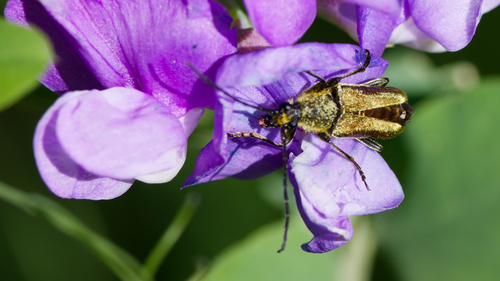
Because of their bright aposematic colors, they are often displayed in zoos, sometimes together with Abedus herberti (also found together in the wild) and other aquatic beetles. The adult beetle has a length of 0.8–1.5 cm (0.31–0.59 in), with females slightly larger than males. The sunburst diving beetle has a black and streamlined carapace covered with bright yellow or golden spots. The male has a suction disk on each foreleg.

The sunburst diving beetle's distinctive yellow spots on a black background... Wikipedia →

Global Distribution

Parks Where Found

# Park Country Daily sighting probability
1 Saguaro National Park 🇺🇸 United States
~10%
2 Grand Canyon National Park 🇺🇸 United States
~10%
3 Cumbres de Monterrey National Park 🇲🇽 Mexico
<5%

Before you go

What are the chances of seeing a Sunburst Diving Beetle in Grand Canyon National Park?

With luck

About 10% of wildlife watchers report a Sunburst Diving Beetle sighting in Grand Canyon National Park on a given day, based on 10 verified sightings from GBIF citizen-science data from 2019 to 2026. It is the 68th most-seen of the 143 insects we can rate there. Over three days the chance rises to about 20%, and over a week to about 40%, if each day is a fresh chance.

When is the best time to see a Sunburst Diving Beetle in Grand Canyon National Park?

April to October

In those months about 10% of wildlife watchers report a Sunburst Diving Beetle in Grand Canyon National Park on a given day, against under 5% in November to March, the lowest months.

What time of day is best to see a Sunburst Diving Beetle?

Between 9 am and noon

Across all the parks we cover, that three-hour window holds the most Sunburst Diving Beetle sightings with a recorded time, and about 9 in 10 of them come between 6 am and 6 pm: it is a daytime animal.

Is Grand Canyon National Park the best place to see a Sunburst Diving Beetle?

Among the best

Of the 3 parks where we can rate Sunburst Diving Beetle sightings, Grand Canyon National Park ranks 2nd at about 10%, level with the leaders once rounded. The best odds are in Saguaro National Park (United States, about 10%).

Where does the Sunburst Diving Beetle sighting chance come from?

GBIF citizen-science records

It is estimated from how often the Sunburst Diving Beetle is recorded against all the insects logged in Grand Canyon National Park (10 verified sightings from 2019 to 2026), calibrated against known sighting rates. Figures are rounded to the nearest 10% because citizen-science data supports honest approximations, not decimals, and months with records from fewer than five people show "—". How it works.

← Back to Grand Canyon National Park