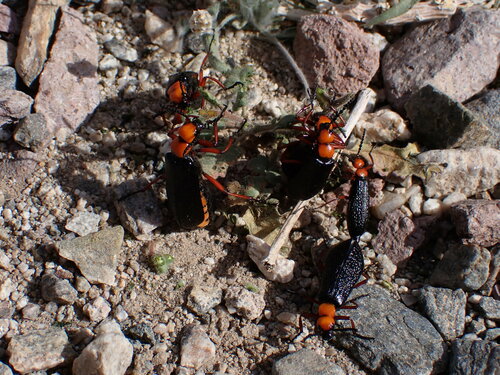
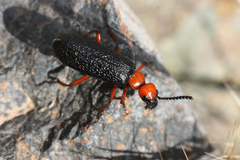
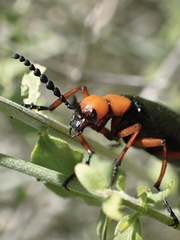
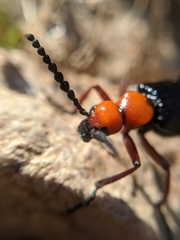

Master Blister Beetle

Master Blister Beetle

Lytta magister

Daily sighting probability ~10% · With luck
at Grand Canyon National Park

In 3 days ~20% in a week ~50%

15 Verified sightings at Grand Canyon National Park From 2019 to 2026
269 In all 4 parks
April Best month
☀️ Diurnal When it's spotted

About the Master Blister Beetle

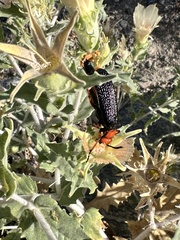
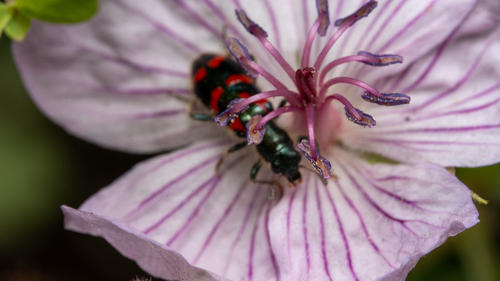
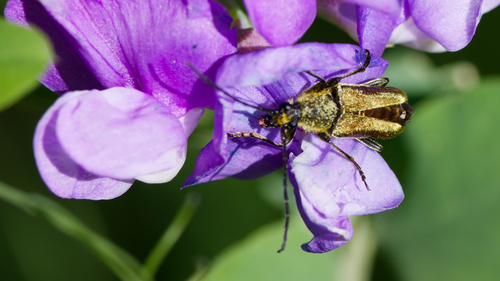
Lytta magister, the desert blister beetle or master blister beetle, is a species of blister beetle found in southwestern North America. Typically 16 to 33 mm (0.6 to 1.3 in) in length, L. magister has a striking red head, legs and prothorax, with black elytra. They can be found in great numbers in the Mojave and Colorado Deserts in spring, and are often seen in swarms.

Females lay eggs in holes in the desert soil. The larvae are insectivorous, mainly attacking bee nests. They consume the immature host along with its provisions, and can often survive on the provisions alone, thus they are not obligatory parasitoids but rather food parasites that are facultatively parasitoid, or simply predatory. Adults feed on flowers and leaves of brittlebush. Though they are not venomous, they can in fact bite. Wikipedia →

Global Distribution

Parks Where Found

# Park Country Daily sighting probability
1 Death Valley National Park 🇺🇸 United States
~40%
2 Joshua Tree National Park 🇺🇸 United States
~20%
3 Grand Canyon National Park 🇺🇸 United States
~10%
4 Saguaro National Park 🇺🇸 United States
~10%

Cities Where Found

# City Country Daily sighting probability
1 Phoenix 🇺🇸 United States
~10%
2 Mesa 🇺🇸 United States
~10%
3 Las Vegas 🇺🇸 United States
~10%

Before you go

What are the chances of seeing a Master Blister Beetle in Grand Canyon National Park?

With luck

About 10% of wildlife watchers report a Master Blister Beetle sighting in Grand Canyon National Park on a given day, based on 15 verified sightings from GBIF citizen-science data from 2019 to 2026. It is the 51st most-seen of the 143 insects we can rate there. Over three days the chance rises to about 20%, and over a week to about 50%, if each day is a fresh chance.

When is the best time to see a Master Blister Beetle in Grand Canyon National Park?

April and May

In those months about 20% of wildlife watchers report a Master Blister Beetle in Grand Canyon National Park on a given day, against under 5% in June to February, the lowest months. Those are among Grand Canyon National Park's driest months, with about 10 mm of rain a month against 40 mm in March.

What time of day is best to see a Master Blister Beetle?

Between 10 am and 1 pm

Across all the parks we cover, that three-hour window holds the most Master Blister Beetle sightings with a recorded time, and about 9 in 10 of them come between 6 am and 6 pm: it is a daytime animal.

Is Grand Canyon National Park the best place to see a Master Blister Beetle?

3rd of 4

Of the 4 parks where we can rate Master Blister Beetle sightings, Grand Canyon National Park ranks 3rd at about 10%. The best odds are in Death Valley National Park (United States, about 40%) and Joshua Tree National Park (United States, about 20%).

Where does the Master Blister Beetle sighting chance come from?

GBIF citizen-science records

It is estimated from how often the Master Blister Beetle is recorded against all the insects logged in Grand Canyon National Park (15 verified sightings from 2019 to 2026), calibrated against known sighting rates. Figures are rounded to the nearest 10% because citizen-science data supports honest approximations, not decimals, and months with records from fewer than five people show "—". How it works.

← Back to Grand Canyon National Park