Boreal Chorus Frog

Boreal Chorus Frog

Pseudacris maculata

Silhouette: Beth Reinke · PhyloPic

LCLeast ConcernNTVUENCR
Daily sighting probability ~10% · With luck
at Grand Teton National Park

In 3 days ~40% in a week ~60%

24 Verified sightings at Grand Teton National Park From 2019 to 2026
307 In all 7 parks
May Best month
☀️ Diurnal When it's spotted

About the Boreal Chorus Frog

The boreal chorus frog (Pseudacris maculata) is a species of chorus frog native to Canada from central Quebec to eastern British Columbia and north to the Northwest Territories and the southern portion of the Yukon. It occurs in the USA throughout Montana, Minnesota, northwestern Wisconsin, northeastern Arizona, northern New Mexico, and southwestern Utah.

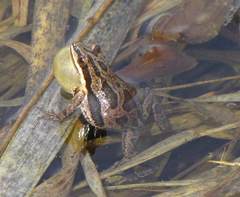
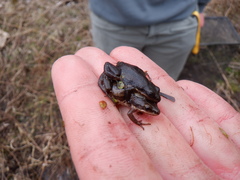
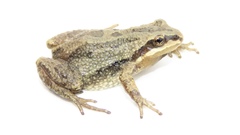
This small species of frog reaches about 30 mm in length. It is highly variable, but is normally brown, and can be green on the dorsal surface, with three broken dorsal stripes; these stripes can be very distinct to quite faint. A dark band is present from the snout, across the eye, and continuing down the side. It has slightly enlarged toe pads to help in climbing small grasses and vegetation. This species is very similar to the western chorus frog (Pseudacris triseriata). It can be distinguished from this species by having shorter legs.

This species can be found around permanent water bodies in cleared land and forest. Males make a "reeeek" call from grasses, vegetation, or ground around the water body from April through to September. This call is characteristic of the trilling frog clade... Wikipedia →

Sounds

Recording1:30

United States · 2013

© Jonathon Jongsma · XC138641 · CC BY-SA 3.0

Recording0:11

Canada · 2015

© Julie · XC298506 · CC BY-NC-SA 4.0

Recording0:05

United States · 2026

© professorquercus · iNaturalist · CC BY-NC 4.0

Global Distribution

Parks Where Found

# Park Country Daily sighting probability
1 Wood Buffalo National Park 🇨🇦 Canada
~40%
2 Elk Island National Park 🇨🇦 Canada
~40%
3 Riding Mountain National Park 🇨🇦 Canada
~20%
4 Badlands National Park 🇺🇸 United States
~10%
5 Grand Teton National Park 🇺🇸 United States
~10%
6 Yellowstone National Park 🇺🇸 United States
~10%
7 Rocky Mountain National Park 🇺🇸 United States
~10%

Cities Where Found

# City Country Daily sighting probability
1 Minneapolis [Saint Paul] 🇺🇸 United States
~10%
2 Edmonton 🇨🇦 Canada
~10%
3 Calgary 🇨🇦 Canada
~10%
4 Denver 🇺🇸 United States
~10%
5 Chicago 🇺🇸 United States
<5%
6 Montreal 🇨🇦 Canada
<5%
7 Toronto 🇨🇦 Canada
<5%

Before you go

What are the chances of seeing a Boreal Chorus Frog in Grand Teton National Park?

With luck

About 10% of wildlife watchers report a Boreal Chorus Frog sighting in Grand Teton National Park on a given day, based on 24 verified sightings from GBIF citizen-science data from 2019 to 2026. It is the 3rd most-seen of the 5 amphibians we can rate there. Over three days the chance rises to about 40%, and over a week to about 60%, if each day is a fresh chance.

When is the best time to see a Boreal Chorus Frog in Grand Teton National Park?

May and June

In those months about 20% of wildlife watchers report a Boreal Chorus Frog in Grand Teton National Park on a given day, against under 5% in September and November–April, the lowest months.

What time of day is best to see a Boreal Chorus Frog?

Between 1 and 4 pm

Across all the parks we cover, that three-hour window holds the most Boreal Chorus Frog sightings with a recorded time, and about 7 in 10 of them come between 6 am and 6 pm: it is a daytime animal.

Which relatives of the Boreal Chorus Frog live in Grand Teton National Park?

Same order: Anura

The closest relatives of the Boreal Chorus Frog that you can see in Grand Teton National Park (order Anura, Frogs and Toads) are Columbia Spotted Frog (about 20%), Western Toad (about 20%) and American Bullfrog (about 10%), with each one's daily chance of a sighting.

Where does the Boreal Chorus Frog sighting chance come from?

GBIF citizen-science records

It is estimated from how often the Boreal Chorus Frog is recorded against all the amphibians logged in Grand Teton National Park (24 verified sightings from 2019 to 2026), calibrated against known sighting rates. Figures are rounded to the nearest 10% because citizen-science data supports honest approximations, not decimals, and months with records from fewer than five people show "—". How it works.

← Back to Grand Teton National Park