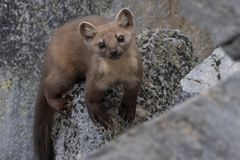
Pacific Marten

Pacific Marten

Martes caurina

Silhouette: Margot Michaud · PhyloPic

Daily sighting probability ~20% · Possible
at Grand Teton National Park

In 3 days ~50% in a week ~80%

42 Verified sightings at Grand Teton National Park From 2019 to 2026
195 In all 6 parks
February Best month
☀️ Diurnal When it's spotted

About the Pacific Marten

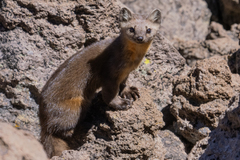
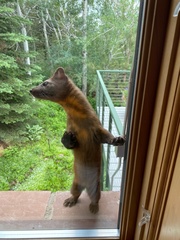
The Pacific marten (Martes caurina) is a species of North American mammal, a member of the family Mustelidae. It is found throughout western North America. The species was formerly considered conspecific with the American marten (M. americana), but several studies using molecular genetics indicate that M. caurina is a distinct species from it, and it has since been recognized as such by the American Society of Mammalogists. The two species also have some morphological differences, with M. caurina having a shorter rostrum and a broader cranial shape. The two species are thought to have diverged during the Last Glacial Maximum after being isolated from one another in glacial refugia.

Seven subspecies have been recognized based on fossil history, cranial analysis, and mitochondrial DNA analysis. None of the subspecies are separable based on morphology, and subspecies taxonomy is usually ignored except with regards to conservation issues centered around subspecies rather than ranges.

Martes caurina subspecies group: M. c. caurina (Merriam) - western British Columbia, Washington, and Oregon; M. c. humboldtensis (Grinnell and Dixon) - northwestern California... Wikipedia →

Sounds

Recording1:12

Canada · 2026

davidbroadland · iNaturalist · CC0

Global Distribution

Parks Where Found

# Park Country Daily sighting probability
1 Grand Teton National Park 🇺🇸 United States
~20%
2 Rocky Mountain National Park 🇺🇸 United States
~10%
3 Great Bear Rainforest 🇨🇦 Canada
~10%
4 Yellowstone National Park 🇺🇸 United States
~10%
5 Sequoia and Kings Canyon National Parks 🇺🇸 United States
~10%
6 Yosemite National Park 🇺🇸 United States
~10%

Zoos & Centres Where Found

# Zoo / Centre Country
1 Northwest Trek Wildlife Park 🇺🇸 United States In captivity

Before you go

What are the chances of seeing a Pacific Marten in Grand Teton National Park?

Possible

About 20% of wildlife watchers report a Pacific Marten sighting in Grand Teton National Park on a given day, based on 42 verified sightings from GBIF citizen-science data from 2019 to 2026. It is the 18th most-seen of the 28 mammals we can rate there. Over three days the chance rises to about 50%, and over a week to about 80%, if each day is a fresh chance.

When is the best time to see a Pacific Marten in Grand Teton National Park?

January and February

In those months about 40% of wildlife watchers report a Pacific Marten in Grand Teton National Park on a given day, against under 5% in December, the lowest month.

What time of day is best to see a Pacific Marten?

Between 10 am and 1 pm

Across all the parks we cover, that three-hour window holds the most Pacific Marten sightings with a recorded time, and about 8 in 10 of them come between 6 am and 6 pm: it is a daytime animal.

Is Grand Teton National Park the best place to see a Pacific Marten?

Yes

Of the 6 parks where we can rate Pacific Marten sightings, Grand Teton National Park has the highest daily chance: about 20%. Next come Rocky Mountain National Park (United States, about 10%) and Great Bear Rainforest (Canada, about 10%).

Which relatives of the Pacific Marten live in Grand Teton National Park?

Same family: Mustelidae

The closest relatives of the Pacific Marten that you can see in Grand Teton National Park (family Mustelidae, Mustelids) are Northern River Otter (about 10%) and American Badger (about 10%), with each one's daily chance of a sighting.

Where does the Pacific Marten sighting chance come from?

GBIF citizen-science records

It is estimated from how often the Pacific Marten is recorded against all the mammals logged in Grand Teton National Park (42 verified sightings from 2019 to 2026), calibrated against known sighting rates. Figures are rounded to the nearest 10% because citizen-science data supports honest approximations, not decimals, and months with records from fewer than five people show "—". How it works.

← Back to Grand Teton National Park