Killer Whale

Killer Whale

Orcinus orca

Silhouette: Chris huh · PhyloPic

Daily sighting probability ~40% · Likely
at Great Bear Rainforest

In 3 days ~80% in a week >90%

336 Verified sightings at Great Bear Rainforest From 2019 to 2026
607 In all 9 parks
August Best month
☀️ Diurnal When it's spotted

About the Killer Whale

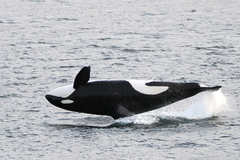
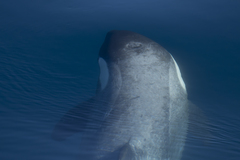
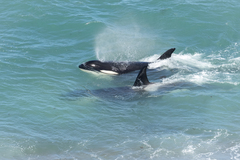
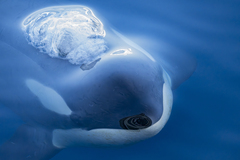
The orca (Orcinus orca), or killer whale, is a toothed whale and the largest member of the oceanic dolphin family. The only extant species in the genus Orcinus, it is recognizable by its distinct pigmentation; being mostly black on top, white on the bottom and having recognizable white eye patches. A cosmopolitan species, it inhabits a wide range of marine environments, from Arctic to Antarctic regions to tropical seas, but is more commonly documented in temperate or cooler coastal waters. Scientists have proposed dividing the global population into races, subspecies, or possibly even species.

Orcas are apex predators with a diverse diet. Individual populations often specialize in particular types of prey, including bony fish, sharks, rays, and marine mammals such as seals, dolphins, and whales. They are highly social, with some populations forming stable matrilineal family groups (pods). Their sophisticated hunting techniques and vocal behaviours, often unique to specific groups and passed down from generation to generation, are considered to be manifestations of animal culture. The most studied populations are off the west coast of North America, which include fish-eating "residents", mammal-eating "transients", and offshores.

The International Union for Conservation of Nature (IUCN) lists the orca's conservation status as data deficient as multiple orca types may represent distinct species. Some local populations are threatened or endangered due to prey depletion, habitat loss, pollution (by PCBs), captures for marine parks, and conflicts with fisheries. In late 2005, the southern resident orcas were added to the US Endangered Species list.

Orcas have been revered by indigenous peoples from regions including the Pacific Northwest, Australia and Peru, while Western cultures have historically feared them. They have been taken by whalers when stocks of larger species have declined. The orca's image took a positive turn in the 1960s, due to greater public and scientific awareness and their display in captivity. Since then, orcas have been trained to perform in marine parks, a practice that has been criticized as unethical. Orcas rarely pose a threat to humans, and no fatal attack has been recorded in the wild. However, captive orcas have injured or killed their handlers in marine theme parks. Wikipedia →

Sounds

Recording0:42

United States · 2026

© naturebynancy · iNaturalist · CC BY-NC 4.0

Recording0:09

Canada · 2024

© Liam Ragan · iNaturalist · CC BY-NC 4.0

Global Distribution

Parks Where Found

# Park Country Daily sighting probability
1 Kenai Fjords National Park 🇺🇸 United States
~70%
2 Península Valdés 🇦🇷 Argentina
~60%
3 Great Bear Rainforest 🇨🇦 Canada
~40%
4 Pacific Rim National Park Reserve 🇨🇦 Canada
~20%
5 Bahía de Loreto National Park 🇲🇽 Mexico
~10%
6 Galápagos Islands 🇪🇨 Ecuador
~10%
7 Olympic National Park 🇺🇸 United States
~10%
8 Channel Islands National Park 🇺🇸 United States
~10%
9 Table Mountain National Park 🇿🇦 South Africa
<5%

Cities Where Found

# City Country Daily sighting probability
1 Vancouver 🇨🇦 Canada
<5%
2 Auckland 🇳🇿 New Zealand
<5%

Zoos & Centres Where Found

# Zoo / Centre Country
1 Zhuhai Chimelong Ocean Kingdom 🇨🇳 China In captivity
2 Shanghai Haichang Ocean Park 🇨🇳 China In captivity
3 SeaWorld Orlando 🇺🇸 United States In captivity
4 Chimelong Spaceship 🇨🇳 China In captivity
5 SeaWorld San Diego 🇺🇸 United States In captivity
6 California Academy of Sciences 🇺🇸 United States In captivity
7 Zoo Miami 🇺🇸 United States In captivity
8 SeaWorld San Antonio 🇺🇸 United States In captivity
9 Mundo Marino 🇦🇷 Argentina In captivity
10 San Francisco Zoo 🇺🇸 United States In captivity
11 San Antonio Zoo 🇺🇸 United States In captivity
12 Loro Parque 🇪🇸 Spain In captivity
13 Discovery Cove 🇺🇸 United States In captivity
14 Marineland (closed) 🇫🇷 France In captivity
15 Kamogawa Sea World 🇯🇵 Japan In captivity
16 Port of Nagoya Public Aquarium 🇯🇵 Japan In captivity
17 Moskvarium 🇷🇺 Russia In captivity
18 海兽馆 🇨🇳 China In captivity
19 Miami Seaquarium 🇺🇸 United States In captivity
20 San Antonio Aquarium 🇺🇸 United States In captivity
21 Taiji Whale Museum 🇯🇵 Japan In captivity

Before you go

What are the chances of seeing a Killer Whale in Great Bear Rainforest?

Likely

About 40% of wildlife watchers report a Killer Whale sighting in Great Bear Rainforest on a given day, based on 336 verified sightings from GBIF citizen-science data from 2019 to 2026. It is the 5th most-seen of the 35 mammals we can rate there. Over three days the chance rises to about 80%, and over a week to over 90%, if each day is a fresh chance.

When is the best time to see a Killer Whale in Great Bear Rainforest?

August and September

In those months about 50% of wildlife watchers report a Killer Whale in Great Bear Rainforest on a given day, against about 10% in January and November, the lowest months.

What time of day is best to see a Killer Whale?

Between 2 and 5 pm

Across all the parks we cover, that three-hour window holds the most Killer Whale sightings with a recorded time, and about 8 in 10 of them come between 6 am and 6 pm: it is a daytime animal.

Is Great Bear Rainforest the best place to see a Killer Whale?

3rd of 9

Of the 9 parks where we can rate Killer Whale sightings, Great Bear Rainforest ranks 3rd at about 40%. The best odds are in Kenai Fjords National Park (United States, about 70%) and Península Valdés (Argentina, about 60%). All parks ranked.

Which relatives of the Killer Whale live in Great Bear Rainforest?

Same order: Cetacea

The closest relatives of the Killer Whale that you can see in Great Bear Rainforest (order Cetacea) are Humpback Whale (about 50%), Dall's Porpoise (about 20%) and Common Porpoise (about 10%), with each one's daily chance of a sighting.

Where does the Killer Whale sighting chance come from?

GBIF citizen-science records

It is estimated from how often the Killer Whale is recorded against all the mammals logged in Great Bear Rainforest (336 verified sightings from 2019 to 2026), calibrated against known sighting rates. Figures are rounded to the nearest 10% because citizen-science data supports honest approximations, not decimals, and months with records from fewer than five people show "—". How it works.

← Back to Great Bear Rainforest