Feather-tailed Glider

Feather-tailed Glider

Acrobates pygmaeus

Silhouette: Sarah Werning · PhyloPic

LCLeast ConcernNTVUENCR Endemic
Daily sighting probability ~10% · With luck
at Great Otway National Park

In 3 days ~20% in a week ~40%

9 Verified sightings at Great Otway National Park From 2019 to 2026
15 In all 2 parks
June Best month
🌙 Nocturnal When it's spotted

About the Feather-tailed Glider

The feathertail glider (Acrobates pygmaeus), also known as the pygmy gliding possum, pygmy glider, pygmy phalanger, flying phalanger and flying mouse, is a species of marsupial native to eastern Australia. It is the world's smallest gliding mammal and is named for its long feather-shaped tail.

A second species, the broad-toed feathertail glider (Acrobates (Dromicia) frontalis, De Vis 1887) is recognised by some authors based on unpublished genetic studies and cryptic morphological differences in toe and tail characteristics. With this recognition, it is suggested that Acrobates pygmaeus takes the common name narrow-toed feathertail glider.

At just 6.5–8 cm (2.6–3.1 in) in head-and-body length and weighing about 12 g (3⁄8 oz), the feathertail glider is only around the size of a small mouse, and is the world's smallest gliding mammal. The fur is soft and silky, and is a uniform greyish brown on the upper body, and white on the underside. There are rings of dark fur around the eyes, the rhinarium is hairless and deeply cleft, and the ears are moderately large and rounded. The glider also has an unusually large number of whiskers, sprouting from the snout and cheeks, and... Wikipedia →

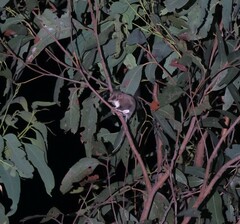
Sounds

Recording0:29

Australia · 2023

© katyw · iNaturalist · CC BY-NC 4.0

Global Distribution

Parks Where Found

# Park Country Daily sighting probability
1 Lamington National Park 🇦🇺 Australia
~10%
2 Great Otway National Park 🇦🇺 Australia
~10%

Zoos & Centres Where Found

# Zoo / Centre Country
1 Columbus Zoo and Aquarium 🇺🇸 United States In captivity
2 Taronga Zoo 🇦🇺 Australia In captivity
3 Budapest Zoo & Botanical Garden 🇭🇺 Hungary In captivity
4 Frankfurt Zoological Garden 🇩🇪 Germany In captivity

Before you go

What are the chances of seeing a Feather-tailed Glider in Great Otway National Park?

With luck

About 10% of wildlife watchers report a Feather-tailed Glider sighting in Great Otway National Park on a given day, based on 9 verified sightings from GBIF citizen-science data from 2019 to 2026. It is the 24th most-seen of the 30 mammals we can rate there. Over three days the chance rises to about 20%, and over a week to about 40%, if each day is a fresh chance.

When is the best time to see a Feather-tailed Glider in Great Otway National Park?

June

In that month about 20% of wildlife watchers report a Feather-tailed Glider in Great Otway National Park on a given day, against under 5% in March, May, July and November–January, the lowest months.

What time of day is best to see a Feather-tailed Glider?

Between 8 and 11 pm

Across all the parks we cover, that three-hour window holds the most Feather-tailed Glider sightings with a recorded time, and about 7 in 10 of them come between 6 pm and 6 am: it is mostly seen at night.

Is Great Otway National Park the best place to see a Feather-tailed Glider?

Among the best

Of the 2 parks where we can rate Feather-tailed Glider sightings, Great Otway National Park ranks 2nd at about 10%, level with the leaders once rounded. The best odds are in Lamington National Park (Australia, about 10%).

Which relatives of the Feather-tailed Glider live in Great Otway National Park?

Same order: Diprotodontia

The closest relatives of the Feather-tailed Glider that you can see in Great Otway National Park (order Diprotodontia, Kangaroos, Possums, Wombats, and Allies) are Koala (about 70%), Eastern Grey Kangaroo (about 50%) and Swamp Wallaby (about 40%), with each one's daily chance of a sighting.

Where does the Feather-tailed Glider sighting chance come from?

GBIF citizen-science records

It is estimated from how often the Feather-tailed Glider is recorded against all the mammals logged in Great Otway National Park (9 verified sightings from 2019 to 2026), calibrated against known sighting rates. Figures are rounded to the nearest 10% because citizen-science data supports honest approximations, not decimals, and months with records from fewer than five people show "—". How it works.

← Back to Great Otway National Park
