Fluttering Shearwater

Fluttering Shearwater

Puffinus gavia

Silhouette: Juan Carlos Jerí · PhyloPic

LCLeast ConcernNTVUENCR
Daily sighting probability <5% · Rare
at Great Otway National Park

In 3 days <5%

19 Verified sightings at Great Otway National Park From 2019 to 2026
47 In all 2 parks
April Best month
☀️ Diurnal When it's spotted

About the Fluttering Shearwater

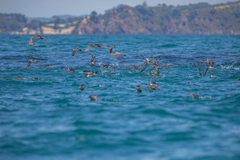
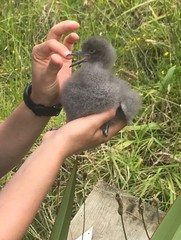
The fluttering shearwater (Puffinus gavia) is a species of seabird in the family Procellariidae. It is endemic to New Zealand and migrates to Australia and the Solomon Islands. Its natural habitats are open seas and rocky shores. It has been known as Forster's shearwater in the past.

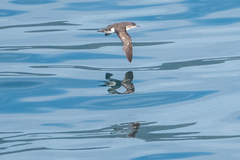
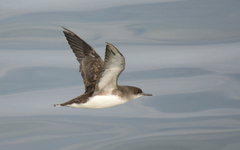
This is a medium to small-sized shearwater with a dark-brown-and-white body. The upper parts, including neck, wings and tail, are uniformly dark brown. The face and neck have a grey-brown colour gradually fading into white below the eye. The under body, from chin to the under-tail, is white except for a dark thigh patch that can be seen in flight. The bottom wing is commonly white while the axillary area is covered in grey-brown fur. Under light conditions, the appearance is different. The fluttering shearwater has pinkish-brown legs and feet with dark webs, and the feet extend beyond the tail in flight. The bill is long and thin with dark colour. The tail is fan-shaped and short in flight and it has mixed colours – dark brown and white.

Moulting starts from late January and the dark upper surfaces fade to mid-brown quickly. The colour of birds close to moulting (February to April) is... Wikipedia →

Sounds

Duet0:08

New Zealand · 2021

© David Boyle · XC925288 · CC BY-NC-SA 4.0

Global Distribution

Parks Where Found

# Park Country Daily sighting probability
1 Abel Tasman National Park 🇳🇿 New Zealand
<5%
2 Great Otway National Park 🇦🇺 Australia
<5%

Cities Where Found

# City Country Daily sighting probability
1 Auckland 🇳🇿 New Zealand
<5%
2 Sydney 🇦🇺 Australia
<5%

Before you go

What are the chances of seeing a Fluttering Shearwater in Great Otway National Park?

Rare

Under 5% of wildlife watchers report a Fluttering Shearwater sighting in Great Otway National Park on a given day, based on 19 verified sightings from GBIF citizen-science data from 2019 to 2026. It is the 156th most-seen of the 175 birds we can rate there. Over three days the chance rises to under 5%, if each day is a fresh chance.

When is the best time to see a Fluttering Shearwater in Great Otway National Park?

Any time of year

In every month with enough records, under 5% of wildlife watchers report a Fluttering Shearwater in Great Otway National Park on a given day, so our monthly data shows no clear season.

What time of day is best to see a Fluttering Shearwater?

Between 1 and 4 pm

Across all the parks we cover, that three-hour window holds the most Fluttering Shearwater sightings with a recorded time, and about 9 in 10 of them come between 6 am and 6 pm: it is a daytime animal.

Is Great Otway National Park the best place to see a Fluttering Shearwater?

Among the best

Of the 2 parks where we can rate Fluttering Shearwater sightings, Great Otway National Park ranks 2nd at under 5%, level with the leaders once rounded. The best odds are in Abel Tasman National Park (New Zealand, under 5%).

Where does the Fluttering Shearwater sighting chance come from?

GBIF citizen-science records

It is estimated from how often the Fluttering Shearwater is recorded against all the birds logged in Great Otway National Park (19 verified sightings from 2019 to 2026), calibrated against known sighting rates. Figures are rounded to the nearest 10% because citizen-science data supports honest approximations, not decimals, and months with records from fewer than five people show "—". How it works.

← Back to Great Otway National Park