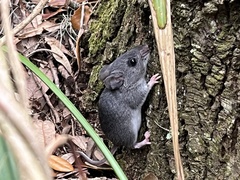
Eastern Woodrat

Eastern Woodrat

Neotoma floridana

Silhouette: T. Michael Keesey · PhyloPic

LCLeast ConcernNTVUENCR Endemic
Daily sighting probability ~10% · With luck
at Great Smoky Mountains National Park

In 3 days ~20% in a week ~40%

10 Verified sightings at Great Smoky Mountains National Park From 2019 to 2026
10 In 1 park
April Best month
☀️ Diurnal When it's spotted

About the Eastern Woodrat

The eastern woodrat (Neotoma floridana), also known as the Florida woodrat or bush rat, is a pack rat native to the central and Eastern United States. It constructs large dens that may serve as nests for many generations and stores food in outlying caches for the winter. While widespread and not uncommon, it has declined or disappeared in several areas.

Of these, the Key Largo woodrat (N. f. smalli) is classified as endangered by the IUCN. The Allegheny woodrat (N. magister) was previously considered a subspecies but was elevated to species status based on comparative mitochondrial DNA analyses. Subspecies are thought to be descended from one species living along the Appalachian Plateau, which subsequently spread out through the Coastal Plain.

The eastern woodrat is a rodent of medium size, with an average length of 21.2 centimetres (8.3 in) and weight of 245 grams (0.540 lb), but grows up to 17 inches (43 cm) long. The body is short and... Wikipedia →

Global Distribution

Parks Where Found

# Park Country Daily sighting probability
1 Great Smoky Mountains National Park 🇺🇸 United States
~10%

More parks will be added in future updates.

Zoos & Centres Where Found

# Zoo / Centre Country
1 Sedgwick County Zoo 🇺🇸 United States In captivity

Before you go

What are the chances of seeing an Eastern Woodrat in Great Smoky Mountains National Park?

With luck

About 10% of wildlife watchers report an Eastern Woodrat sighting in Great Smoky Mountains National Park on a given day, based on 10 verified sightings from GBIF citizen-science data from 2019 to 2026. It is the 16th most-seen of the 27 mammals we can rate there. Over three days the chance rises to about 20%, and over a week to about 40%, if each day is a fresh chance.

When is the best time to see an Eastern Woodrat in Great Smoky Mountains National Park?

April–July and November

In those months about 10% of wildlife watchers report an Eastern Woodrat in Great Smoky Mountains National Park on a given day, against under 5% in August–October and December–March, the lowest months.

What time of day is best to see an Eastern Woodrat?

Between 8 and 11 am

Across all the parks we cover, that three-hour window holds the most Eastern Woodrat sightings with a recorded time, and about 8 in 10 of them come between 6 am and 6 pm: it is a daytime animal.

Where else can you see an Eastern Woodrat?

Only Great Smoky Mountains National Park, in our data

Great Smoky Mountains National Park is the only park on Wallace's Line with enough records to rate Eastern Woodrat sightings: about 10% of wildlife watchers there report one on a given day.

Where does the Eastern Woodrat sighting chance come from?

GBIF citizen-science records

It is estimated from how often the Eastern Woodrat is recorded against all the mammals logged in Great Smoky Mountains National Park (10 verified sightings from 2019 to 2026), calibrated against known sighting rates. Figures are rounded to the nearest 10% because citizen-science data supports honest approximations, not decimals, and months with records from fewer than five people show "—". How it works.

← Back to Great Smoky Mountains National Park