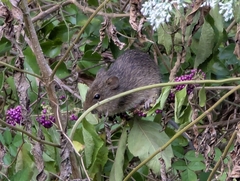
Hispid Cotton Rat

Hispid Cotton Rat

Sigmodon hispidus

Silhouette: Natasha Vitek · PhyloPic

LCLeast ConcernNTVUENCR
Daily sighting probability <5% · Rare
at Great Smoky Mountains National Park

In 3 days ~10% in a week ~30%

5 Verified sightings at Great Smoky Mountains National Park From 2019 to 2026
84 In all 5 parks
October Best month
🌅 Crepuscular When it's spotted

About the Hispid Cotton Rat

The hispid cotton rat (Sigmodon hispidus) is a rat long thought to occur in parts of South America, Central America, and southern North America. However, recent taxonomic revisions, based on mitochondrial DNA sequence data, have split this widely distributed species into three separate species (S. hispidus, S. toltecus, and S. hirsutus). The distribution of S. hispidus ranges from Arizona in the west to Virginia to the east and from the Platte River in Nebraska in the north to, likely, the Rio Grande in the south, where it meets the northern edge of the distribution of S. toltecus (formerly S. h. toltecus). Adult size is total length 202–340 mm (8.0–13.4 in); tail 87–122 mm (3.4–4.8 in), frequently broken or stubbed; hind foot 29–35 mm (1.1–1.4 in); ear 16–20 mm (0.63–0.79 in); mass 50–250 g (1.8–8.8 oz). They have been used as laboratory animals.

The currently accepted scientific name for the hispid cotton rat is Sigmodon hispidus. It is a member of the family Cricetidae. Although 25 subspecies are accepted, including the type subspecies, the most distinct genetic subdivision within S. hispidus separates the species into two genetic lineages, an eastern one and a western... Wikipedia →

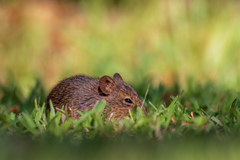
Sounds

Recording0:07

United States · 2025

© Lukas Sotelo · iNaturalist · CC BY-NC 4.0

Global Distribution

Parks Where Found

# Park Country Daily sighting probability
1 Everglades National Park 🇺🇸 United States
~10%
2 Merritt Island National Wildlife Refuge 🇺🇸 United States
~10%
3 Big Cypress National Preserve 🇺🇸 United States
~10%
4 Cumbres de Monterrey National Park 🇲🇽 Mexico
~10%
5 Great Smoky Mountains National Park 🇺🇸 United States
<5%

Cities Where Found

# City Country Daily sighting probability
1 Dallas 🇺🇸 United States
~10%
2 Austin 🇺🇸 United States
<5%
3 Monterrey 🇲🇽 México
<5%
4 Miami 🇺🇸 United States
<5%
5 Orlando 🇺🇸 United States
<5%
6 Houston 🇺🇸 United States
<5%

Zoos & Centres Where Found

# Zoo / Centre Country
1 Burgers' Ocean 🇳🇱 Netherlands In captivity
2 Royal Burgers' Zoo 🇳🇱 Netherlands In captivity

Before you go

What are the chances of seeing a Hispid Cotton Rat in Great Smoky Mountains National Park?

Rare

Under 5% of wildlife watchers report a Hispid Cotton Rat sighting in Great Smoky Mountains National Park on a given day, based on 5 verified sightings from GBIF citizen-science data from 2019 to 2026. It is the 24th most-seen of the 27 mammals we can rate there. Over three days the chance rises to about 10%, and over a week to about 30%, if each day is a fresh chance.

When is the best time to see a Hispid Cotton Rat in Great Smoky Mountains National Park?

June–August and October

In those months about 10% of wildlife watchers report a Hispid Cotton Rat in Great Smoky Mountains National Park on a given day, against under 5% in September and November–May, the lowest months.

What time of day is best to see a Hispid Cotton Rat?

Between 7 and 10 am

Across all the parks we cover, that three-hour window holds the most Hispid Cotton Rat sightings with a recorded time, and about 7 in 10 of them come between 6 am and 6 pm: it is most active around dawn and dusk.

Which relatives of the Hispid Cotton Rat live in Great Smoky Mountains National Park?

Same family: Cricetidae

The closest relatives of the Hispid Cotton Rat that you can see in Great Smoky Mountains National Park (family Cricetidae, Hamsters, Voles, Lemmings, and Allies) are Eastern Woodrat (about 10%) and White-footed Mouse (about 10%), with each one's daily chance of a sighting.

Where does the Hispid Cotton Rat sighting chance come from?

GBIF citizen-science records

It is estimated from how often the Hispid Cotton Rat is recorded against all the mammals logged in Great Smoky Mountains National Park (5 verified sightings from 2019 to 2026), calibrated against known sighting rates. Figures are rounded to the nearest 10% because citizen-science data supports honest approximations, not decimals, and months with records from fewer than five people show "—". How it works.

← Back to Great Smoky Mountains National Park