
Rainbow Grasshopper

Rainbow Grasshopper

Dactylotum bicolor

Daily sighting probability ~40% · Likely
at Guadalupe Mountains National Park

In 3 days ~80% in a week >90%

50 Verified sightings at Guadalupe Mountains National Park From 2019 to 2026
106 In all 3 parks
September Best month
☀️ Diurnal When it's spotted

About the Rainbow Grasshopper

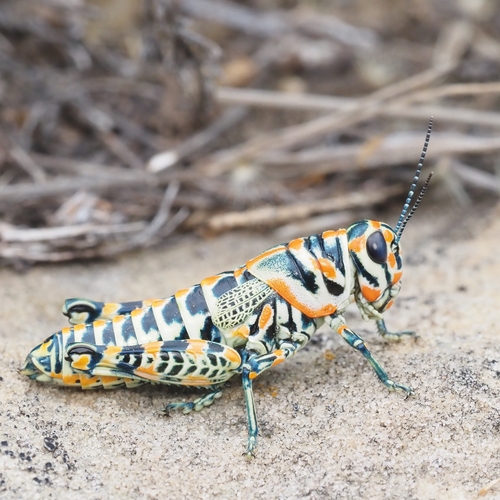
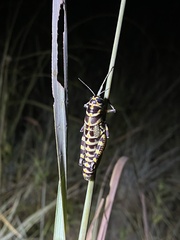
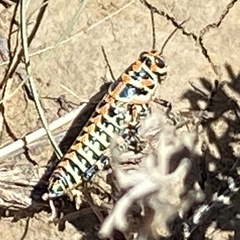
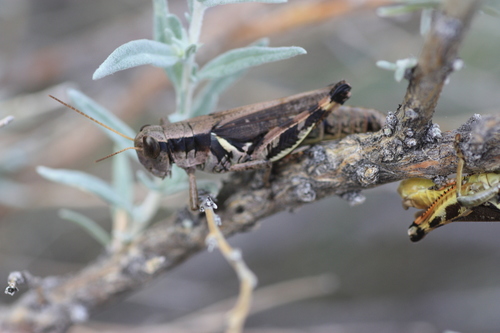
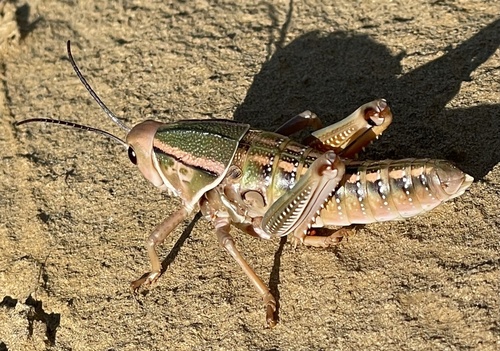
Dactylotum bicolor, also known as the rainbow grasshopper, painted grasshopper, pictured grasshopper, or the barber pole grasshopper, is a species of grasshopper in the family Acrididae. It is native to the United States, Canada and northern Mexico and exhibits aposematism (warning coloration). It was first described by the German entomologist Toussaint de Charpentier in 1843.

Dactylotum bicolor grows to an average length of about 20 mm (0.8 in) for males and 35 mm (1.4 in) for females. It is mainly black with distinctive reddish and yellowish markings, a pale green prothorax and pale green wingpads. The tibia of the hind leg bears six to eight spines. This species does not develop wings and is unable to fly.

Before the discovery of Dichroplus silveiraguidoi... Wikipedia →

Global Distribution

Parks Where Found

# Park Country Daily sighting probability
1 Guadalupe Mountains National Park 🇺🇸 United States
~40%
2 Big Bend National Park 🇺🇸 United States
~10%
3 Cumbres de Monterrey National Park 🇲🇽 Mexico
~10%

Before you go

What are the chances of seeing a Rainbow Grasshopper in Guadalupe Mountains National Park?

Likely

About 40% of wildlife watchers report a Rainbow Grasshopper sighting in Guadalupe Mountains National Park on a given day, based on 50 verified sightings from GBIF citizen-science data from 2019 to 2026. It is the 2nd most-seen of the 57 insects we can rate there. Over three days the chance rises to about 80%, and over a week to over 90%, if each day is a fresh chance.

When is the best time to see a Rainbow Grasshopper in Guadalupe Mountains National Park?

September

In that month about 70% of wildlife watchers report a Rainbow Grasshopper in Guadalupe Mountains National Park on a given day, against under 5% in January and March–May, the lowest months. That is one of Guadalupe Mountains National Park's wettest months, with about 40 mm of rain against 10 mm in April.

What time of day is best to see a Rainbow Grasshopper?

Between 11 am and 2 pm

Across all the parks we cover, that three-hour window holds the most Rainbow Grasshopper sightings with a recorded time, and about 8 in 10 of them come between 6 am and 6 pm: it is a daytime animal.

Is Guadalupe Mountains National Park the best place to see a Rainbow Grasshopper?

Yes

Of the 3 parks where we can rate Rainbow Grasshopper sightings, Guadalupe Mountains National Park has the highest daily chance: about 40%. Next come Big Bend National Park (United States, about 10%) and Cumbres de Monterrey National Park (Mexico, about 10%).

Which relatives of the Rainbow Grasshopper live in Guadalupe Mountains National Park?

Same family: Acrididae

The closest relatives of the Rainbow Grasshopper that you can see in Guadalupe Mountains National Park (family Acrididae, Short-horned Grasshoppers) are Canyon Grasshopper (about 20%), Ebony Grasshopper (about 20%) and Pallid-Winged Grasshopper (about 20%), with each one's daily chance of a sighting.

Where does the Rainbow Grasshopper sighting chance come from?

GBIF citizen-science records

It is estimated from how often the Rainbow Grasshopper is recorded against all the insects logged in Guadalupe Mountains National Park (50 verified sightings from 2019 to 2026), calibrated against known sighting rates. Figures are rounded to the nearest 10% because citizen-science data supports honest approximations, not decimals, and months with records from fewer than five people show "—". How it works.

← Back to Guadalupe Mountains National Park