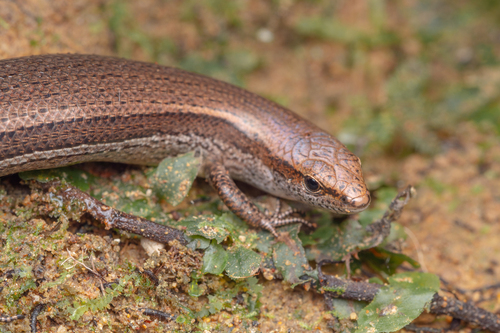
Gold Dust Day Gecko

Gold Dust Day Gecko

Phelsuma laticauda

Silhouette: Alex Slavenko · PhyloPic

LCLeast ConcernNTVUENCR
Daily sighting probability ~30% · Possible
at Haleakala National Park

In 3 days ~60% in a week ~90%

13 Verified sightings at Haleakala National Park From 2019 to 2026
86 In all 3 parks
November Best month
☀️ Diurnal When it's spotted

About the Gold Dust Day Gecko

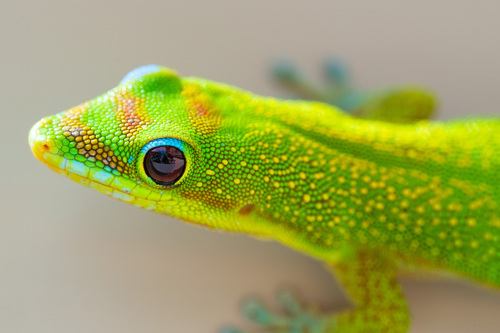
The gold dust day gecko (Phelsuma laticauda) is a diurnal species of gecko. It lives in northern Madagascar, the Comoro Islands, and the Mascarene Islands; it has also been introduced to Hawaii and other Pacific islands. It is primarily an arboreal species which can be found in tropical forests and may also associate with human dwellings. The gold dust day gecko feeds on insects and nectar.

One subspecies is recognized (in addition to the nominate one): Phelsuma laticauda angularis. This lizard can reach a total length of 3.9–5.1″ (10–13cm). The body colour is a bright green or yellowish green or rarely blue. Typical for this day gecko are the gold speckles on the neck and the upper back. There are three rust-coloured transverse bars on the snout and head; the upper part of the skin around the eye is blue. On the lower back there are three tapering red bars. The tail is slightly flattened. The under side is off-white. Juveniles lack the red colourations and the tail and limbs appear off-white.

These day geckos feed on various insects and other invertebrates, and are capable of eating other smaller lizards. They also eat soft, sweet fruit and pollen and...
Wikipedia →

Global Distribution

Parks Where Found

# Park Country Daily sighting probability
1 Kilauea Point National Wildlife Refuge 🇺🇸 United States
~60%
2 Hawaii Volcanoes National Park 🇺🇸 United States
~30%
3 Haleakala National Park 🇺🇸 United States
~30%

Zoos & Centres Where Found

# Zoo / Centre Country
1 Zoo Pilsen 🇨🇿 Czechia In captivity
2 Kélonia 🇫🇷 France In captivity
3 Wrocław Zoological Garden 🇵🇱 Poland In captivity
4 Wilhelma 🇩🇪 Germany In captivity
5 Paphos Zoo 🇨🇾 Cyprus In captivity
6 Mandraka Reptile Farm 🇲🇬 Madagascar In captivity
7 Africarium 🇵🇱 Poland In captivity
8 Sea Life Bangkok Ocean World 🇹🇭 Thailand In captivity
9 terrarium ogrodu zoologicznego we Wrocławiu 🇵🇱 Poland In captivity

Before you go

What are the chances of seeing a Gold Dust Day Gecko in Haleakala National Park?

Possible

About 30% of wildlife watchers report a Gold Dust Day Gecko sighting in Haleakala National Park on a given day, based on 13 verified sightings from GBIF citizen-science data from 2019 to 2026. Over three days the chance rises to about 60%, and over a week to about 90%, if each day is a fresh chance.

When is the best time to see a Gold Dust Day Gecko in Haleakala National Park?

November

In that month about 50% of wildlife watchers report a Gold Dust Day Gecko in Haleakala National Park on a given day, against under 5% in January, May, July and October, the lowest months.

What time of day is best to see a Gold Dust Day Gecko?

Between noon and 3 pm

Across all the parks we cover, that three-hour window holds the most Gold Dust Day Gecko sightings with a recorded time, and about 9 in 10 of them come between 6 am and 6 pm: it is a daytime animal.

Is Haleakala National Park the best place to see a Gold Dust Day Gecko?

3rd of 3

Of the 3 parks where we can rate Gold Dust Day Gecko sightings, Haleakala National Park ranks 3rd at about 30%. The best odds are in Kilauea Point National Wildlife Refuge (United States, about 60%) and Hawaii Volcanoes National Park (United States, about 30%).

Where does the Gold Dust Day Gecko sighting chance come from?

GBIF citizen-science records

It is estimated from how often the Gold Dust Day Gecko is recorded against all the reptiles logged in Haleakala National Park (13 verified sightings from 2019 to 2026), calibrated against known sighting rates. Figures are rounded to the nearest 10% because citizen-science data supports honest approximations, not decimals, and months with records from fewer than five people show "—". How it works.

← Back to Haleakala National Park